
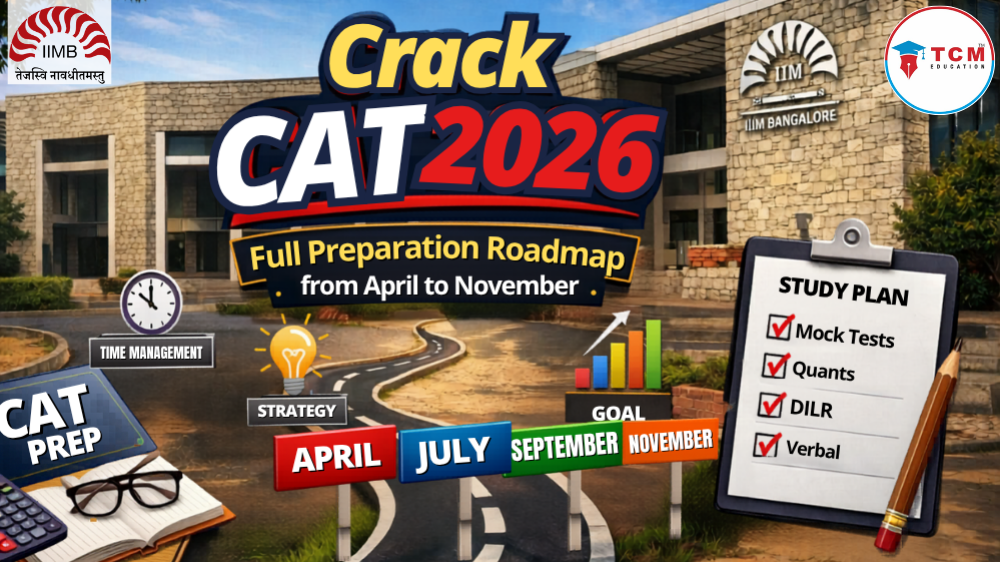
Preparing for the CAT 2026 exam requires a well-structured plan, consistency, and smart strategy. With roughly 7–8 months in hand (April to November), you can build a strong foundation, improve accuracy, and maximize your percentile with the right roadmap.
CAT 2026 Exam Overview
Before diving into the roadmap, understand the exam structure:
• Sections:
o VARC (Verbal Ability & Reading Comprehension)
o DILR (Data Interpretation & Logical Reasoning)
o QA (Quantitative Aptitude)
• Duration: 2 Hours
• Mode: Computer-Based Test
• Difficulty Level: Moderate to High
Month-Wise CAT 2026 Preparation Roadmap
April – Build Strong Basics
This is the foundation month. Focus on understanding concepts.
What to Do:
- Start with basic concepts in QA (Arithmetic first)
- Begin reading daily (editorials, articles)
- Learn basic LR sets and DI charts
- Understand CAT exam pattern
Focus Box:
Build conceptual clarity, not speed
Study 2–3 hours daily consistently
May – Strengthen Core Concepts
Now, start practicing alongside learning.
What to Do:
- Continue QA (Algebra basics)
- Practice RC passages regularly
- Solve 2–3 LRDI sets daily
- Start sectional practice
Focus Box:
Accuracy > Speed
Maintain formula notes
June – Start Practice Mode
Shift gradually from learning to applying.
What to Do:
- Complete Arithmetic & Algebra
- Start Geometry & Modern Maths (basic level)
- Increase RC practice (3–4 passages daily)
- Attempt first diagnostic mock test
Focus Box:
Identify strengths & weaknesses
Begin time-bound practice
July – Introduce Mock Tests
Mocks become essential from this stage.
What to Do:
- Attempt 1 mock test per week
- Deep analysis of each mock
- Practice mixed LRDI sets
- Strengthen weak topics
Focus Box:
Spend more time analyzing than attempting
Track progress weekly
August – Improve Speed & Accuracy
Now focus on performance optimization.
What to Do:
- Attempt 2 mocks per week
- Work on time management
- Solve previous year questions
- Improve weak sections
Focus Box:
Develop exam strategy
Avoid guesswork
September – Peak Practice Phase
This is the most critical preparation period.
What to Do:
- Attempt 2–3 mocks per week
- Focus on sectional timing
- Revise formulas and concepts
- Practice high-level questions
Focus Box:
Aim for consistency in scores
Fine-tune attempt strategy
October – Revision & Strategy
Now it's time to consolidate everything.
What to Do:
- Attempt 3 mocks per week
- Revise all short notes and formulas
- Focus on accuracy in QA
- Strengthen RC and LRDI selection
Focus Box:
Focus on strong areas
Avoid learning new topics
November – Final Sprint
The last few weeks before CAT are crucial.
What to Do:
- Attempt 2–3 mocks per week
- Light revision only
- Focus on mental calmness
- Maintain a healthy routine
Focus Box:
Stay confident
Avoid burnout
Section-Wise Preparation Strategy
VARC (Verbal Ability & Reading Comprehension)
- Read daily (30–45 minutes)
- Practice RCs from diverse topics
- Focus on inference-based questions
DILR (Data Interpretation & Logical Reasoning)
- Practice sets daily
- Focus on selection of easy sets
- Improve puzzle-solving approach
QA (Quantitative Aptitude)
- Master Arithmetic & Algebra
- Practice daily problem sets
- Focus on accuracy and shortcuts
Smart Preparation Tips
✔️ Follow a daily study schedule
✔️ Analyze every mock deeply
✔️ Maintain error logs
✔️ Focus on weak areas regularly
✔️ Stay consistent and disciplined
Final Thoughts
Cracking CAT 2026 is not about studying 10 hours a day—it's about studying smart, staying consistent, and analyzing your performance.
If you follow this April-to-November roadmap with dedication, you can significantly boost your chances of scoring a high percentile and getting into top B-schools.
FAQs
Q1. When should I start mocks for CAT 2026?
Start with 1 mock per week from July.
Q2. Is 7 months enough for CAT preparation?
Yes, with proper planning and consistency, it's more than enough.
Q3. Which section is toughest in CAT?
It varies, but DILR is often considered the most unpredictable.
