
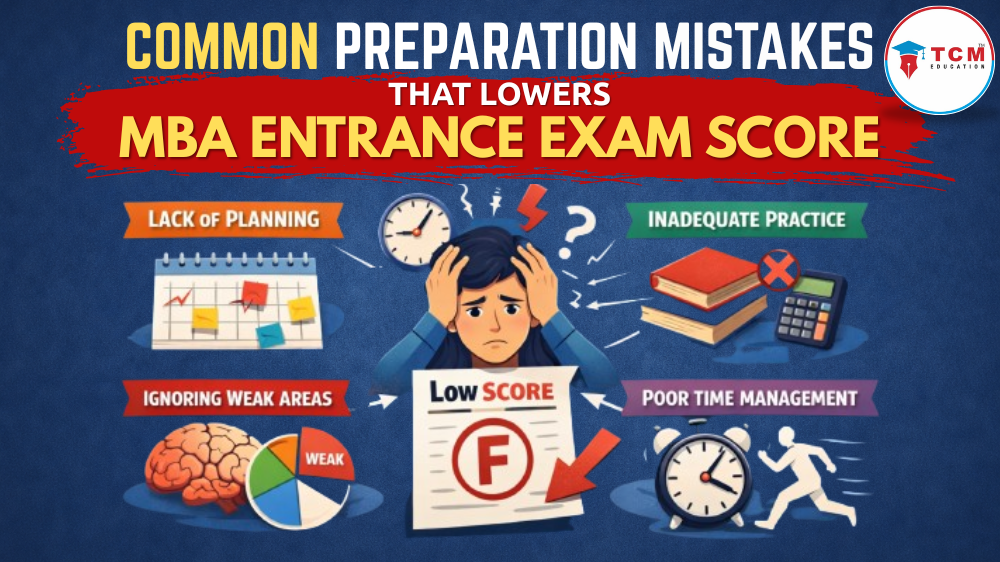
We’ve all seen it. A student spends ten hours a day locked in a room with books, finishes the entire syllabus twice, and yet, on result day, the percentile doesn't cross 90. Meanwhile, someone else studying just three hours a day cruises into an IIM with a 99+.
The difference isn't always "intelligence." Often, it’s just that the first student fell into the common preparation traps that act like invisible leaks in a bucket. No matter how much water (effort) you pour in, the bucket never fills up.
If you want to ensure your hard work actually translates into a seat at a top B-school, you need to stop making these classic mistakes.
1. The "Syllabus Completion" Delusion
Most beginners treat CAT or entrance exams like a college semester exam. They think, "If I finish the book, I’m ready." This is a massive trap. These are aptitude tests, not memory tests.
The mistake here is focusing on breadth over depth. Students try to learn every single obscure geometry formula but can't solve a basic Arithmetic problem that has been slightly twisted.
The Fix: Master the core. Arithmetic and Algebra make up the massive bulk of Quant. If you can't solve a Percentage question in 45 seconds, it doesn't matter if you know advanced Trigonometry. Focus on being a "specialist" in high-weightage areas before you try to be a "generalist" in everything.
2. Neglecting Mocks during the "Learning Phase"
Many aspirants say, "I'll start taking mocks once I finish the syllabus in September." By September, it’s usually too late.
When you wait to take mocks, you are studying in a vacuum. You don't realize that the way a topic is taught in a textbook is completely different from how it appears in a timed, high-pressure exam.
The Fix: Take a "Diagnostic Mock" right now. Even if you know nothing. It helps you understand the "exam interface" and identifies your natural strengths. Periodic mocks during the learning phase act as a compass, telling you if your study method is actually working or if you’re just wasting time on low-yield topics.
3. Passive Analysis (The "Look-at-the-Solution" Trap)
This is perhaps the most common reason for score plateaus. A student takes a mock, looks at the score, feels bad, and then "analyzes" it by reading the provided solutions for the questions they got wrong.
That is not analysis. That is reading.
The Fix: Use the 2:1 Analysis Rule. Spend twice as much time analyzing as you did taking the test. Before looking at the solution, try solving the wrong questions again without a timer. If you still can't do it, then it’s a concept problem. If you can, it’s a strategy or pressure problem.
4. The Formula Obsession (Engineer’s Bias)
Engineers often struggle with Quant because they try to use complex equations for everything. CAT and IPMAT are designed to reward logical shortcuts. If you are using a pen and paper for every single step, you are losing the race.
The Fix: Develop "Number Sense." Learn to play with options and use approximation. In many cases, you don't need to find the exact answer—you just need to eliminate the three wrong ones.
5. Ignoring the "Sectional Balance"
We all have a "favourite" section. You might love solving Quant and hate Reading Comprehension. The mistake is spending 80% of your time on what you’re already good at because it feels "productive."
The Fix: IIMs have sectional cutoffs. A 99 in Quant and a 60 in VARC will get you a rejection letter. You must force yourself to spend more time on your weakest section. If VARC is your nightmare, start your day with it when your brain is freshest.
6. Falling for the "Factory" Coaching Model
Many students join big, national coaching "factories" where they are just a roll number. When their mock scores dip, there is no one to ask why. They follow a generic schedule that doesn't account for their specific "Time Traps" or conceptual leaks.
The Fix: Seek Personalized Mentorship. You need a mentor who knows your specific mock trends and can tell you, "You are spending too much time on DILR sets that involve circular arrangements." At TCM, we ensure every student is guided by a mentor from a top B-school to avoid this generic "one-size-fits-all" trap.
Conclusion: Stop Working Hard, Start Working Smart
Cracking an MBA entrance isn't a reward for "hours spent." It is a reward for precision. If your scores aren't moving, stop adding more study hours and start looking at these mistakes. Are you analyzing deeply? Are you skipping time traps? Are you balancing your sections?
A 6-month mission can change your life, but only if you aren't carrying these heavy mistakes with you.
Frequently Asked Questions (FAQs)
1. I consistently get 90+ percentile in practice but freeze during mocks. Why?
This is usually a "pressure trap." You are likely treating the mock as a final judgment rather than a diagnostic tool. Focus on the process of the next question rather than the final score.
2. Is it okay to skip a section entirely if I’m really bad at it?
No. Most top-tier institutes like IIMs have strict sectional cutoffs. You don't have to be a topper in your weak section, but you must be "competent" enough to cross the minimum threshold.
3. How do I know if I’m "analyzing" correctly?
If your mistakes in the next mock are different from your mistakes in the previous one, you are analyzing correctly. If you are repeating the same errors, your analysis is too passive.
4. Should I learn every shortcut I see on YouTube?
No. Too many shortcuts lead to "mental clutter." Stick to one reliable method or mentor. At TCM, we provide a structured Three-Level Learning Model to ensure you don't get overwhelmed by conflicting "tricks".
