
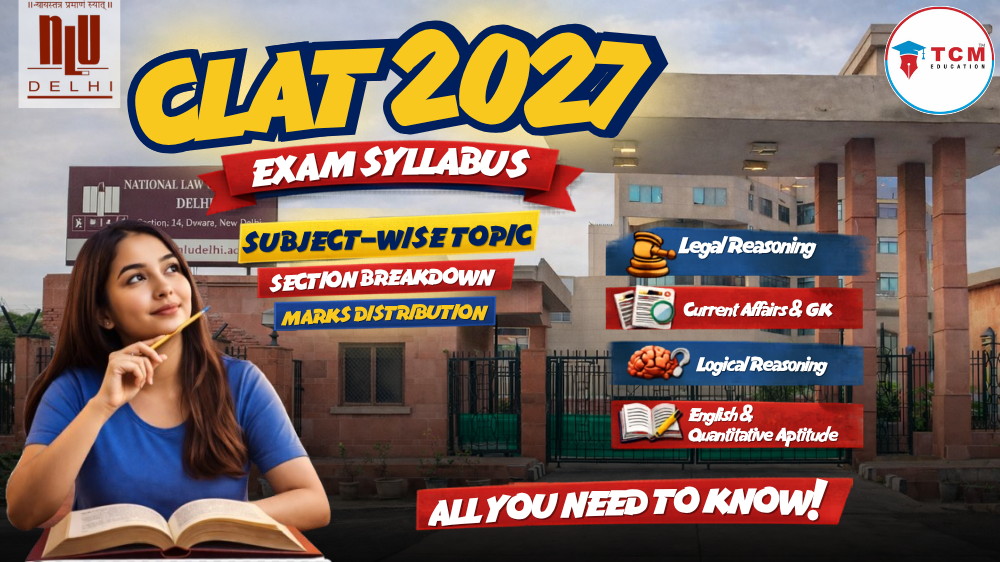
Preparing for CLAT 2027 requires a clear understanding of the syllabus, exam pattern, and section-wise weightage. The Common Law Admission Test (CLAT) is designed to assess comprehension, reasoning, and analytical skills rather than rote learning. This guide provides a complete, user-friendly breakdown of the CLAT 2027 syllabus to help you plan your preparation effectively.
CLAT 2027 Exam Overview
CLAT is a national-level entrance exam for admission to undergraduate law programs. The paper is comprehension-based and includes passages followed by questions.
Key Highlights:
- Mode: Offline (Pen & Paper)
- Duration: 2 Hours
- Total Questions: 120
- Type: Multiple Choice Questions (MCQs)
- Marking Scheme:
o +1 for correct answer
o -0.25 for incorrect answer
Section-Wise Weightage (Expected)
| Section | No. of Questions | Weightage (%) |
| English Language | 22–26 | ~20% |
| Current Affairs & GK | 28–32 | ~25% |
| Legal Reasoning | 28–32 | ~25% |
| Logical Reasoning | 22–26 | ~20% |
| Quantitative Techniques | 10–14 | ~10% |
Subject-Wise CLAT 2027 Syllabus
1. English Language
This section tests your reading comprehension and language skills.
Topics Covered:
- Reading comprehension passages (450 words approx.)
- Vocabulary (synonyms, antonyms)
- Grammar and sentence correction
- Inference-based questions
- Tone and central idea of passage
Preparation Tip:
Focus on improving reading speed and understanding editorial articles from newspapers.
2. Current Affairs & General Knowledge
This section evaluates awareness of recent events and static GK.
Topics Covered:
- National and international current affairs
- Important government schemes
- Awards and honors
- Sports and major events
- History, Geography, Polity, Economics (basic static GK)
Preparation Tip:
Read daily news and revise monthly current affairs regularly.
3. Legal Reasoning
This is the most important section for CLAT aspirants.
Topics Covered:
- Legal principles and facts
- Constitutional law basics
- Legal maxims
- Landmark judgments (basic understanding)
- Application of law to given situations
Preparation Tip:
No prior legal knowledge is required, but practicing legal passages is crucial.
4. Logical Reasoning
This section tests analytical and critical thinking skills.
Topics Covered:
- Arguments and conclusions
- Assumptions and inferences
- Logical sequences
- Cause and effect
- Statement-based questions
Preparation Tip:
Practice puzzles and reasoning sets regularly to build accuracy and speed.
5. Quantitative Techniques
This section is based on basic mathematics with data interpretation.
Topics Covered:
- Ratios and proportions
- Percentages
- Profit and loss
- Time and work
- Data interpretation (graphs, tables)
Preparation Tip:
Focus on basic calculations and interpreting numerical data quickly.
Important Preparation Strategy
✔️ Focus more on comprehension-based learning
✔️ Practice previous year papers
✔️ Attempt mock tests weekly
✔️ Analyze mistakes after every test
✔️ Maintain short notes for revision
Final Thoughts
The CLAT 2027 syllabus is designed to test your ability to read, understand, and analyze information efficiently. Instead of memorizing, focus on developing strong reading habits, logical thinking, and consistent practice.
A well-structured study plan, combined with regular mock tests and revision, can significantly improve your chances of securing a top rank.
FAQs
Q1. Is CLAT 2027 syllabus tough?
Not really. It focuses more on comprehension and reasoning rather than difficult concepts.
Q2. Which section carries the highest weightage?
Legal Reasoning and Current Affairs usually have the highest weightage.
Q3. Do I need Maths for CLAT?
Yes, but only basic level Maths is required.
