
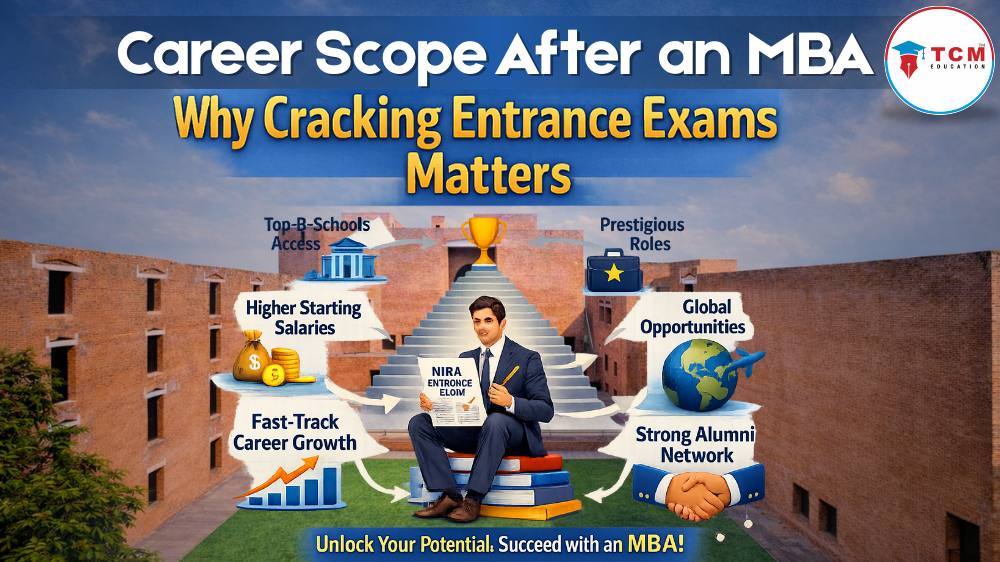
To many MBA entrance exams like CAT, XAT, or NMAT look like a hurdle between them and their degree.But what they may fail to consider is that these exams are first steps for many to define their career trajectory.
An MBA is not a one-size-fits-all out come.It might sound harsh but the out comes of most careers after an MBA are directly linked to the pedigree of the B-school that you convert. This is why the preparation phase is one of the most important parts of your professional life.
The reality of MBA“brand”:
InIndia,theMBA market is tiered.An MBA from a top-10 B-school can lead to a completely different career path than a mid-tier B-school.
Cracking a top entrance exam gives you access to an“EliteLeague.” It is not just about the subjects that these B-schools teach,it is also aboutthe companies thatvisityour campusfor internshipand placement opportunities, the alumni network you join, and even a starting salary that sets your baseline for life.
High-Growth Career Paths After an MBA:
Once you secure a seat at a premier institute after all the gruelling hardwork,a set of doors for roles that are otherwise almost impossible to enter open up for you.
1. Managing Consulting: Consulting is one of the most coveted sectors by MBA grads. Firms like Mc Kinsey, BCG, and Bain look for sharp and logical minds and for that they look for candidates from top ranked B-schools because these candidates are already ‘filtered’ for high analytical ability by the institutions themselves.
2. Investment Banking and PE: If you have an interest in finance and want to explore amazing career options in the field, top ranked B-schools are one of the few consistent gateways to Global Investment Banks. The roles that might come your way here include, mergers, acquisitions, and high-stakes wealth management.
3. Product Management: For people belonging toTech background or interested in the domain, an MBA can very well help you land a career in Product Management. You will become the bridge between the developers and stakeholders, and help design products that will be used for millions of people all over the world.
Why the Entrance ExamisYour "Sieve":
Now that you have some idea about the amazing careers that you all might go into after going into these top B-schools, you might now be wondering why the recruiters care so much about your entrance exam score even two years later.
Simple answer for this query is that these exams aren’t just there to sieve out candidates, they act as an initial judge of your management temperament.
XAT’s Decision Making tests your ethics and logic.
DILR sections in these exams check if you can handled at a without panicking. Managementis, after all, a lot about numbers.
These exams also test your time management skills. Take CAT for example, solving 68 questions within 120 minutes distributed across 3 sections with varied levels of difficulties in questions. This checks how good can you manage your time and opt the questions that will be most ‘profitable’for you. This is exactly how corporate life works.
The Salary Gap: Top-Tiervs.Others:
One of the most common reasons for candidates to pursue an MBA is to step into an attractive career with a handsome package. Let’s look at the average placement data to understand why that extra 5%ile in your entrance exam matters so much.
|
Institute Tier |
Entrance Exam Percentile |
Avg. Starting Salary |
|
Tier-1 |
99+ |
28-35 LPA |
|
Tier-2 |
95-98 |
18-25 LPA |
|
Tier-3 |
80-90 |
6-10LPA |
Pain Points: What Happens if You Settle?
During your MBA journey you might come across a “burnedout” phase and might start to feel that it is alright for you to settle for a lower-tier college. It might seem realistic even since not everyone will get admission in a top B-school. But settling before even giving a fight might be one of the most regrettable decisions for you for several reasons:
1. You might get a job,but the goal of reaching the C-suite roles like CEO, CFO, etc. takes much longer without attractive B-school tag.
2. Top-tier roles instrategy and Private Equity are often not available for the candidates from lower-ranked colleges for their first role.
3. Your“batch mates”are going to be your future business partners. A top B-school gives you access to a network of high achieving individuals.
Conclusion:The First Step is the Biggest:
The scope of an MBA is limited only by where you choose to start. Cracking an entrance exam with a high percentileis one of the most effective ways to de risk your future. This ensures that your first
job is not just a pay cheque but a launch pad for your career. Don’t settle for any MBA. Aim for one that changes your career’s trajectory for good.
FrequentlyAskedQuestions (FAQs):
1. Is an MBA worth it if I don’t get into an IIM? Yes, but the ROI (Return on Investment) changes. Top non-IIMs like XLRI, FMS, and SPJIMR offere qual, if not better, scope. How ever, if you fall below the top 50 colleges, the career growth slows down significantly.
2. Does my past academic record matter for my career scope? It does for the first job. Top B- schools and recruiters look at your10th,12th,andGraduation scores.How ever,a stellar CAT score and a great MBA performance can often "overwrite" a mediocre past.
3. Can I switch specializations after my MBA? Your first job usually defines your path, but an MBA is a versatile degree. Within5-7 years, many MBAs move from Operations to Strategy or Marketing to General Management.
4. How much weight age do recruiters give to the entrance exam score? While the score gets you into the college, the "brand" of the college stays on your resume forever. Recruiters trust the entrance exam because it acts as a reliable filter for high-IQ and high-grit candidates.
5. When should I stop trying and just join a college? If you have given 2-3 serious attempts and are stuck at a certain percentile, it might be time to join the best college available and work your way up. However, most students give up just before their "breakthrough" attempt.
