CAT 2019 Question Paper | CAT QA CAT Question Paper | CAT Previous Year Paper
Questions 67 to 100 carry 3 marks each.
Q. 1.
A shopkeeper sells two tables, each procured at cost price p, to Amal and Asim at a profit of 20% and at a loss of 20%, respectively. Amal sells his table to Bimal at a profit of 30%, while Asim sells his table to Barun at a loss of 30%. If the amounts paid by Bimal and Barun are x and y, respectively, then (x − y)/p equals
A).
0.50
B).
0.7
C).
1
D).
1.2
Cost price to Amal = 1.2p⇒ Cost price to Bimal x = 1.3 × 1.2p = 1.56p = x.
Cost price to Asim = 0.8p⇒ Cost price to Barun y = 0.7 × 0.8p = 0.56p = y.
(x − y)/p = (1.56p − 0.56p)/p = 1.
Hence, option 3.
Questions 67 to 100 carry 3 marks each.
Q. 2.
The quadratic equation x2 + bx + c = 0 has two roots 4a and 3a, where a is an integer. Which of the following is a possible value of b2 + c?
A).
361
B).
3721
C).
427
D).
549
In a quadratic equation, ax2 + bx + c = 0, sum of roots = − (b/a) and product of roots = (c/a).
For the given quadratic equation, a = 1.
∴ Sum of roots = −b and Product of roots = c.
The two roots are 3a and 4a.
∴b = −7a and c = 12a2
∴b2 + c = 49a2 + 12a2 = 61a2 Since, a is an integer, the answer should be a multiple of 61 and also a multiple of square of an integer.
The only option that satisfies is 61 × 9 = 549.
Hence, option 4.
Questions 67 to 100 carry 3 marks each.
Q. 3.
Let a, b, x, y, be real numbers such that a2 + b2 = 25, x2 + y2 = 169, and ax + by = 65. If k = ay – bx, then
A).
k = 5/13
B).
k = 0
C).
k > 5/13
D).
0 < k < 5/13
(ax + by) = 65
Squaring both sides we get;
(ax + by)2 = a2x2 + b2y2 + 2abxy = 4225 …(I)
a2 + b2 = 25, x2 + y2 = 169.
Multipling the above two expressions we get;
(a2 + b2)(x2 + y2) = 25 × 169 = 4225
∴a2x2 + a2y2 + b2x2 + b2y2 = 4225 ...(II)
Equating (I) and (II), we get;
a2y2 + b2x2 = 2abxy
∴a2y2 + b2x2 − 2abxy = 0
∴ (ay – bx)2 = 0
∴k = ay – bx = 0.
Hence option 2.
Questions 67 to 100 carry 3 marks each.
Q. 4.
In an examination, the score of A was 10% less than that of B, the score of B was 25% more than that of C, and the score of C was 20% less than that of D. If A scored 72, then the score of D was
A = (9/10) B; B = (5/4) C and C = (4/5) D.
∴ B = (10/9)A = (10/9) × 72 = 80.
∴ C = (4/5) B = (4/5) × 80 = 64.
∴ D = (5/4) C = (5/4) × 64 = 80.
Answer: 80.
Questions 67 to 100 carry 3 marks each.
Q. 5.
A man makes complete use of 405 cc of iron, 783 cc of aluminium, and 351 cc of copper to make a number of solid right circular cylinders of each type of metal. These cylinders have the same volume and each of these has radius 3 cm. If the total number of cylinders is to be kept at a minimum, then the total surface area of all these cylinders, in sq cm, is
A).
928π
B).
1026(1 + π)
C).
(3) 8464π
D).
1044(4 + π)
As the total number of cylinders to be kept at a minimum, the volume of each cylinder must be maximum possible.
HCF(405, 783, 351) = 27 ⇒ Volume of each cylinder = 27 cc.
∴ πr2h = 27 (where r and h represent the radius and height of the cylinder)
Given that r = 3, so πh = 3.
Number of cylinders of;
Iron = 405/27 = 15.
Aluminium = 783/27 = 29.
Copper = 351/27 = 13.
∴ Total number of cylinders = 15 + 29 + 13 = 57.
Total surface area of all the cylinders = 57 × [2πr2 + 2πrh]
Put r = 3 and πh = 3 to get;
Required surface area = 1026(1 + π) sq. cm.
Hence, option 4.
Questions 67 to 100 carry 3 marks each.
Q. 6.
The average of 30 integers is 5. Among these 30 integers, there are exactly 20 which do not exceed 5. What is the highest possible value of the average of these 20 integers?
A).
3.5
B).
5
C).
4
D).
4.5
Average of 30 integers is 5 ⇒ Sum of the 30 integers = 150
Since, we need to maximise the average of given 20 integers, we need to minimise the other 10 integers
These 10 integers can take a minimum value of 6, so their minimum sum = 10 × 6 = 60.
Maximum sum of other 20 integers = 150 − 60 = 90.
Average of these 20 integers = 90/20 = 4.5.
Hence, option 4.
Questions 67 to 100 carry 3 marks each.
Q. 7.
The strength of a salt solution is p% if 100 ml of the solution contains p grams of salt. Each of three vessels A, B, C contains 500 ml of salt solution of strengths 10%, 22%, and 32%, respectively. Now, 100 ml of the solution in vessel A is transferred to vessel B. Then, 100 ml of the solution in vessel B is transferred to vessel C. Finally, 100 ml of the solution in vessel C is transferred to vessel A. The strength, in percentage, of the resulting solution in vessel A is
A).
14
B).
15
C).
12
D).
13
Amount of salt in 100 ml of solution A= 10% of 100 = 10 gm.
After the first operation, salt in vessel B = (22% of 500) + 10 = 110 + 10 = 120 gm in 600 ml solution.
Also vessel A will now have 400 ml solution with 40 gm salt in it.
Amount of salt in 100 ml solution from vessel B = 120/6 = 20 gm.
After adding this 100 ml solution from vessel B to vessel C.
Amount of salt in vessel C = (32% of 500) + 20 = 160 + 20 = 180 gm in 600 ml solution.
Amount of salt in 100 ml of the solution in C = 180/6 = 30 gm.
Finally when this 100 ml is transferred to vessel A, 500 ml of solution in vessel A will have 40 + 30 = 70 gm of salt.
Required percentage = (70/500) × 100 = 14%.
Hence option 1.
Questions 67 to 100 carry 3 marks each.
Q. 8.
In 2010, a library contained a total of 11500 books in two categories - fiction and nonfiction. In 2015, the library contained a total of 12760 books in these two categories. During this period, there was 10% increase in the fiction category while there was 12% increase in the non-fiction category. How many fiction books were in the library in 2015?
A).
6160
B).
6600
C).
6000
D).
5500
Let the number of fiction and non-fiction books in 2010 be f and n respectively.
∴f + n = 11500 ...(I)
∴ Number of fiction books in 2015 = 1.1f.
Number of non-fiction books in 2015 = 1.12n.
∴ 1.1f + 1.12n = 12760 ...(II)
Solving (I) and (II), we get;
f = 6000.
∴ Number of fiction books in 2015 = 1.1 × 6000 = 6600.
Hence option 1.
Questions 67 to 100 carry 3 marks each.
Q. 9.
Let f be a function such that f (mn) = f (m) f (n) for every positive integers m and n. If f (1), f (2) and f (3) are positive integers, f (1) < f (2), and f (24) = 54, then f (18) equals
f(2) = f(1 × 2) = f(1) f(2)
∴f(1) = 1 as f(2) ≠ 0.
Also f(1) < f(2)
Now, f(4) = f(2 × 2) = [f(2)]2
f(8) = f(2 × 4) = f(2) × [f(2)]2= [f(2)]3
f(24) = f(3 × 8) = f(3)× [f(2)]3= 54 = 2 × 33
∴f(3) = 2 and f(2) = 3.
f(18) = f(2 × 9) = f(2)× [f(3)]2 = 3 × 22 = 12.
Answer: 12.
Questions 67 to 100 carry 3 marks each.
Q. 10.
A).
1 ≤ x ≤ 3
B).
–3 ≤ x ≤ 3
C).
–1 ≤ x ≤ 3
D).
1 ≤ x ≤ 2
√loge [(4x − x2)/3] is a real number.
∴ loge [(4x − x2)/3] ≥ 0
∴ (4x − x2)/3 ≥ e0
∴ 4x – x2 ≥ 3
∴x2 – 4x + 3 ≤ 0
∴ (x – 3)(x – 1) ≤ 0
∴ 1 ≤ x ≤ 3.
Hence option 1.
Questions 67 to 100 carry 3 marks each.
Q. 11.
Two circles, each of radius 4 cm, touch externally. Each of these two circles is touched externally by a third circle. If these three circles have a common tangent, then the radius of the third circle, in cm, is
A).
B).
1
C).
π/3
D).
Let the radius of the third circle be ‘x’ cm.
AF = DE = 4 cm ⇒ AK = DC = (4 – x) cm
In ∆ADC, AC2 = AD2 + DC2.
(4 + x)2 = 42 + (4 – x)2
∴x = 1.
Hence option 1.
Questions 67 to 100 carry 3 marks each.
Q. 12.
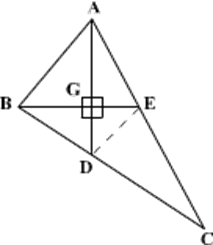
In a triangle ABC, medians AD and BE are perpendicular to each other, and have lengths 12 cm and 9 cm, respectively. Then, the area of triangle ABC, in sq cm, is
A).
72
B).
68
C).
78
D).
80
As AD and BE are medians, so G is the centroid of ∆ABC.
So, AG : GD = BG : GE = 2 : 1.
∴ AG = 8 cm, GD = 4 cm, BG = 6 cm and GE = 3 cm.
CD/CB = CE/CA = 1/2.
∴ Area ∆EDC/ Area ∆ABC = (1/2)2 = 1/4. So let area of ∆EDC and ∆ABC be a and 4a.
If 5x – 3y = 13438 and 5x–1 + 3y+1 = 9686, then x + y equals
Units digit of any power of 5 is 5.
Units digit of any power of 3 is 3 or 9 or 7 or 1.
5x−1 + 3y+1 = 9686. Considering only the units digits: 5 + Units digit of 3y+1 = 6.
∴ Units digit of 3y+1 = 1.
This is possible only when (y + 1) is multiple of 4.
i.e. (y + 1) = 4, 8, 12, .. and so on.
Also, 3y+1 < 9686
Note that 312 = (34)3 > 9676
∴ (y + 1) ≠ 12
If (y + 1) = 4, 3y+1 = 81 and hence 5x−1 + 81 = 9686 ⇒ 5x−1 = 9605 which is not possible.
If (y + 1) = 8, 3y+1 = 6561 and hence, 5x−1 + 6561 = 9686 ⇒ 5x−1 = 3125 i.e. (x – 1) = 5.
∴x = 6 and y = 7.
It can be cross checked with the other equation.
LHS = 5x − 3y = 56 − 37 = 13438 = RHS.
∴x + y = 6 + 7 =13.
Answer: 13.
Questions 67 to 100 carry 3 marks each.
Q. 14.
Anil alone can do a job in 20 days while Sunil alone can do it in 40 days. Anil starts the job, and after 3 days, Sunil joins him. Again, after a few more days, Bimal joins them and they together finish the job. If Bimal has done 10% of the job, then in how many days was the job done?
A).
13
B).
14
C).
15
D).
12
Let the total job to be done be the a multiple of the LCM of 40 and 20 which is 40 units.
Work done in a day;
By Anil = 40/20 = 2 units.
By Sunil = 40/40 = 1 unit.
In the first 3 days, amount of work done by Anil = 2 × 3 = 6 units.
Amount of work remaining = 34 units.
Since Bimal does 10% of the job (= 4 units), the remaining 30 units (34 − 4) has to be done by Anil and Sunil
They together do (2 + 1) = 3 units of work in a day
∴ Time taken by them to do 30 units of work = 30/3 = 10 days.
So, total number of days = [10 (for 34 units work) + 3 (for 6 units work)] = 13 days.
Hence, option 1.
Questions 67 to 100 carry 3 marks each.
Q. 15.
In a six-digit number, the sixth, that is, the rightmost, digit is the sum of the first three digits, the fifth digit is the sum of first two digits, the third digit is equal to the first digit, the second digit is twice the first digit and the fourth digit is the sum of fifth and sixth digits. Then, the largest possible value of the fourth digit is
Let the six digit number be abcdef.
f = a + b + c
e = a + b
c = a
b = 2a
d = e + f
Let, a = k.
∴b = 2k; c = k; f = a + b + c = 4k; e = 3k and d = e + f = 7k.
Fourth digit = 7k. It can take a maximum value of 7 when k = 1.
Answer: 7.
Questions 67 to 100 carry 3 marks each.
Q. 16.
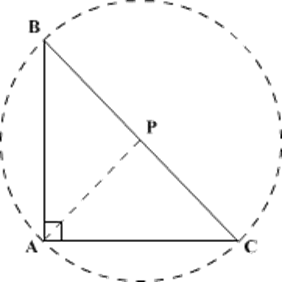
Let ABC be a right-angled triangle with hypotenuse BC of length 20 cm. If AP is perpendicular on BC, then the maximum possible length of AP, in cm, is
A).
B).
10
C).
5
D).
∠BAC = 90°, so BC can be considered diameter of a circle with center anywhere on BC.
AP is maximum when it is the perpendicular bisector from the vertex to the hypotenuse. So, BP = PC = 20/2 = 10. This implies that P is the center of the circle.
∴ AP = BP = PC = 10 cm.
Hence, option 2
Questions 67 to 100 carry 3 marks each.
Q. 17.
How many pairs (m, n) of positive integers satisty the equation m2 + 105 = n2?
The given equation can be rewritten as n2− m2 = 105.
∴ (n + m)(n − m) = 105.
Since n and m are positive, (n + m) is also positive and hence from equation (I), we can deduce that (n − m) is positive.
So, (n − m) > 0 or n > m.
There are 8 factors of 105: 1, 3, 5, 7, 15, 21, 35 and 105.
Both m and n are positive integers, so (n + m) > (n − m).
∴ (n + m)(n − m) = (105 × 1) or (35 × 3) or (21 × 5) or (15 × 7)
Let (n + m) be a and (n − m) be b. So, 2n = (a + b) ⇒n = (a + b)/2.
So, (a + b) needs to be divisible by 2 which is true for all four cases [(a, b) = (105, 1) or (35, 3) or (21, 5) or (15, 7)].
So, possible number of ordered pairs (m, n) is 4.
Answer: 4.
Questions 67 to 100 carry 3 marks each.
Q. 18.
John jogs on track A at 6 kmph and Mary jogs on track B at 7.5 kmph. The total length of tracks A and B is 325 metres. While John makes 9 rounds of track A, Mary makes 5 rounds of track B. In how many seconds will Mary make one round of track A?
Ratio of speeds of John and Mary = 6 : 7.5 = 4 : 5. So let speeds of Johan and Mary be 4k and 5k respectively.
Let length of tracks A and B be a and b respectively.
Tiime taken by John to make 9 rounds of track A = Time taken by Mary to make 5 rounds of B.
∴ 9a/4k = 5b/5k.
∴b = 2.25a ....(I)
a + b = 325 ...(II)
∴a = 100 m and b = 225 m.
So, a = 0.1 km.
∴ Time taken by Mary to complete one round of A = a/7.5 = 0.1/7.5 = 0.01333 hrs = 48 seconds.
Answer: 48.
Questions 67 to 100 carry 3 marks each.
Q. 19.
Amal invests Rs 12000 at 8% interest, compounded annually, and Rs 10000 at 6% interest, compounded semi-annually, both investments being for one year. Bimal invests his money at 7.5% simple interest for one year. If Amal and Bimal get the same amount of interest, then the amount, in Rupees, invested by Bimal is
Total Amount received by Amal = [(12000 × 1.08) + (10000 × 1.03 × 1.03)] = (12960 + 10609) = Rs. 23569
∴ Total interest received by him = 23569 − 22000 = Rs. 1569
Since, Amal and Bimal receive the same amount of interest, Bimal also recieves Rs 1569 as interest.
∴ Priniciple amount invested by Bimal at 7.5% simple interest for one year = (1569/7.5)× 100 = Rs. 20920.
Answer: 20920.
Questions 67 to 100 carry 3 marks each.
Q. 20.
The number of common terms in the two sequences: 15, 19, 23, 27, . . . . , 415 and 14, 19, 24, 29, . . . , 464 is
A).
18
B).
20
C).
21
D).
9
Both the sequences are APs. So, if we only consider the common terms, that sequence will also be in AP with the common difference d equal to the L.C.M of the common differences of the two given sequences.
∴d = L.C.M (4 , 5) = 20.
Consider the sequence consisting of common terms: The general term Tn = 19 + (n − 1)d and the greatest number in this series is less than or equal to 415. (415 is the smaller of the two between 415 and 464)
∴Tn = 19 + [(n − 1)× 20] = 20n − 1.
∴ 20n − 1 ≤ 415
∴n ≤ 20.8.
So, nmax = 20.
So, there are 20 common terms.
Hence, option 2.
Questions 67 to 100 carry 3 marks each.
Q. 21.
Two ants A and B start from a point P on a circle at the same time, with A moving clock-wise and B moving anti-clockwise. They meet for the first time at 10:00 am when A has covered 60% of the track. If A returns to P at 10:12 am, then B returns to P at
A).
10:45 am
B).
10:27 am
C).
10:25 am
D).
10:18 am
Let the meeting point be Q. When A and B are at Q, A and B have covered 60% and 40% of the track respectively.
∴ Ratio of speeds of A and B = 60 : 30 = 3 : 2.
A takes 12 minutes (to cover 40% of the distance) to go from Q to P at a speed of 3x (say).
So, time taken by A (to cover 60% of the distance) to go from P to Q = (12/40) × 60 = 18 minutes.
Time taken by B at a speed of 2x (to cover 60% of the distance) to go from Q to P = 18 × (3/2) = 27 minutes.
So, B will return to P at 10:27 am.
Hence, option 2.
Questions 67 to 100 carry 3 marks each.
Q. 22.
Let A and B be two regular polygons having a and b sides, respectively. If b = 2a and each interior angle of B is 3/2 times each interior angle of A, then each interior angle, in degrees, of a regular polygon with a + b sides is
Interior angle of a regular polygon having n sides An = [(n − 2)/n] × 180
Give that Ab = (3/2) × Aa.
∴ [(b − 2)/b] × 180 = (3/2) × [(a − 2)/a] × 180
Use b = 2a to get; a = 4 and b = 8.
a + b = 4 + 8 = 12.
Each interior angle of a regular polygon having 12 sides = [(12 − 2)/12] × 180 = 150°.
Answer: 150.
Questions 67 to 100 carry 3 marks each.
Q. 23.
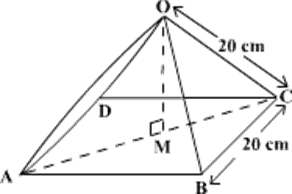
The base of a regular pyramid is a square and each of the other four sides is an equilateral triangle, length of each side being 20 cm. The vertical height of the pyramid, in cm, is
A).
12
B).
10√2
C).
5√5
D).
8√3
In the above image, the side length of the square is equal to the side length of the equilateral triangle.
So, AB = BC = OC = 20 cm.
∆AOM is a right angled triangle with ∠AMO = 90°, AO = 20 cm. OM is the height of the pyramid.
AC is the diagonal of the square base, so AM = AC/2 = (20√2)/2 = 10√2.
So using pythagoras theorem; OM2 = AO2 − AM2 = 202 − (10√2)2 = 400 − 200 = 200.
∴ OM = 10√2.
Hence, option 2
Questions 67 to 100 carry 3 marks each.
Q. 24.
John gets Rs 57 per hour of regular work and Rs 114 per hour of overtime work. He works altogether 172 hours and his income from overtime hours is 15% of his income from regular hours. Then, for how many hours did he work overtime?
Let's say John does 'a' hours of regular work and 'b' hours of overtime work.
a + b = 172 ....(I)
Also, (Income)Overtime = 15% of (Income)Regular.
∴ 114b = 0.15 × 57a ...(II)
Solving (I) and (II), we get; b = 12 and a = 160.
Answer: 12.
Questions 67 to 100 carry 3 marks each.
Q. 25.
Let a1, a2, … be integers such that a1 – a2 + a3 – a4 + … + (–1)n–1an = n for all n ≥ 1. Then a51 + a52 + … + a1023 equals
A).
10
B).
-1
C).
0
D).
1
In the expression we put;
n = 1 to get; a1 = 1 ...(I)
n = 2 to get; a1 − a2 = 2 ...(II)
∴a2 = −1.
n = 3 to get; a1 − a2 +a3 = 3 ...(II)
∴a3 = 1.
n = 4 to get; a1 − a2 +a3 − a4 = 4 ...(II)
∴a4 = −1.
So the pattern followed is 1, −1, 1, −1 and so on.
So aodd = 1 and aeven = −1.
51, 52, 53 .... 1023 is an AP with number of terms = [(1023 − 51)/1] + 1 = 973.
The salaries of Ramesh, Ganesh and Rajesh were in the ratio 6 : 5 : 7 in 2010, and in the ratio 3 : 4 : 3 in 2015. If Ramesh’s salary increased by 25% during 2010-2015, then the percentage increase in Rajesh’s salary during this period is closest to
A).
8
B).
7
C).
10
D).
9
Let the salaries of Ramesh, Ganesh and Rajesh in 2010 be 60, 50 and 70 respectively.
If Ramesh's salary increses by 25%, so his salary in 2015 = 60 × (5/4) = 75.
The ratio of the salaries of Ramesh, Ganesh and Rajesh in 2015 is 3 : 4 : 3. Let these salaries be 3x, 4x and 3x respectively.
∴ 3x = 75 ⇒x = 25.
∴ Salaries of Ramesh, Ganesh and Rajesh in 2015 are 75, 100 and 75 respectively.
∴ Increase in salary of Rajesh during the period =75− 70= 5.
In an examination, Rama's score was one-twelfth of the sum of the scores of Mohan and Anjali. After a review, the score of each of them increased by 6. The revised scores of Anjali, Mohan, and Rama were in the ratio 11 : 10 : 3. Then Anjali's score exceeded Rama's score by
A).
35
B).
32
C).
24
D).
26
Let the scores of Rama, Mohan and Anjali be R, M and A respectively.
Given: (A + 6) : (M + 6) : (R + 6) = 11 : 10 : 3.
(A + 6) − (R + 6) = (A − R) = (11 − 3)k = 8k.
So the answer has to be multiple of 4, so options 1 and 4 are discarded.
Initially, 12R = M + A
∴ 12(3k − 6) = (10k − 6) + (11k − 6)
∴k = 4.
So, (A − R) = 8k = 8 × 4 = 32.
Hence option 2.
Questions 67 to 100 carry 3 marks each.
Q. 28.
How many factors of 24 × 35 × 104 are perfect squares which are greater than 1?
The expression can be written as :
= 28 × 35 × 54
The factors which are perfect squares will contain the following factors : (20, 22, 24, 26, 28) , (30, 32, 34) and (50, 52, 54)
Total number of factors = 5 × 3 × 3 = 45
One of these factors is 1.
Required number of factors = 45 − 1 = 44.
Answer: 44.
Questions 67 to 100 carry 3 marks each.
Q. 29.
The real root of the equation 26x + 23x+2 – 21 = 0 is
A).
B).
log2 9
C).
log2 27
D).
Let 23x be t.
We can rewrite the expression as, t2 + 4t − 21 = 0
= (t + 7) (t − 3) = 0
∴t = −7, 3
t = 23x, so t cannot be negative.
∴ 23x = 3
Taking log both sides, we get;
3x log 2 = log 3
So, x = (log2 3)/3
Hence, option 4.
Questions 67 to 100 carry 3 marks each.
Q. 30.
A).
8
B).
6
C).
16
D).
12
The expressions can be written as:
[(n + 4)(n + 3)/(n − 4)(n + 3)]
= (n + 4)/(n − 4)
= (n − 4 + 8)/(n − 4)
= 1 + [8/(n − 4)]
For this expression to be a positive integer, (n − 4) needs to be a factor of 8.
The various values of (n − 4) are 1, 2, 4 and 8.
So, n = 5, 6, 8 and 12.
∴nmax = 12.
Hence, option 4.
Questions 67 to 100 carry 3 marks each.
Q. 31.
If (2n + 1) + (2n + 3) + (2n + 5) + … + (2n + 47) = 5280, then what is the value of 1 + 2 + 3 + … + n?
, 3, 5 .... 47 constitutes an AP.
So, 47 = 1 + (k − 1) × 2 (where k is the number of terms in this AP)
∴k = 24.
Now the expression can be written as (24 × 2n) + (1 + 3 + 5 + 7 + ........ + 47)
A cyclist leaves A at 10 am and reaches B at 11 am. Starting from 10:01 am, every minute a motor cycle leaves A and moves towards B. Forty-five such motor cycles reach B by 11 am. All motor cycles have the same speed. If the cyclist had doubled his speed, how many motor cycles would have reached B by the time the cyclist reached B?
A).
15
B).
22
C).
20
D).
23
Every minute a motor cycle leaves A and moves towards B. The last motor cycle (45th) reaches B at 11am.
The motorcycles start from A at 10: 01, 10:02 ...and so on. So we can infer that the last motorcycle (45th) would have left A at 10:45 and reaches B at 11 am.
Since the speed of each motorcycles is same, hence each motorcycle takes 15 minutes (10:45 am to 11 am) to reach B from A.
When the cyclist doubles its speed, it will reach in half the time i.e. 30 minutes. So the cyclist reaches B at 10:30 am.
In this case, the last motorcycle to reach B would have to start at 10:15 am. So this must be the 15th motorcycle.
∴ Total 15 motorcycles would have started from A and reached B by the time the cyclist reached B.
Hence, option 1.
Questions 67 to 100 carry 3 marks each.
Q. 33.
Let A be a real number. Then the roots of the equation x2 − 4x – log2A = 0 are real and distinct if and only if
A).
A > 1/16
B).
A < 1/8
C).
A < 1/16
D).
A > 1/8
For a quadratic equation ax2 + bx + c to have real and distinct roots, its discriminant needs to be greater than zero.
∴ b2 − 4ac > 0
∴ 42 − [4 × 1× (−log2A)] > 0
∴ 16 > −4 log2A
∴ 4 > − log2A
∴ log2A > −4
∴A > 2−4
∴A > 1/16
Hence, option 1.
Questions 67 to 100 carry 3 marks each.
Q. 34.
Mukesh purchased 10 bicycles in 2017, all at the same price. He sold six of these at a profit of 25% and the remaining four at a loss of 25%. If he made a total profit of Rs. 2000, then his purchase price of a bicycle, in Rupees, was
A).
4000
B).
6000
C).
8000
D).
2000
Let the purchase price of one bicycle be100x.
∴ Total purchase pricefor all 10 bicycles= 1000x
Total selling price of six bicycles (at 25% profit) = 6 × 125x = 750x
Total selling price of the remaining four bicycles (at 25% loss) = 4 × 75x = 300x
∴ Total selling price of all the ten bicycles = 750x + 300x = 1050x
Total profit = Total selling price − Total purchase price = 2000 (given)
= 1050x −1000x = 50x = 2000 ∴ x = 40.
So purchase price of one bicycle = 40 × 100 = 4000.