CAT 2019 Question Paper | CAT QA CAT Question Paper | CAT Previous Year Paper
Questions 67 to 100 carry 3 marks each.
Q. 1.
Amala, Bina, and Gouri invest money in the ratio 3 : 4 : 5 in fixed deposits having respective annual interest rates in the ratio 6 : 5 : 4. What is their total interest income (in Rs) after a year, if Bina's interest income exceeds Amala's by Rs 250?
A).
7000
B).
7250
C).
6350
D).
6000
Let the amount invested by Amala, Bina and Gouri be 3x, 4x and 5x respectively.
Also, let the respective rates be 6r, 5r and 4r.
So, the respective ratio of simple interest is (3x × 6r) : (4x × 5r) : (5x × 4r).
= 18xr : 20xr : 20xr.
Bina's interest income exceeds Amala's by Rs 250.
∴ 20xr − 18xr = 250.
∴xr = 125.
Total interest income = 18xr + 20xr + 20xr = 58xr = 58 × 125 = Rs. 7250.
Hence option 2.
Questions 67 to 100 carry 3 marks each.
Q. 2.
A person invested a total amount of Rs 15 lakh. A part of it was invested in a fixed deposit earning 6% annual interest, and the remaining amount was invested in two other deposits in the ratio 2 : 1, earning annual interest at the rates of 4% and 3%, respectively. If the total annual interest income is Rs 76000 then the amount (in Rs lakh) invested in the fixed deposit was
Let the amount invested in the ratio 2 : 1 be 2x and x.
∴ Amount invested in fixed deposit = 15L − 3x (where L is lakhs)
Simple interest earned on the fixed deposit = [(15L − 3x) × (6/100) × 1] ...(I)
Simple interest earned on x principle = x × (3/100) × 1 ...(III)
(I) + (II) + (III) = 76000.
Solving we get; x = 2L.
So, amount invested in fixed deposit = 15L − 3x = 15L − 6L = 9L.
Answer: 9
Questions 67 to 100 carry 3 marks each.
Q. 3.
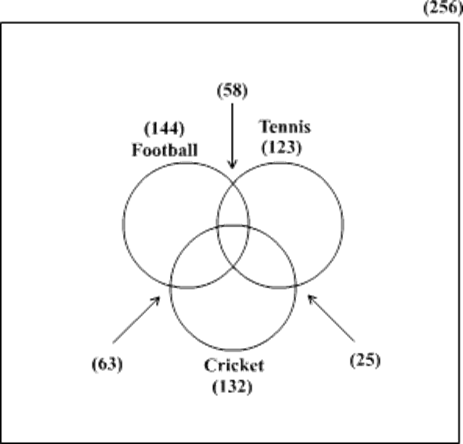
A club has 256 members of whom 144 can play football, 123 can play tennis, and 132 can play cricket. Moreover, 58 members can play both football and tennis, 25 can play both cricket and tennis, while 63 can play both football and cricket. If every member can play at least one game, then the number of members who can play only tennis is
A).
45
B).
43
C).
32
D).
38
Let the number of members who play exactly one game, two games and all three games be a, b and c respectively.
So, a + 2b + 3c = 144 + 123 + 132 = 399 ...(I)
Total number of members = a + b + c = 256 ....(II)
Subtracting (II) from (I), we get;
b + 2c = 143 ....(III)
Also, b + 3c = 58 + 25 + 63 = 146 ....(IV)
Solving (III) and (IV), we get; c = 3 and b = 137.
Using (II), a = 116.
Number of members who can play only tennis = 123 − (58 + 25 − 3) = 43.
Hence option 2.
Questions 67 to 100 carry 3 marks each.
Q. 4.
Let x and y be positive real numbers such that log5 (x + y) + log5 (x − y) = 3, and log2 y − log2 x = 1 − log2 3. Then xy equals
A).
250
B).
150
C).
100
D).
25
log5 (x + y) + log5 (x − y) = 3.
∴ log5 [(x + y)(x − y)] = 3.
∴ (x + y)(x − y) = 53 = 125
So, x2 − y2 = 125 ....(I)
log2 y − log2 x = 1 − log2 3.
∴ log2(3y/x) = 1
∴ (3y/x) = 21 = 2.
So, 3y = 2x .... (II)
Solving (I) and (II), we get;
x = 15 and y =10.
∴xy = 15 × 10 = 150.
Hence option 2.
Questions 67 to 100 carry 3 marks each.
Q. 5.
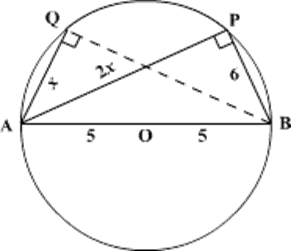
AB is a diameter of a circle of radius 5 cm. Let P and Q be two points on the circle so that the length of PB is 6 cm, and the length of AP is twice that of AQ. Then the length, in cm, of QB is nearest to
A).
7.8
B).
8.5
C).
9.3
D).
9.1
Let AQ be x, so AP = 2x.
Since diameter subtends an angle of 90° at any point on the circumference, ∆APB is a right angled triangle.
So AB2 = AP2 + PB2⇒ 102 = (2x)2 + 62
∴x = 4.
∆AQB is also a right angled triangle, so AB2 = AQ2 + QB2
∴ 102 = x2 + QB2
Put x = 4 to get QB = √84 = 9.165 ≈ 9.1 cm.
Hence option 4.
Questions 67 to 100 carry 3 marks each.
Q. 6.
The product of the distinct roots of ∣x2 − x − 6∣ = x + 2 is
A).
-16
B).
-4
C).
-8
D).
-24
∣x2 − x − 6∣ = x + 2
∴∣(x − 3)(x + 2)∣ = x + 2
Case 1: x < −2.
(−x + 3)(−x − 2) = x + 2
∴x = 4. (which is rejected since 4 is not less than −2)
Case 2: x = −2.
This is a real root of this equation.
Case 3: −2 < x < 3.
(−x + 3)(x + 2) = x + 2
∴x = 2.
Case 4: x = 3.
This does not satisfy the equation so x = 3 is not a root of this equation.
Case 5: x > 3.
(x − 3)(x + 2) = x + 2
∴x = 4.
Required product = (−2) × 2 × 4 = −16.
Hence option 1.
Questions 67 to 100 carry 3 marks each.
Q. 7.
The wheels of bicycles A and B have radii 30 cm and 40 cm, respectively. While traveling a certain distance, each wheel of A required 5000 more revolutions than each wheel of B. If bicycle B traveled this distance in 45 minutes, then its speed, in km per hour, was
A).
14π
B).
18π
C).
16π
D).
12π
Let the radius of A and B be a and b respectively. (a = 30 and b = 40)
Distance travelled by any wheel D = (Circumference C) × (Number of revolutions N)
∴D∝R × N (∵C ∝ Radius R)
∴N∝ 1/R
∴Na/Nb = b/a = 40/30 = 4/3 ...(I)
It is given that Na = Nb + 5000 ...(II)
Solving (I) and (II), we get; Na = 20000 and Nb = 15000.
D = Ca × Na = 2πa × Na = vb × (3/4) [where vb is the velocity of B]
∴ 2π × (30 × 10−5) × 20000 = vb × (3/4)
∴vb = 16π.
Hence option 3.
Questions 67 to 100 carry 3 marks each.
Q. 8.
If 5.55x = 0.555y = 1000, then the value of (1/x) − (1/y) is
Option 1: 2/0 = not defined. So this option is incorrect.
Option 2: 2/(1 + 1) = 2/2 = 1. So this option is correct.
Option 3: (2 − 1)/(1 + 1) = 1/2. So this option is incorrect.
Option 4: (2 − 1)/(1 + 1) = 1/2. So this option is incorrect.
Hence option 2.
Questions 67 to 100 carry 3 marks each.
Q. 11.
In a class, 60% of the students are girls and the rest are boys. There are 30 more girls than boys. If 68% of the students, including 30 boys, pass an examination, the percentage of the girls who do not pass is
Let the total number of students be 100x.
So, number of girls and boys are 60x and 40x respectively.
There are 30 more girls than boys ∴ 60x = 40x + 30.
∴x = 3/2.
Number of students who passed = 68x = 68 × (3/2) = 102 out of which 30 boys passed.
So, number of girls who passed = 102 − 30 = 72
Number of girls who did not pass = 60x − 72 = 90 − 72 = 18.
Required percentage = [18/90] × 100 = 20%.
Answer: 20.
Questions 67 to 100 carry 3 marks each.
Q. 12.
Consider a function f satisfying f(x + y) = f(x) f(y) where x, y are positive integers and f(1) = 2. If f(a + 1) + f(a + 2) +…+ f(a + n) = 16(2n – 1) then a is equal to
On selling a pen at 5% loss and a book at 15% gain, Karim gains Rs. 7. If he sells the pen at 5% gain and the book at 10% gain, he gains Rs. 13. What is the cost price of the book in Rupees?
A).
95
B).
85
C).
100
D).
80
Let the cost price of one pen and one book be 100p and 100b respectively.
On selling a pen at 5% loss and a book at 15% gain, Karim gains Rs. 7.
So, cost price of one book = 100b = 100 × (4/5) = Rs. 80.
Hence option 4.
Questions 67 to 100 carry 3 marks each.
Q. 14.
If the population of a town is p in the beginning of any year then it becomes 3 + 2p in the beginning of the next year. If the population in the beginning of 2019 is 1000, then the population in the beginning of 2034 will be
A).
(1003)15 + 6
B).
(997)15 – 3
C).
(1003)215 – 3
D).
(997)214 + 3
Population of the town at the beginning of the;
First year = p.
Second year = 3 + 2p.
Third year = 3 + 2(3 + 2p) = 9 + 4p = 3(1 + 2) + 4p
So, we can deduce that population at the beginining of the nth year = 3(1 + 21 + 22 + ...2(n−2)) + 2(n−1) p
= 3[2(n−1)− 1] + 2(n−1) p
= 2(n−1) [3 + p] − 3
If we consider 2019 as 1st year, then 2034 is 16th year. (2034 − 2019 + 1 = 16)
So, population at the beginining of 2034 (n = 16) = 2(16−1) [3 + 1000] − 3
= [215 × 1003] − 3
Hence option 3.
Questions 67 to 100 carry 3 marks each.
Q. 15.
In a race of three horses, the first beat the second by 11 metres and the third by 90 metres. If the second beat the third by 80 metres, what was the length, in metres, of the racecourse?
Let x be the length of the racecourse.
The first horse beat the second by 11 metres and the third by 90 metres.
∴ Distances travelled by the first, second and third horse are x, x − 11 and x − 90 respectively.
The second horse beat the third by 80 metres.
Distances travelled by the second and third horse are x and x − 80 respectively.
Ratio of speeds of second and third horse is constant which is equal to the ratio of the distances travelled by the second and third horse.
∴ (x − 11)/(x − 90) = x/(x − 80)
Solving this equation, we get; x = 880.
Answer: 880.
Questions 67 to 100 carry 3 marks each.
Q. 16.
For any positive integer n, let f(n) = n(n + 1) if n is even, and f(n) = n + 3 if n is odd. If m is a positive integer such that 8 f(m + 1) − f(m) = 2, then m equals
Case I: m is odd.
So, (m + 1) is even.
∴ 8[(m + 1)(m + 2)] − (m + 3) = 2
∴ 8m2 + 23m + 11 = 0.
Both roots of this equation are negative as sum of the roots (−23/8) is negative and the product (11/8) is positive. But it is given that m is a positive integer. Hence this case is discarded.
Case II: m is even.
So, (m + 1) is odd.
∴ 8(m + 3 + 1) − m(m + 1) = 2.
∴m2 − 7m − 30 = 0
Solving this equation, we get; m = 10 or −3.
Since m is positive, m = 10.
Answer: 10.
Questions 67 to 100 carry 3 marks each.
Q. 17.
The income of Amala is 20% more than that of Bimala and 20% less than that of Kamala. If Kamala's income goes down by 4% and Bimala's goes up by 10%, then the percentage by which Kamala's income would exceed Bimala's is nearest to
A).
31
B).
29
C).
28
D).
32
Let incomes of Amala, Bimala and Kamala be a, b and k respectively.
∴a = (6/5)b = (4/5)k.
∴ (k/b) = 3/2 ....(I)
Kamala's new income = (96/100)k = 0.96k and Bimla's new income = (11/10)b = 1.1b.
Ramesh and Gautam are among 22 students who write an examination. Ramesh scores 82.5. The average score of the 21 students other than Gautam is 62. The average score of all the 22 students is one more than the average score of the 21 students other than Ramesh. The score of Gautam is
A).
53
B).
21
C).
49
D).
48
Let marks of Gautam be G.
∴G + (62 × 21) = T ...(I) (where T is the total marks of all 22 students)
82.5 + (21 × x) = T ...(II) (where x is the average marks of 21 students other than Ramesh)
The average score of all the 22 students is one more than the average score of the 21 students other than Ramesh.
∴ (T/22) = 1 + x ...(III)
Solving (I), (II) and (III), we get; x = 60.5, T = 1353 and G = 51.
Hence option 2.
Questions 67 to 100 carry 3 marks each.
Q. 19.
Three men and eight machines can finish a job in half the time taken by three machines and eight men to finish the same job. If two machines can finish the job in 13 days, then how many men can finish the job in 13 days?
Let the work done by one man and one machine be x and y respectively.
Three men and eight machines can finish a job in half the time taken by three machines and eight men to finish the same job.
Since efficiency is inversely proportional to the time taken, so the efficiency of 3 men and 8 machines is twice that of 8 men and 3 machines.
∴ (3x + 8y) = 2(8x + 3y)
∴ 13x = 2y.
So, work done by 13 men in a day = work done by 2 machines in a day.
∴ If two machines can finish the job in 13 days, same work will be done by 13 men in 13 days.
Answer: 13.
Questions 67 to 100 carry 3 marks each.
Q. 20.
The number of solutions to the equation |x|(6x2 + 1) = 5x2 is
For x > 0: 6x2 + 1 = 5x ⇒ 6x2 − 5x + 1 = 0. The two roots of this equation are 1/2 and 1/3.
For x = 0, LHS = RHS, ∴x = 0 is a root of the equation.
For x < 0: 6x2 + 1 = −5x ⇒ 6x2 + 5x + 1 = 0. The two roots of this equation are −1/2 and −1/3.
∴ Number of roots = 2 + 1 + 2 = 5.
Answer: 5.
Questions 67 to 100 carry 3 marks each.
Q. 21.
Meena scores 40% in an examination and after review, even though her score is increased by 50%, she fails by 35 marks. If her post-review score is increased by 20%, she will have 7 marks more than the passing score. The percentage score needed for passing the examination is
A).
60
B).
80
C).
70
D).
75
Let the total marks be 100x.
Meena's score = 40x.
Meena's score after review = 40x + [(40x)/2] = 60x.
Passing marks = 60x + 35.
Post review score × (6/5) = 7 + Passing marks
∴ 60x × (6/5) = 60x + 42.
Solving this equation we get; x = 3.5.
So, passing marks = 60x + 35 = (60 × 3.5) + 35 = 245 and total marks = 100x = 100 × 3.5 = 350.
Percentage score needed to pass the examination = (Passing marks/Total marks) × 100
= (245/350) × 100 = 70%.
Hence option 3.
Questions 67 to 100 carry 3 marks each.
Q. 22.
The product of two positive numbers is 616. If the ratio of the difference of their cubes to the cube of their difference is 157 : 3, then the sum of the two numbers is
If a1 + a2 + a3 + … + an = 3(2n+1 – 2), for every n ≥ 1, then a11 equals
Eleventh term of the series (a11) = S11 − S10 (where Sn represents the sum of n terms of the series)
S11 = 3(212 − 2) and S10 = 3(211 − 2).
∴a11 = 3(212 − 211) = 3 × 211 (2 − 1) = 6144.
Answer: 6144.
Questions 67 to 100 carry 3 marks each.
Q. 24.
At their usual efficiency levels, A and B together finish a task in 12 days. If A had worked half as efficiently as she usually does, and B had worked thrice as efficiently as he usually does, the task would have been completed in 9 days. How many days would A take to finish the task if she works alone at her usual efficiency?
A).
36
B).
24
C).
12
D).
18
Let total work be the LCM of 12 and 9 = 36 units.
Let the efficiency of A and B be a and b respectively.
Work done per day when A and B are working together = 36/12 = 3 units. ∴a + b = 3 ...(I)
Work done per day when A is working at half efficieny and B is working at thrice efficiency = 36/9 = 4 units. ∴ (a/2) + 3b = 4 ...(II)
Solving (I) and (II), we get; a = 2.
Time taken by A alone to complete the work = 36/2 = 18 days.
Hence option 4.
Questions 67 to 100 carry 3 marks each.
Q. 25.
One can use three different transports which move at 10, 20, and 30 kmph, respectively. To reach from A to B, Amal took each mode of transport 1/3 of his total journey time, while Bimal took each mode of transport 1/3 of the total distance. The percentage by which Bimal’s travel time exceeds Amal’s travel time is nearest to
A).
22
B).
21
C).
20
D).
19
Let time taken by Amal be 3t, so time taken with each speed = 3t/3 = t.
Let total distance travelled be 3s.
∴ 3s = 10t + 20t + 30t = 60t.
∴s = 20t.
Time taken by Bimal = (s/10) + (s/20) + (s/30) = (11s/60) = 11t/3.
Two cars travel the same distance starting at 10:00 am and 11:00 am, respectively, on the same day. They reach their common destination at the same point of time. If the first car travelled for at least 6 hours, then the highest possible value of the percentage by which the speed of the second car could exceed that of the first car is
A).
25
B).
10
C).
30
D).
20
Car starting at 10 am: Let the speed and time taken be a and t respectively.
Car starting at 11 am: Let the speed be b. Time taken = t − 1.
Since distances covered by both cars are same, so D = at = b(t − 1)
∴b/a = t/(t − 1) = 1/[1 − (1/t)]
(b/a) is maximum when t is minimum.
tmin = 6 (given)
∴b/a = 6/5.
Required percentage = [(6/5) − 1] × 100 = 20%.
Henc option 4.
Questions 67 to 100 carry 3 marks each.
Q. 27.
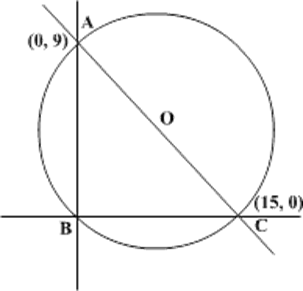
Let T be the triangle formed by the straight line 3x + 5y − 45 = 0 and the coordinate axes. Let the circumcircle of T have radius of length L, measured in the same unit as the coordinate axes. Then, the integer closest to L is
3x + 5y − 45 = 0 cuts the coordinate axes at C(15,0) and A(0,9) as shown in the image below.
∠ABC = 90°, so we can deduce that AC is the diameter of the circumcircle.
Diameter = √(152 + 92) = √306.
Radius = (√306)/2 = 8.74 ≈ 9 units.
Answer: 9
Questions 67 to 100 carry 3 marks each.
Q. 28.
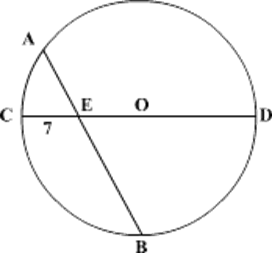
In a circle of radius 11 cm, CD is a diameter and AB is a chord of length 20.5 cm. If AB and CD intersect at a point E inside the circle and CE has length 7 cm, then the difference of the lengths of BE and AE, in cm, is
A).
0.5
B).
2.5
C).
3.5
D).
1.5
The circle can be drawn as shown below. Diameter of the circle = 2 × 11 = 22 cm.
CE = 7, so ED = CD − CE = 22 − 7 = 15.
Let AE be x units, so EB = AB − AE = 20.5 − x.
Using the intersecting chords theorem; AE × EB = CE × ED.
Let S be the set of all points (x, y) in the x-y plane such that |x| + |y| ≤ 2 and |x| ≥ 1. Then, the area, in square units, of the region represented by S equals
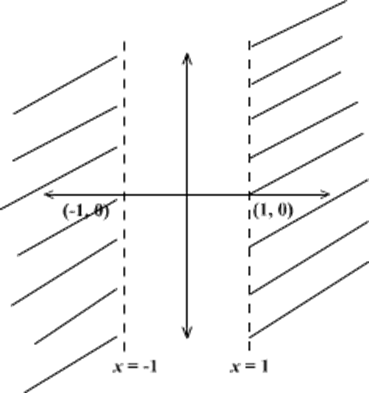
|x| ≥ 1 ⇒x ≥ 1 and x ≤ −1. This is represented as the shaded region in the figure below.
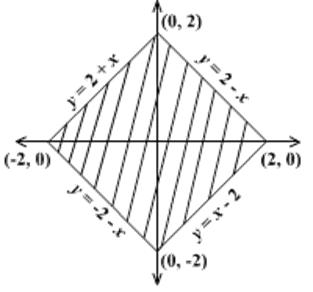
|x| + |y| ≤ 2 : This will have four subcases depending on which quadrant the point is.
1st quadrant (x > 0; y > 0) : y ≤ 2 − x
2nd quadrant (x < 0; y > 0) : y ≤ 2 + x
3rd quadrant (x < 0; y < 0) : y ≥ −2 − x
4th quadrant (x > 0; y < 0) : y ≥ x − 2
Combining these four, the graph for |x| + |y| ≤ 2 is as shown below.
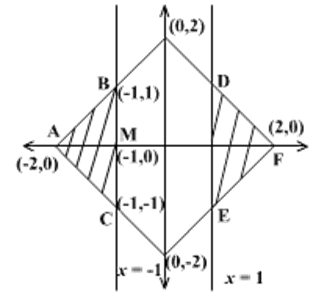
The intersection of |x| + |y| ≤ 2 and |x| ≥ 1 is as shown as the shaded area in the following image.
We need to find Area ∆ABC + Area ∆DEF
Area ∆ABC = Area ∆DEF = (1/2) × BC × AM = (1/2) × 2 × 1 = 1 square unit.
Required area = 1 + 1 = 2 square units.
Answer: 2.
Questions 67 to 100 carry 3 marks each.
Q. 30.
A chemist mixes two liquids 1 and 2. One litre of liquid 1 weighs 1 kg and one litre of liquid 2 weighs 800 gm. If half litre of the mixture weighs 480 gm, then the percentage of liquid 1 in the mixture, in terms of volume, is
A).
70
B).
85
C).
80
D).
75
Weight/Volume for liquid 1 = 1000 g/L.
Weight/Volume for liquid 2 = 800 g/L.
Half litre of the mixture weighs 480 gm, so 1 L of the mixture weighs 960 gm.
So, Weight/Volume for the mixture = 960 g/L.
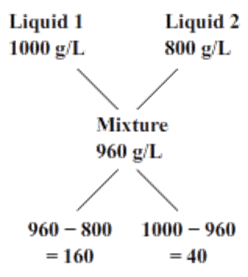
Using the alligation cross;
(Liquid 1 in the mixture)/(Liquid 2 in the mixture) = (960 − 800)/(1000 − 960) = 160/40 = 4/1.
Percentage of liquid 1 in the mixture = (4/5) × 100 = 80%.
Hence option 3.
Questions 67 to 100 carry 3 marks each.
Q. 31.
If m and n are integers such that (√2)19 34 42 9m 8n = 3n 16m (64)1/4, then m is
A).
-16
B).
-12
C).
-24
D).
-20
(√2)19 34 42 9m 8n = 3n 16m (64)1/4
∴ 219/2 34 24 32m 23n = 3n 24m 23/2
∴ 2[(19/2) + 4 + 3n]3(4 + 2m) = 2[4m + (3/2)]3n
Equating the powers of 2 and 3 on both sides, we get;
If the rectangular faces of a brick have their diagonals in the ratio 3 : 2√3 : √15, then the ratio of the length of the shortest edge of the brick to that of its longest edge is?
A).
B).
C).
D).
Let the brick have length, breadth, height as x, y and z respectively. Also let the lengths of the three different diagonals be 3k, (2√3)k and (√15)k.
∴x2 + y2 = (3k)2 = 9k2 ...(I)
y2 + z2 = [(2√3)k]2 = 12k2 ...(II)
z2 + x2 = [(√15)k]2 = 15k2 ...(II)
Adding (I), (II) and (III), we get;
x2 + y2 + z2 = 18k2 ...(IV)
Using (IV) along with any of (I), (II) and (III), we get;
x = k√6 , y = k√3 and z = 3k,
Required ratio = (k√3)/3k = 1/√3.
Hence option 3.
Questions 67 to 100 carry 3 marks each.
Q. 33.
With rectangular axes of coordinates, the number of paths from (1, 1) to (8, 10) via (4, 6), where each step from any point (x, y) is either to (x, y + 1) or to (x + 1, y), is
Number of paths from (1,1) to (8,10) = [Number of paths from (1,1) to (4,6)] × [Number of paths from (4,6) to (8,10)]
Consider (1,1) to (4,6): ∆x = 4 − 1 = 3 and ∆y = 6 − 1 = 5. So we need to go 3 units horizontally and 5 units vertically. So a total of 8 units.
∴ Number of paths from (1,1) to (4,6) = 8C3 × 5C5 = 56.
Consider (4,6) to (8,10): ∆x = 8 − 4 = 4 and ∆y = 10 − 6 = 4. So we need to go 4 units horizontally and 4 units vertically. So a total of 8 units.
∴ Number of paths from (4,6) to (8,10) = 8C4 × 4C4 = 70.
Total required number of paths = 56 × 70 = 3920.
Answer: 3920.
Questions 67 to 100 carry 3 marks each.
Q. 34.
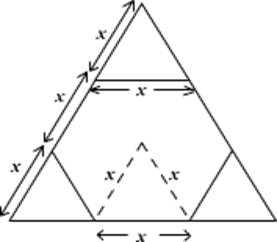
Corners are cut off from an equilateral triangle T to produce a regular hexagon H. Then, the ratio of the area of H to the area of T is
A).
5 : 6
B).
4 : 5
C).
3 : 4
D).
2 : 3
Resulting hexagon will be regular only if the hexagon is symmetrical wrt the original triangle. That is only possible when the corners cut are all equilateral and the side length of the hexagon is equal to side length of the equilateral corner (x say).
H = 6 × [(√3)/4] x2 (∵ A regular hexagon consists of six equilateral triangles of side length equal to the side length of the hexagon)
T = [(√3)/4] (3x)2 (∵ Side length of the triiangle = x + x + x = 3x)