CAT 2017 Question Paper | CAT LR/DI CAT Question Paper | CAT Previous Year Paper
Directions for questions 47 to 50:
Answer the following question based on the information given below.
Questions 47 to 50 carry 3 marks each.
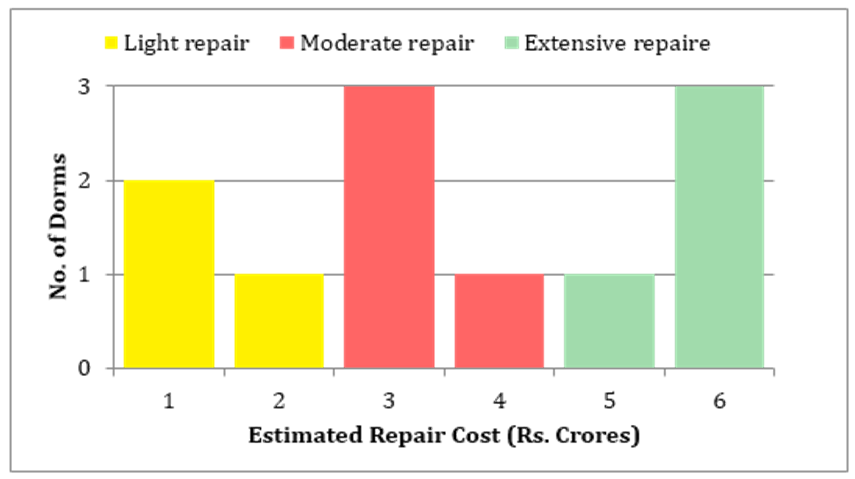
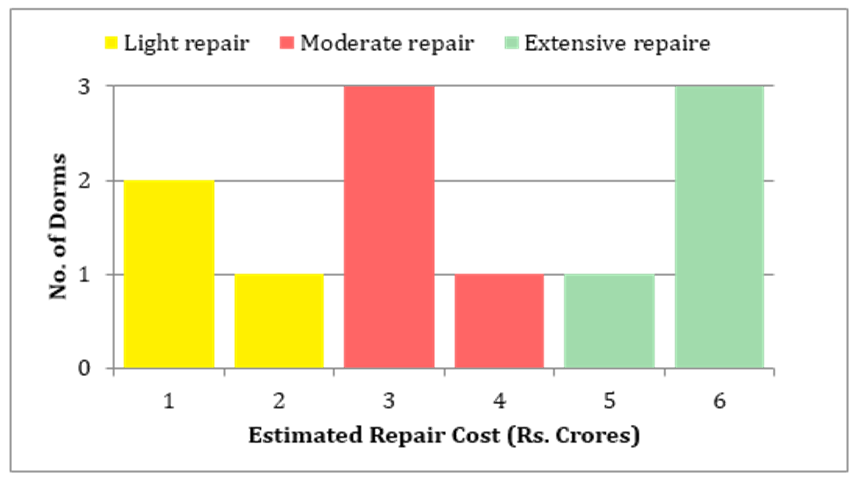
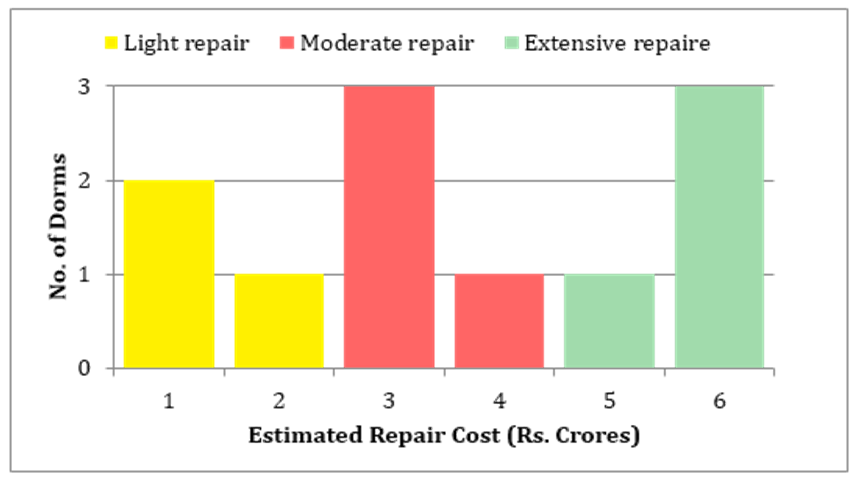
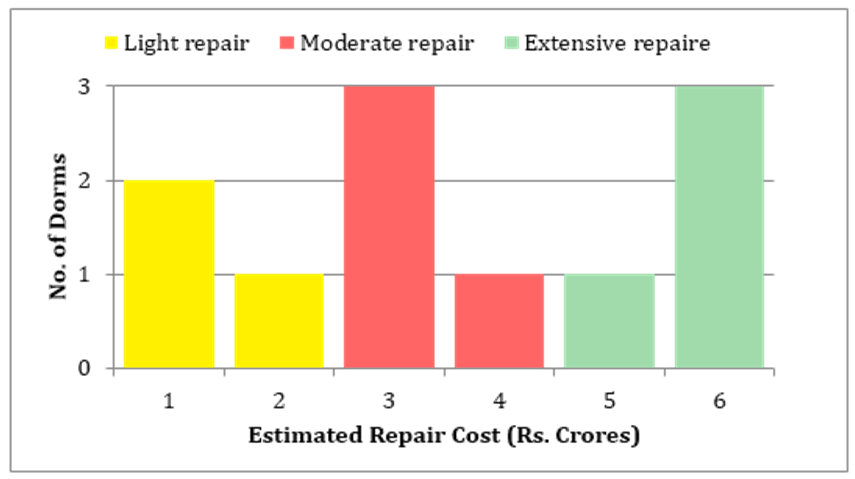
At a management school, the oldest 10 dorms, numbered 1 to 10, need to be repaired urgently. The following diagram represents the estimated repair costs (in Rs. Crores) for the 10 dorms. For any dorm, the estimated repair cost (in Rs. Crores) in an integer. Repairs with estimated cost Rs. 1 or 2 Crores are considered light repairs, repairs with estimated cost Rs. 3 or 4 are considered moderate repairs and repairs with estimated cost Rs. 5 of 6 Crores are considered extensive repairs.
Further, the following are known:
Odd – numbered dorms do not need light repair; even-numbered dorms do not need moderate repair and dorms, whose numbers are divisible by 3, do not need extensive repair.
Dorms 4 to 9 all need different repair costs, with Dorm 7 needing the maximum and Dorm 8 needing the minimum.
[CAT 2017 SLOT II]
Q. 1.
Suppose further that:
4 of the 10 dorms needing repair are women’s dorms and need a total of Rs. 20 Crores for repair.
Only one of Dorms 1 to 5 is a women’s dorm.
Which of the following is a women’s dorm?
A).
Dorm 2
B).
Dorm 5
C).
Dorm 8
D).
Dorm 10
Referring to the answer to the previous question we can see that out of the given options only Dorm 10 is a women’s dorm.
Hence, option 4.
Directions for questions 47 to 50:
Answer the following question based on the information given below.
Questions 47 to 50 carry 3 marks each.
At a management school, the oldest 10 dorms, numbered 1 to 10, need to be repaired urgently. The following diagram represents the estimated repair costs (in Rs. Crores) for the 10 dorms. For any dorm, the estimated repair cost (in Rs. Crores) in an integer. Repairs with estimated cost Rs. 1 or 2 Crores are considered light repairs, repairs with estimated cost Rs. 3 or 4 are considered moderate repairs and repairs with estimated cost Rs. 5 of 6 Crores are considered extensive repairs.
Further, the following are known:
Odd – numbered dorms do not need light repair; even-numbered dorms do not need moderate repair and dorms, whose numbers are divisible by 3, do not need extensive repair.
Dorms 4 to 9 all need different repair costs, with Dorm 7 needing the maximum and Dorm 8 needing the minimum.
[CAT 2017 SLOT II]
Q. 2.
Suppose further that:
4 of the 10 dorms needing repair are women’s dorms and need a total of Rs. 20 Crores for repair.
Only one of Dorms 1 to 5 is a women’s dorm.
What is the cost for repairing Dorm 9 (in Rs. Crores)?
Consider the solution to the first question. Now the only way the cost of repairing 4 dorms adds upto 20 crores is when the repair cost of 2 of the dorms is 6 crores each, the repair cost of the 3rd dorm is 5 crores and the repair cost of the 4th dorm is 3 crores.
This means that dorms 7 and 4 are definitely women’s dorms. Now if we follow condition. Now if we follow condition (2), we get to know that from Dorm 1 to 5 only Dorm 4 is a women’s dorm. So, the remaining 3 women’s dorms have to be from Dorm 6 to 10. Now from Dorm 6 to Dorm 10, we already know that Dorm 7 is a women’s dorm. Now the Dorm for which the cost of repair is 3 crore has to be a dorm where number is between 6 to 10. This only happens in case 2, where Dorm 9 is one of the 3 dorm that costs Rs. 3 crore to repair. Also in case 2, the second dorm that cost Rs.6 crores to repair has to be Dorm No. 10 to satisfy condition (2).
Hence the 4 women’s dorms that Rs.20 crores to repair are Dorms 7, 10, 4 and 9. So the cost of repairing Dorm 9 is Rs. 3 crores.
Answer: 3
Directions for questions 47 to 50:
Answer the following question based on the information given below.
Questions 47 to 50 carry 3 marks each.
At a management school, the oldest 10 dorms, numbered 1 to 10, need to be repaired urgently. The following diagram represents the estimated repair costs (in Rs. Crores) for the 10 dorms. For any dorm, the estimated repair cost (in Rs. Crores) in an integer. Repairs with estimated cost Rs. 1 or 2 Crores are considered light repairs, repairs with estimated cost Rs. 3 or 4 are considered moderate repairs and repairs with estimated cost Rs. 5 of 6 Crores are considered extensive repairs.
Further, the following are known:
Odd – numbered dorms do not need light repair; even-numbered dorms do not need moderate repair and dorms, whose numbers are divisible by 3, do not need extensive repair.
Dorms 4 to 9 all need different repair costs, with Dorm 7 needing the maximum and Dorm 8 needing the minimum.
[CAT 2017 SLOT II]
Q. 3.
What is the total cost of repairing the odd-numbered dorms (in Rs. Crores)?
Consider the solution to the first question.
Dorms 1 and 3 cost 3 crores each to repair.
One of Dorm 5 or Dorm 9 costs 3 crores to repair and the other costs 4 crores repair.
Dorm 7 costs 6 crores to repair.
Total cost of repairing odd numbered dorms = 3 + 3 + 3 + 4 + 6 = 19 crores
Directions for questions 47 to 50:
Answer the following question based on the information given below.
Questions 47 to 50 carry 3 marks each.
At a management school, the oldest 10 dorms, numbered 1 to 10, need to be repaired urgently. The following diagram represents the estimated repair costs (in Rs. Crores) for the 10 dorms. For any dorm, the estimated repair cost (in Rs. Crores) in an integer. Repairs with estimated cost Rs. 1 or 2 Crores are considered light repairs, repairs with estimated cost Rs. 3 or 4 are considered moderate repairs and repairs with estimated cost Rs. 5 of 6 Crores are considered extensive repairs.
Further, the following are known:
Odd – numbered dorms do not need light repair; even-numbered dorms do not need moderate repair and dorms, whose numbers are divisible by 3, do not need extensive repair.
Dorms 4 to 9 all need different repair costs, with Dorm 7 needing the maximum and Dorm 8 needing the minimum.
[CAT 2017 SLOT II]
Q. 4.
Which of the following is NOT necessarily true?
A).
Dorm 1 needs a moderate repair
B).
Dorm 5 repair will cost no more than Rs. 4 Crores
C).
Dorm 7 needs an extensive repair
D).
Dorm 10 repair will cost no more than Rs. 4 Crores
Let us tabulate the information given in the bar chart. As per condition (i) we get the following information
From this we can conclude that Dorm 6 would require light repairs and that Dorm 3 and 9 would require moderate repairs. Now following condition (2), we get to know that Dorm 7 would require 6 cr for repair. and Dorm 8 would required 1 cr. This means that in light repairs, Dorm 8 requires 1 crore for repair and Dorm 2 requires 6 crores for repair. Now as each of Dorms to 9 requires a different amount for repairs, and no even numbered dorm requires ,moderate repair, it would imply that Dorm no 4 requires heavy repairs. Already Dorm 7 needs the maximum amount for repairs, (i.e, 6 crores) which means that Dorm4 would require 5 crores for repair. Now Dorm 9 would require 3 or 4 cr for repair. This leads us to 2 possible cases.
In case 1, as 4 cr is required for Dorm no 9, 3 cr will be required for Dorm no. 5. Also, as no even numbered dorm can have a moderate expenditure, out of the remaining 4 dorms, 1 and 3 (which are also the only odd numbered dorms out of the remaining 4 dorms) will have an expenditure of 3 crores (also since there is only 1 dorm which has a expense of 4 cr which in this case is the expense for Dorm 9). This leaves out only Dorm 2 and Dorm 10, one of these 2 dorms will have an expense of 1 cr and the other an expense of 6 crores. In case 2, 3 cr is the expense for Dorm No. 9 and 4 cr will be the expense for Dorm no 5. Like in case 1, Dorm no 1 and 3 will have an expense of 1 crore and the other an expense of 6 crores. So our final table for both cases will be as below
Now using these tables let us answer each of the questions.
Let us examine each of the statements individually
1] Statement 1 is true as Dorm no 1 needs a moderate repair of 3 crores
2] Statement 2 is also true as Dorm no 5 needs a repair of 3 or 4 crores
3] Statement 3 is also true as Dorm 7 requires a extensive repair of 6 crores
4] Statement 4 may or may not be true as Dorm 10 has a repair cost of 1 crore or 6 crores
Hence, option 4.
Directions for questions 43 to 46:
Answer the following question based on the information given below.
Questions 43 to 46 carry 3 marks each.
An old woman had the following assets:
(a) Rs. 70 lakh in bank deposits (b) 1 house worth Rs. 50 lakh (c). 3 flats, each worth Rs. 30 lakh (d) Certain number of gold coins, each worth Rs. 1 lakh
She wanted to distribute her assets among her three children; Neeta, Seeta and Geeta.
The house, any of the flats or any of the coins were not to be split. That is, the house went entirely to one child; a flat went to one child and similarly, a gold coin went to one child.
[CAT 2017 SLOT II]
Q. 5.
The value of the assets distributed among Neeta, Seeta and Geeta was in the ratio of 1 : 2 : 3, while the gold coins were distributed among them in the ratio of 2 : 3 : 4. One child got all three flats and she did not get the house. One child, other than Geeta, got Rs. 30 lakh in bank deposits.
How much did Geeta get in bank deposits (in lakhs of rupees)?
Consider the solution to the previous question.
Geeta gets 20 lakhs from bank deposits.
Directions for questions 43 to 46:
Answer the following question based on the information given below.
Questions 43 to 46 carry 3 marks each.
An old woman had the following assets:
(a) Rs. 70 lakh in bank deposits (b) 1 house worth Rs. 50 lakh (c). 3 flats, each worth Rs. 30 lakh (d) Certain number of gold coins, each worth Rs. 1 lakh
She wanted to distribute her assets among her three children; Neeta, Seeta and Geeta.
The house, any of the flats or any of the coins were not to be split. That is, the house went entirely to one child; a flat went to one child and similarly, a gold coin went to one child.
[CAT 2017 SLOT II]
Q. 6.
The value of the assets distributed among Neeta, Seeta and Geeta was in the ratio of 1 : 2 : 3, while the gold coins were distributed among them in the ratio of 2 : 3 : 4. One child got all three flats and she did not get the house. One child, other than Geeta, got Rs. 30 lakh in bank deposits.
How many gold coins did the old woman have?
A).
72
B).
90
C).
180
D).
216
Consider the solution to the first question.
Let the total value of assets held by Neeta, Geeta and Seeta be x, 2x and 3x and the total number of gold coins held by each of them be 2y, 3y and 4y. So the total assets (apart from the gold coins) held by Neeta, Geeta and Seeta will be x – 2y, 2x – 3y and 3x – 4y.
Now total assets apart from gold coin = 210 lakhs
∴ (x – 2y) + (2x -3y) + (3x – 4y) = 210
⇒ 6x – 9y = 210
On simplifying we get 2x – 3y = 70
This means that the total assets held by Geeta apart from the gold coins = 70 lakhs We are further told that one child got all 3 flats and one person other than Geeta got 30 lakhs in bank deposits. So then the only way Geeta could have got assets (other than gold coins) worth 70 lakhs is by getting the house of 50 lakhs and 20 lakhs from the bank deposit. This is also because all the 3 flats of Rs. 30 lakh each have gone to one person and obviously that person cannot be Geeta. This means that the 3rd sister has got 20 lakhs from the bank deposit (since one more sister has got 30 lakhs). Since Geeta cannot receive 30 lakhs from the bank deposit, it would imply that Neeta will receive 30 lakhs and Geeta will receive 20 lakhs from the bank deposit. Now, all 3 flats go to either Neeta or Geeta.
If all 3 flats are received by Neeta, then the ratio of value of assets of Neeta and Geeta
(in terms of y) will be (30 + 90 + 2y): (20 + 4y)
⇒ 360 + 6y = 20 + 4y⇒ 2y = -340 or y = -170
However ‘y’ cannot be a negative value. So all 3 flats will go to Geeta
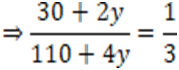
∴ Ratio of value of assets of Neeta and Geeta (in terms of y) will be (30 + 2y) : (20 + 90 + 4y)
⇒ 90 + 6y = 110 + 4y⇒y = 10
Total number of gold coins = 2y + 3y + 4y = 9y = 90.
Hence, option 2.
Directions for questions 43 to 46:
Answer the following question based on the information given below.
Questions 43 to 46 carry 3 marks each.
An old woman had the following assets:
(a) Rs. 70 lakh in bank deposits (b) 1 house worth Rs. 50 lakh (c). 3 flats, each worth Rs. 30 lakh (d) Certain number of gold coins, each worth Rs. 1 lakh
She wanted to distribute her assets among her three children; Neeta, Seeta and Geeta.
The house, any of the flats or any of the coins were not to be split. That is, the house went entirely to one child; a flat went to one child and similarly, a gold coin went to one child.
[CAT 2017 SLOT II]
Q. 7.
Among the three, Neeta received the least amount in bank deposits, while Geeta received the highest. The value of the assets was distributed equally among the children, as were the gold coins
How many flats did Neeta receive?
Consider the solution to the first question.
Since Neeta is the person who receives the least amount in bank deposits i.e., 10 lakhs, he will receive 2 flats of 30 lakhs each.
Answer: 2
Directions for questions 43 to 46:
Answer the following question based on the information given below.
Questions 43 to 46 carry 3 marks each.
An old woman had the following assets:
(a) Rs. 70 lakh in bank deposits (b) 1 house worth Rs. 50 lakh (c). 3 flats, each worth Rs. 30 lakh (d) Certain number of gold coins, each worth Rs. 1 lakh
She wanted to distribute her assets among her three children; Neeta, Seeta and Geeta.
The house, any of the flats or any of the coins were not to be split. That is, the house went entirely to one child; a flat went to one child and similarly, a gold coin went to one child.
[CAT 2017 SLOT II]
Q. 8.
Among the three, Neeta received the least amount in bank deposits, while Geeta received the highest. The value of the assets was distributed equally among the children, as were the gold coins.
How much did Seeta receive in bank deposits (in lakhs of rupees)?
A).
30
B).
40
C).
20
D).
10
As per the data given in the question the gold coins were equally distributed amongst the 3 children. We are also told that the remaining assets (apart from the gold coins) are also equally distributed and that no flat or house is split or divided between 2 or more people. Only the bank deposit of Rs.70 lakhs can be split. Apart from the gold coins, the total value of the assets is 70 + 50 + 30 + 30 + 30 = 210 lakhs
So 210 lakhs split equally would means that each of the 3 daughters would get Rs.70 lakhs. This would mean that the person receiving the Rs.50 lakh house would get Rs.20 lakhs from the bank deposit. Now there are 3 flats of Rs.30 lakhs each and a balance of 50 lakhs in the bank deposit. The only way these assets can be split equally is if one of the 2 remaining people gets one of the flats of Rs.30 lakhs and receives 40 lakhs from the bank deposit. The second person would receive 70-40-20 = 10 Lakhs as bank deposit and 2 flats of 30 lakhs each, the sum of which adds upto 70 lakhs. As Neeta receives the least amount in bank deposits, she will receive 10 lakhs. Also, as Geeta receives the highest amount in bank deposits she wil receive 40 lakhs. Therefore, Seeta will receive 20 lakhs from the bank deposit.
Hence, option 3.
Directions for questions 39 to 42:
Answer the following question based on the information given below.
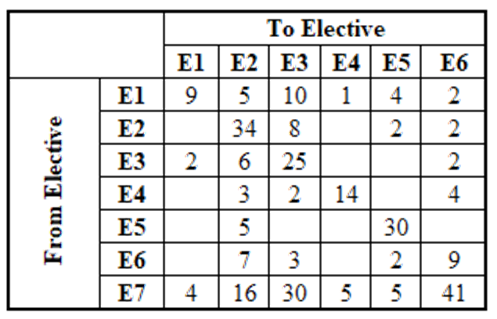
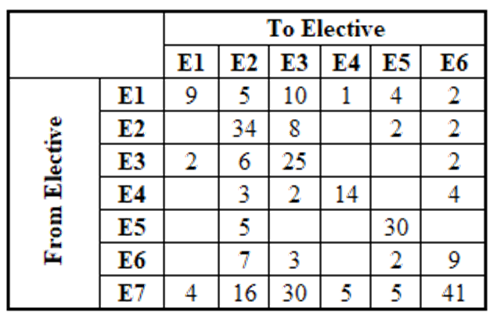
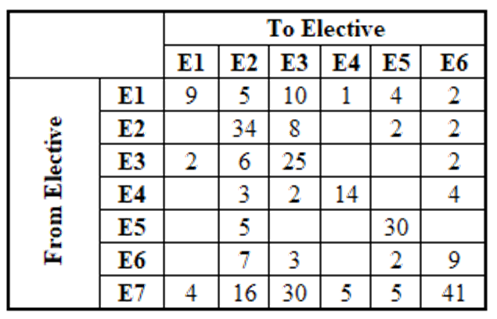
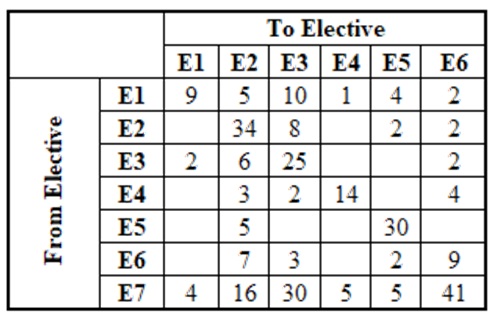
There were seven elective courses - E1 to E7 – running in a specific term in a college. Each of the 300 students enrolled had chosen just one elective from among these seven. However, before the start of the term, E7 was withdrawn as the instructor concerned had left the college. The students who had opted for E7 were allowed to join any of the remaining electives. Also, the students who had chosen other electives were given one chance to change their choice. The table below captures the movement of the students from one elective to another during this process. Movement from one elective to the same elective simply means no movement. Some numbers in the table got accidentally erased; however, it is known that these were either 0 or 1.
Further, the following are known:
Before the change process there were 6 more students in E1 than in E4, but after the reshuffle, the number of students in E4 was 3 more than that in E1.
The number of students in E2 increased by 30 after the change process.
Before the change process, E4 and 2 more students than E6, while E2 had 10 more students than E3.
[CAT 2017 SLOT II]
Q. 9.
Later, the college imposed a condition that if after the change of electives, the
enrollment in any elective (other than E7) dropped to less than 20 students, all the
students who had left that course will be required to re-enroll for that elective.
Which of the following is a correct sequence of electives in decreasing order of their
final enrollments?
A).
E2, E3, E6, E5, E1, E4
B).
E3, E2, E6, E5, E4, E1
C).
E2, E5, E3, E1, E4, E6
D).
E2, E3, E5, E6, E1, E3
Consider the solution to the first question.
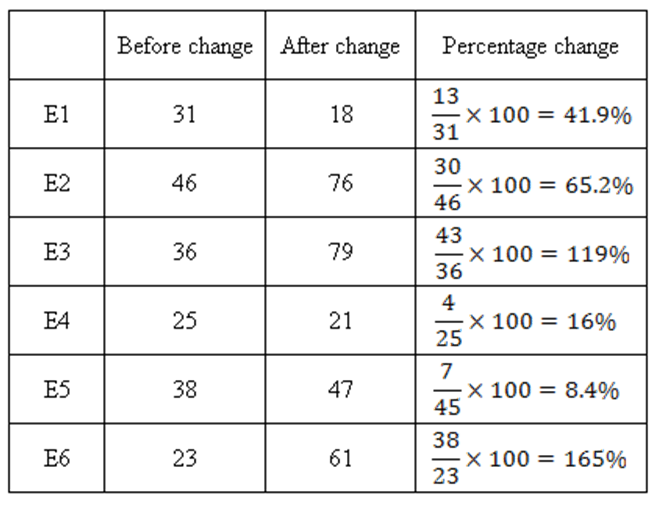
It is only for elective E1 that the enrollments have fallen to below 20. If the students who had left the course E1, now re-enroll for it, the final number of students for each of the electives will be as follows
As can be seen from the table the correct sequence of the electives in decreasing order of their electives is E2, E3, E6, E5, E1 and E4.
Hence, option 1
Directions for questions 39 to 42:
Answer the following question based on the information given below.
There were seven elective courses - E1 to E7 – running in a specific term in a college. Each of the 300 students enrolled had chosen just one elective from among these seven. However, before the start of the term, E7 was withdrawn as the instructor concerned had left the college. The students who had opted for E7 were allowed to join any of the remaining electives. Also, the students who had chosen other electives were given one chance to change their choice. The table below captures the movement of the students from one elective to another during this process. Movement from one elective to the same elective simply means no movement. Some numbers in the table got accidentally erased; however, it is known that these were either 0 or 1.
Further, the following are known:
Before the change process there were 6 more students in E1 than in E4, but after the reshuffle, the number of students in E4 was 3 more than that in E1.
The number of students in E2 increased by 30 after the change process.
Before the change process, E4 and 2 more students than E6, while E2 had 10 more students than E3.
[CAT 2017 SLOT II]
Q. 10.
After the change process, which course among E1 to E6 had the largest change in its enrollment as a percentage of its original enrollment?
A).
E1
B).
E2
C).
E3
D).
E6
Consider the solution to the first question.
As can be seen from the table above, the highest percentage is for E6
Hence, option 4.
Note: We do not need to calculate the exact value. If we compare the value of number of students in electives before and after change, we will see by observation that the ratio for E6 will be highest
Directions for questions 39 to 42:
Answer the following question based on the information given below.
There were seven elective courses - E1 to E7 – running in a specific term in a college. Each of the 300 students enrolled had chosen just one elective from among these seven. However, before the start of the term, E7 was withdrawn as the instructor concerned had left the college. The students who had opted for E7 were allowed to join any of the remaining electives. Also, the students who had chosen other electives were given one chance to change their choice. The table below captures the movement of the students from one elective to another during this process. Movement from one elective to the same elective simply means no movement. Some numbers in the table got accidentally erased; however, it is known that these were either 0 or 1.
Further, the following are known:
Before the change process there were 6 more students in E1 than in E4, but after the reshuffle, the number of students in E4 was 3 more than that in E1.
The number of students in E2 increased by 30 after the change process.
Before the change process, E4 and 2 more students than E6, while E2 had 10 more students than E3.
[CAT 2017 SLOT II]
Q. 11.
After the change process, which of the following is the correct sequence of number of students in the six electives E1 to E6?
A).
19, 76, 79, 21, 45, 60
B).
19, 76, 78, 22, 45, 60
C).
18, 76, 79, 23, 43, 61
D).
18, 76, 79, 21, 45, 61
Consider the solution to the first question.
As can be seen from the table, the correct sequence of the number of students in the 6
electives E1 to E6 is 18, 76, 79, 21, 45 and 61.
Hence, option 4
Directions for questions 39 to 42:
Answer the following question based on the information given below.
Questions 39 to 42 carry 3 marks each.
There were seven elective courses - E1 to E7 – running in a specific term in a college. Each of the 300 students enrolled had chosen just one elective from among these seven. However, before the start of the term, E7 was withdrawn as the instructor concerned had left the college. The students who had opted for E7 were allowed to join any of the remaining electives. Also, the students who had chosen other electives were given one chance to change their choice. The table below captures the movement of the students from one elective to another during this process. Movement from one elective to the same elective simply means no movement. Some numbers in the table got accidentally erased; however, it is known that these were either 0 or 1.
Further, the following are known:
Before the change process there were 6 more students in E1 than in E4, but after the reshuffle, the number of students in E4 was 3 more than that in E1.
The number of students in E2 increased by 30 after the change process.
Before the change process, E4 and 2 more students than E6, while E2 had 10 more students than E3.
[CAT 2017 SLOT II]
Q. 12.
How many elective courses among E1 to E6 had a decrease in their enrollments after the change process?
A).
4
B).
1
C).
2
D).
2
Let us first try and tabulate the number of people for each of the electives before and after the change in elective
Now we know that after change of electives number of people choosing E2 increases by 30. This means that before change of electives, number of people choosing E2 is 76 – 30 = 46.
Now if we check row E2, the values 34, 8, 2 and 2 add upto 46. Since the values of blank cells can be 0 or 1, it means that the remaining 2 cells in row E2 will be 0.
Now before the change, E1 had 6 more students than E4, which means E4 had 31 – 6 = 25 students. If we look at the row E4, there are 2 blank cells. Also, the total of the remaining 4 cells adds upto 3 + 2 + 14 + 4 = 23. As total of all 6 cells has to be 25, it would mean that remaining 2 cells can only have a value of 1. Also the number of students before change of elective in E6 is 25 – 2 = 23. Again in row E6, sum of 4 occupied cells = 7 + 3 + 2 + 9 = 21. Here too with only 2 vacant cells, the balance 2 cells will have a value of 1 each. Now in E2 there are 10 students more than E3 before change of electives, which means in row E3 the total will be 36. This further implies that in row E5, total will be 300 – (31 + 46 + 36 + 25 + 23 + 101) = 38
So far, the total of columns E1 to E6 is 17 + 76 + 78 + 21 + 44 + 60 = 296
This means that the remaining 6 vacant cells in the table will be filled up four ‘1’s and two 0’s. Since the number of students after the reshuffle in E1 is 3 less than the number of students in E4 (which is 21 without the 2 blank cells), the total of column E1 has to be at least 18 which means the vacant cell in column E1 will be filled with 1. This further implies that the balance 2 cells in column E4 will be filled with 0. So then the remaining cells in columnE3, E5 and E6 will be filled with 1. Our final table will appear as below
Now using this table let us answer each of the questions
If we look at the table there is a decrease in the number of students for electives E1 (which
decreases from 31 to 18) and E4 (which decreases from 25 to 21).
Hence, option 3.
Directions for questions 35 to 38:
Five sentences related to a topic are given below. Four of them can be put together to form a meaningful and coherent short paragraph. Identify the odd one out
Questions 35 to 38 carry 3 marks each
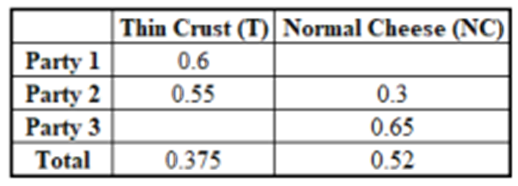
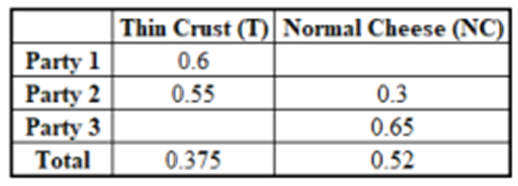
Funky Pizzaria was required to supply pizzas to three different parties. The totalnumber of pizzas it had to deliver was 800, 70% of which were to be delivered to party3 and the rest equally divided between Party 1 and Party 2.
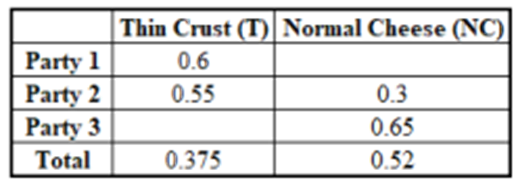
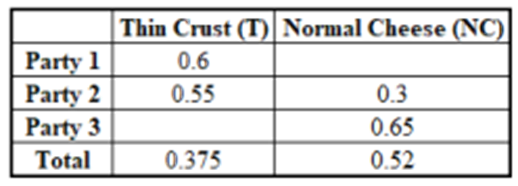
Pizzas could be of Thin Crust (T) or Deep Dish (D) variety and come in either NormalCheese (NC) or Extra Cheese (EC) versions. Hence, there are four types of pizzas: T NC, T-EC, D-NC and D-EC. Partial information about proportions of T and NC pizzasordered by the three parties is given below:
[CAT 2017 SLOT II]Consider the solution to the first question. Let the price of a T-NC pizza and D-NC pizza beRs ‘3x’. So, the price of a D-EC pizza will be ‘5x’ and the price of T-EC pizza will be Rs. ‘5x– 50’
Now 5x – 50 = 500 ⇒ 5x = 550 or x = 110
So the price of T-NC and D-NC pizza will be 3 × 110 or Rs. 330
Further, the price of D-NC pizza will be Rs. 550 and that of T-EC pizza will be Rs. 500
Q. 13.
Suppose that a T-NC pizza cost as much as a D-NC pizza, but 3/5th of the price of aD-EC pizza. A D-EC pizza costs Rs. 50 more than a T-EC pizza, and the latter costsRs. 500.
If 25% of the Normal Cheese pizzas delivered to Party 1 were of Deep Dish variety,what was the total bill for Party 1?
A).
Rs. 59480
B).
Rs. 59840
C).
Rs. 42520
D).
Rs. 45240
Consider the solution to the first question. Let the price of a T-NC pizza and D-NC pizza be Rs ‘3x’. So, the price of a D-EC pizza will be ‘5x’ and the price of T-EC pizza will be Rs. ‘5x – 50’
Now 5x – 50 = 500 ⇒ 5x = 550 or x = 110
So the price of T-NC and D-NC pizza will be 3 × 110 or Rs. 330
Further, the price of D-NC pizza will be Rs. 550 and that of T-EC pizza will be Rs. 500
Given a + d = 16 ⇒ 4d = 16 or d = 4
∴ a = 16 – 4 = 12
So total number of T-NC, T-EC, D-NC and D-EC pizzas, delivered to party 1 is 12, 60, 4 and44 respectively.
Five sentences related to a topic are given below. Four of them can be put together to form a meaningful and coherent short paragraph. Identify the odd one out
Questions 35 to 38 carry 3 marks each
Funky Pizzaria was required to supply pizzas to three different parties. The totalnumber of pizzas it had to deliver was 800, 70% of which were to be delivered to party3 and the rest equally divided between Party 1 and Party 2.
Pizzas could be of Thin Crust (T) or Deep Dish (D) variety and come in either NormalCheese (NC) or Extra Cheese (EC) versions. Hence, there are four types of pizzas: T NC, T-EC, D-NC and D-EC. Partial information about proportions of T and NC pizzasordered by the three parties is given below:
[CAT 2017 SLOT II]
Q. 14.
For Party 2, if 50% of the Normal Cheese pizzas were of Thin Crust variety, what wasthe difference between the numbers of T-EC and D-EC pizzas to be delivered to party2?
A).
18
B).
12
C).
30
D).
24
Consider the solution to the first question.
If 50% of the normal cheese pizzas delivered to party 2 are of thin crust variety, then b : 36 – b
= 1 : 1
So number if T-EC pizzas = 66 – b = 66 – 18 = 48
Also, number of D-EC pizzas = 18 + b = 18 + 18 = 36
So difference between number of T-EC and D-EC pizzas = 48 – 36 = 12 Hence, option 2.
Directions for questions 35 to 38:
Five sentences related to a topic are given below. Four of them can be put together to form a meaningful and coherent short paragraph. Identify the odd one out
Questions 35 to 38 carry 3 marks each
Funky Pizzaria was required to supply pizzas to three different parties. The totalnumber of pizzas it had to deliver was 800, 70% of which were to be delivered to party3 and the rest equally divided between Party 1 and Party 2.
Pizzas could be of Thin Crust (T) or Deep Dish (D) variety and come in either NormalCheese (NC) or Extra Cheese (EC) versions. Hence, there are four types of pizzas: T NC, T-EC, D-NC and D-EC. Partial information about proportions of T and NC pizzasordered by the three parties is given below:
[CAT 2017 SLOT II]
Q. 15.
How many Normal Cheese pizzas were required to be delivered to Party 1?
A).
104
B).
84
C).
16
D).
196
Consider the solution to the first question. Now, number of normal cheese pizzas delivered toall parties is 416. Also total number of normal cheese pizzas delivered to party 1 = a + d
∴ 416 = a + b + c + d + 36 – b + 364 – c
416 = a + d + 400
⇒ a + d = 16.
Hence, option 3.
Directions for questions 35 to 38:
Five sentences related to a topic are given below. Four of them can be put together to form a meaningful and coherent short paragraph. Identify the odd one out
Questions 35 to 38 carry 3 marks each
Funky Pizzaria was required to supply pizzas to three different parties. The totalnumber of pizzas it had to deliver was 800, 70% of which were to be delivered to party3 and the rest equally divided between Party 1 and Party 2.
Pizzas could be of Thin Crust (T) or Deep Dish (D) variety and come in either NormalCheese (NC) or Extra Cheese (EC) versions. Hence, there are four types of pizzas: T NC, T-EC, D-NC and D-EC. Partial information about proportions of T and NC pizzasordered by the three parties is given below:
[CAT 2017 SLOT II]
Q. 16.
35 How many Thin Crust pizzas were to be delivered to Party 3?
A).
398
B).
162
C).
196
D).
198
Now 70% of the pizzas were delivered to party 3 and the balance 30% of the pizzas weredelivered to the remaining 2 parties i.e., Party 1 and Party 2. So each of Party 1 and Party 2will receive
= 560 pizzas.
Now number of Thin crust pizzas received by Party 1 = 0.6 × 120 = 72
So number of Deep dish pizzas received by Party 1 = 120 – 72 = 48
Similarly, number of Thin crust pizzas received by Party 2 = 0.55 × 120 = 66 and number ofdeep dish pizzas received by party 2 = 120 – 60 = 54
Number of normal cheese pizzas received by party 2 = 0.3 × 120 = 36
Number of extra cheese pizzas received by party 2 = 120 – 36 = 84
Now number of normal cheeze pizzas received by party 3 = 0.65 × 560 = 364 So number of extra cheese pizzas received by party 3 = 560 – 364 = 196 Now total number of Thin crust pizzas delivered to the 3 parties = 0.375 × 800 = 300
So, number of Deep Dish Pizzas delivered to the 3 parties = 800 – 416 = 384
So number of thin crust pizzas received by party B = 300 – (72 + 66) = 162 and number of deep dish pizzas received by party 3 = 500 – (48 + 54) = 398
Let number of thin crust normal cheese pizzas received by party 1, 2 and 3 be a, b and c. Now number of deep dish normal cheese pizzas received by party 2 = 36 – b So, the number of deep dish extra cheese pizzas received by party 2 = 54 – (36 – b) = 18 + b
Now total number of extra cheese deep dish pizzas received by party 3 = 196 – (162 – c) = 34 + c
Let number of deep pan normal cheese pizzas received by party 1 be ‘d’. ∴ Number of deep dish extra cheeze pizzas will be ‘48-d’
Now let us represent all this information in a table given below
As can be seen from the table, number of thin crust pizzas delivered to party 3 is 162. Hence, option 2