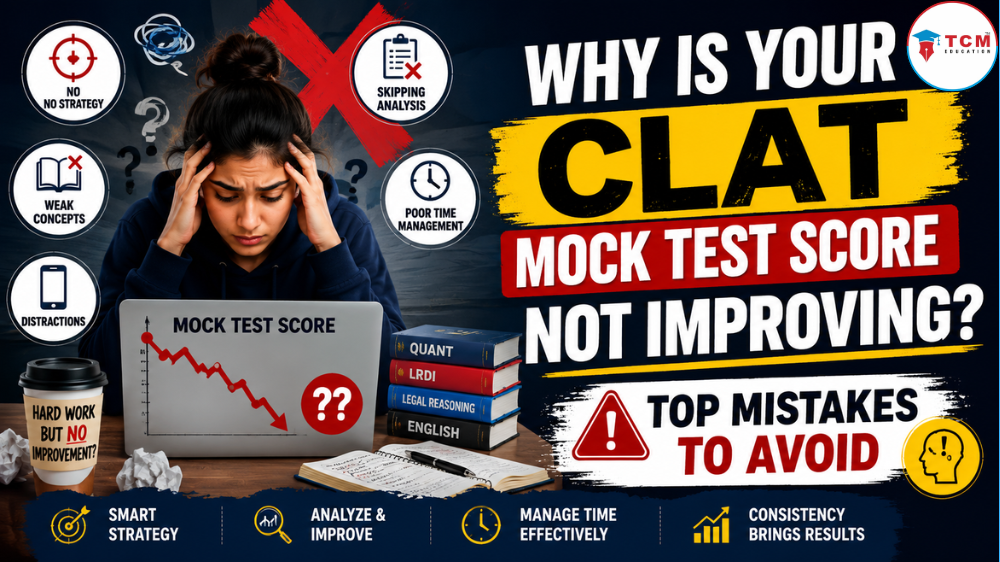
You’re sitting at your desk, checking the results from your latest CLAT Mock Test. You put in hours of reading, practiced legal reasoning concepts, and memorized current affairs. Still , your CLAT Mock Test Score feels completely stuck. It is really an incredibly frustrating feeling that almost every law aspirant faces during their CLAT 2027 preparation.
When your score plateaus, it rarely means you don’t know enough. Instead, it usually signals that your exam strategy, analysis habits, or time management needs a shift—like, a real one. Let’s unpack exactly why your scores aren’t budging and see the practical CLAT preparation tips that can help you break through that ceiling.
The Quick Answer: Why Scores Stop Improving
If your CLAT Mock Test Score isn’t improving, the most common reason is treating CLAT practice tests as just assessment tools, not as diagnostic instruments. Many students complete a test, glance at the final rank, feel disappointed, and immediately move on to the next mock. But without deep analysis, you end up repeating the same structural errors under time pressure every single week.
Top 5 CLAT Mock Test Mistakes Stalling Your Progress
Finding specific errors in your CLAT mock test performance is the first step toward growth. Here are the five most frequent pitfalls:
1. The Passive Review (Or Skipping Analysis Entirely)
Spending two hours on a mock and then only ten minutes looking at the answer key is a recipe for a plateau. If you don’t figure out why you missed a critical legal principle, or misread a comprehension passage, you will repeat that same mistake next weekend.
2. Mismanaging the 120 Minute Clock
CLAT does not only test what you know, it also tests how fast you comprehend. If you spend around seven minutes on one single complicated data interpretation caselet, it really messes with your timing for the rest of the paper, and then you end up rushing through the “lighter” bits like English or Current Affairs .
3. Emotional or Random Guessing
That negative marking ($0.25$ marks per wrong answer) quietly chips away at your net score. Many aspirants reduce a choice to two options and then lean on a sort of “gut feeling” instead of strict textual evidence. In the end, five wrong stabs can wipe out more than the value of one complete correct attempt that took effort.
4. Poor Sectional Strategy
Walking into the exam hall without a customized section order creates this weird kind of panic. If you keep your weakest section for the last twenty minutes, when mental tiredness starts to peak , then your accuracy will drop fast, like sharply.
5. Ignoring Sectional Inconsistencies
Scoring high in Legal Reasoning, but then slipping below even double digits in Quantitative Techniques creates a lopsided profile. CLAT tends to reward steadiness and balanced performance across all areas, not just one strong lane.
How to Analyze a CLAT Mock Test Correctly
Real CLAT mock analysis needs an error log. Keep your incorrect questions and unattempted questions separated into three different categories, and then review them consistently.
| Error Category | What It Means | Actionable Solution |
| Conceptual Error | You did not understand the underlying law, math formula, or grammar rule. | Go back to your core study material and rebuild the foundational theory. |
| Strategic/Timing Error | You knew the answer but ran out of time, or spent too long on the passage. | Practice sectional mock drills with a strict countdown timer. |
| Silly/Careless Mistake | You misread "Which of the following is not true" or made a simple calculation slip. | Slow down your reading speed by roughly 10% during high-stakes passages. |
A Step-by-Step Strategy to Improve Your Scores
Knowing how to improve CLAT mock test score metrics comes down to systematic adjustments.
[Take Mock] ➔ [Categorize Errors in Log] ➔ [Target Weak Concepts] ➔ [Take Sectional Drills] ➔ [Repeat]
Step 1: Fix your reading stamina
CLAT is kind of a reading heavy exam, you know. So, start reading editorial pages from reputable newspapers every day, this helps you build the speed needed to move through long passages without having to re read sentences.
Step 2: Put a fixed sectional time budget in place
During your CLAT mock attempts, keep strict upper limits for every section. Like for example:
- Current Affairs / GK: 10–12 minutes
- English Language: 25–28 minutes
- Legal Reasoning: 30–35 minutes
- Logical Reasoning: 25–28 minutes
- Quantitative Techniques: 12–15 minutes
If the clock says you’re done for that section, move on right away , don’t look back too much. Protect your easy marks elsewhere.
Step 3: Do sectional drills, not just full mocks
If your overall score keeps wobbling mainly because of Logical Reasoning, then for a few days stop taking full length mocks. Instead, focus on timed 30 minute sectional booklet practice until your accuracy is stable again.
How the right mentorship makes a difference
Trying to adjust your approach purely on your own can feel overwhelming, it’s a lot. But when you have a structured environment with clear guideposts, the full process becomes simpler, kinda.
At TCM Education in Prayagraj, we structure our law preparation program around these same core challenges. Rather than just giving you endless stacks of identical papers, our experienced faculty works with individual diagnostic tracking, step by step.
- Small Batch Sizes & Personal Mentorship: We keep the batch sizes small so our mentors can sit with you and go through your personal error log, and then point out where your reasoning drifts from the examiner’s perspective.
- Updated Materials & Deep Analysis: Our ongoing testing series reflects changing exam patterns, and it is supported by granular performance analysis, to really pinpoint your exact conceptual gaps.
- Comprehensive Support: From resolving tricky legal core concepts in dedicated doubt sessions to providing complete interview guidance later on, our student-centric approach ensures you are never guessing your next strategic step.
Your Weekly Mock Test Checklist
Before you plop yourself down for your next practice session, just make sure you tick off these crucial bits:
- Pre-Exam Strategy Set : decide your section order , before you even open the test booklet.
- Strict Time Tracking: keep your watch in sight, so you can manage your sectional budget properly, no drifting.
- The "Two-Pass" Rule: on the first pass, only answer the questions that feel clear and unambiguous. Then, if you still have time, come back later for the trickier puzzles.
- Post-Exam Error Log updated: write down every wrong attempt and tag it with its error category within 24 hours of getting the results.
- Targeted Practice: plan at least two focused drills , each covering one concept you’re weakest at before your next full mock.
Conclusion
A plateaued CLAT Mock Test Score doesn’t mean you will never clear the exam. It mostly says that your current method has brought you to a limit, and now it’s time to recalibrate your strategy. When you reduce careless guessing, stick to a strict sectional timeline, and then dissect your mistakes deeply you’ll start noticing slow but steady improvements.
Also if you want advice that fits your specific strengths and weak spots, a more structured approach really changes everything. Check how TCM Education in Prayagraj offers personal mentorship and a learning process that’s already proven, to streamline your preparation. Just focus on correcting one kind of error at a time, stay steady, and give your plan the space it needs to work.
Frequently Asked Questions (FAQs)
1. How many CLAT mock tests should I take every week?
In the early part of your preparation, taking one mock test per week feels like the sweet spot. I mean, your main attention should stay on finishing the core syllabus and actually understanding the basic ideas, not just rushing through papers. Once the exam is getting closer, around 3–4 months before the final date, you can bump it to two mocks per week. But don’t cross that limit, never take more than two weekly tests. Too many tests leave you with little time for a proper, deeper review, and then burnout shows up, often without any real score gain.
2. What is considered a good score in a standard CLAT mock test?
“Good” is kind of relative, because each mock paper can be easier or harder. Still, in a normal, well-balanced mock test, scoring consistently above $80$ marks generally puts you in a very strong place for the top National Law Universities (NLUs). If right now you are sitting between $50$ and $65$, then you probably have solid foundation stuff, but you may need to fix how you pace yourself and also manage negative marking better, so your score moves into the next bracket, gradually.
3. How do I reduce negative marking in my CLAT practice tests?
To reduce negative marks, you should set up a firm policy for when to guess. Go for a question only if you can confidently remove at least two wrong options, using clear textual hints or logical evidence. If you can’t eliminate two options, then just skip it, blank it out. Also keep a clear tally of all your “blind guesses” in your error log, like explicitly. When you see how many hard-earned marks are lost to random attempts, you start being more careful and selective, and the discipline improves naturally.
4. My accuracy is great, but I cannot finish the paper. How do I speed up?
Slow speed usually points to a reading bottleneck or over-investing time in difficult questions. To fix this, work on timed sectional drills rather than full mocks. Practice scanning passages for core arguments instead of reading every single word with equal emphasis. Additionally, implement a strict time limit per question; if a legal or logical reasoning passage confuses you after one minute of reading, flag it and move on immediately.
5. Can I prepare effectively for CLAT 2027 if my mock scores are low right now?
Yes, absolutely. Low scores early in your preparation cycle are completely normal and serve as an excellent road map for study. They highlight your exact conceptual vulnerabilities before the actual exam day. By focusing heavily on systematic error analysis, strengthening weak topics, and working alongside mentors who understand the exam pattern, you have more than enough time to steadily build your accuracy and pacing.