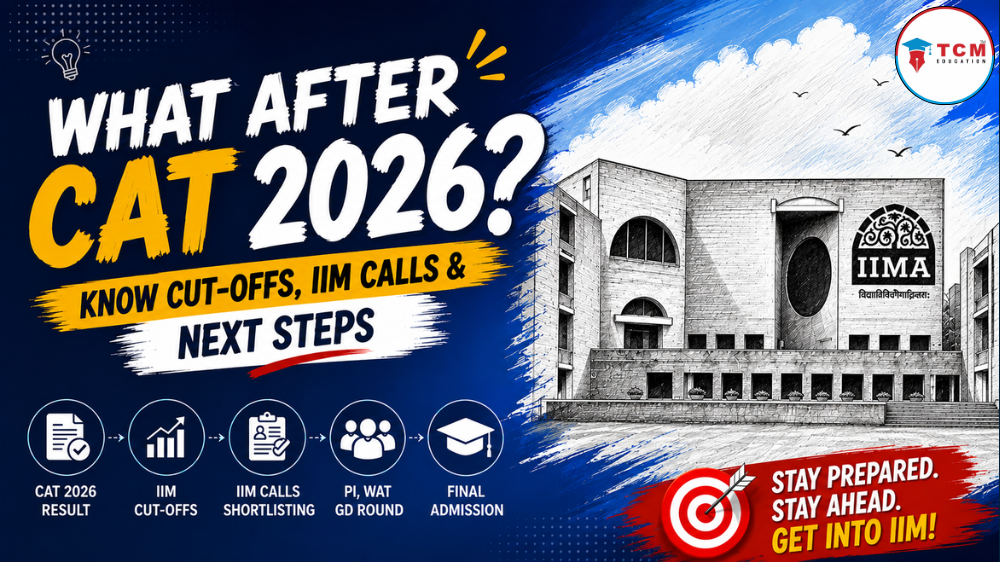
You have spent months prepping for CAT 2026. The mocks are over, the exam is done, and now comes the part that can feel even more confusing, kind of hard to place your mind on: What after CAT 2026?
Will your percentile be enough for an IIM? What will the CAT 2026 cut off look like, in real terms? When will shortlists arrive and who actually gets called? What happens during the interview, like practically speaking? And if you do not land your first-choice IIM, what should you do next, then
The good news is, you don’t have to solve all of this at the last minute. If you understand the post-CAT journey early, it can help you make smarter decisions and prepare for the next stage with confidence.
Yes, your CAT percentile matters, but it is not the full admission story. IIMs can look at CAT performance, academics, work experience, diversity factors, and your showing in later selection stages too. For example, IIM Ahmedabad’s current published admission policy uses CAT performance together with academic performance and later AWT/PI performance, with different weightages in different rounds.
What After CAT 2026? Understand the Complete Journey
After CAT 2026, what next ? Think about the full journey in a kind of calm way, because it does not just jump from exam to admission. Usually it moves like this :
CAT Exam → Response Sheet/Answer Key → CAT Result → Shortlisting → WAT/PI or Interview → Final Selection → Admission Offer.
Now, the real point is this whole flow can look slightly different for each IIM, and also for different programmes. There isn’t one universal formula where one percentile means, okay you will surely get a call from every IIM.
So, your first job after CAT should not only be “let me find a single safe percentile” and stop there. Instead, pause and ask more real questions like:
- What percentile am I expecting right now, based on my prep and guesses?
- How are my sectional scores actually shaping up?
- Which IIMs am I targeting, like for sure not just in theory?
- How does my academic profile read overall?
- Do I have work experience, and if yes, what does it add?
- Which other B-schools should I consider along with the IIMs?
- Am I ready for the interview stage, not only for the questions but for the discussion, examples and clarity too ?
When you answer these, you get a clearer view of your options , and you can plan what to do next, step by step, instead of guessing blindly.
CAT 2026 Cut Off: what does it actually mean?
This “CAT 2026 cut off” phrase can feel a bit confusing, because there really is no one single cut-off that fits every IIM. It’s more like a blended picture, and most people just summarize it as if it’s one number. Usually there are two key ideas you should catch first, not later.
Qualifying Cut-Off
A qualifying cut-off is basically the minimum percentile an institute publishes, so candidates are even allowed to be considered for the next stage, or at least for further sorting. But crossing that mark doesn’t mean an interview call will come automatically. Not even close sometimes.
Just to keep things in perspective, IIM Ahmedabad’s published criteria for the 2026–28 batch, based on CAT 2025, showed a General/ EWS overall qualifying percentile of 95. Along with that, the sectional requirements were set at 85. The minimums for the other categories were not the same though, and that’s where many people misread the overall story.
Similarly, IIM Bangalore’s published 2026–28 criteria based on CAT 2025 listed something like an 85 overall minimum for General candidates, and 75 for NC-OBC and EWS candidates. On top of that, it includes sectional requirements too. It also says clearly that these are minimum requirements for the first shortlist only, which matters a lot.
So yes, these numbers help you understand how IIM admission logic works, but they should not be treated as the CAT 2026 cut-offs in a direct way. The truth is admission policies, including the effective cut-offs, can shift year to year.
Effective or Competitive Cut-Off
The percentile where candidates start becoming truly competitive for a shortlist can be noticeably higher than the published minimum, sometimes by a fair margin.
Why does this happen?
Because IIMs have limited seats and they get applications from a huge pool of high performing candidates, many of them strong in almost every aspect.
So, in practice:
Just meeting the qualifying cut-off means you enter the “possible” zone, but it still does not ensure a call.
You might be considered, yes but definite selection is not guaranteed.
This subtle difference is extremely important while estimating your CAT 2026 chances.
Does a 95, 98 or 99+ Percentile Guarantee an IIM Call?
No, not exactly.
And honestly this is one of the biggest misconceptions students keep after CAT.
Let’s say two candidates both end up with a similar percentile. Still their odds might not be equal, because of factors like
- Class 10 marks,
- Class 12 marks
- Graduation performance
- academic discipline
- Work experience
- Category
- Gender or academic diversity factors, where applicable
- Also the sectional percentile, and in many places the individual IIM admission policy
For example IIM Ahmedabad says, its shortlisting process looks at CAT performance along with academic details, and it uses a composite score at the shortlist stage.
So instead of asking
“Is 98 percentile enough for IIM”
try asking something more grounded like:
“With my CAT percentile and overall profile, which IIMs, and B-schools should I realistically target?”
That little change in the way you think can save you from a lot of unnecessary stress.
CAT 2026 shortlisting criteria: what do IIMs really look at?
Honestly, understanding CAT 2026 shortlisting criteria is a big deal, because your CAT percentile is only one small piece of the whole story, not the entire thing. Even though each IIM may tweak its own approach, there are some usual signals they tend to check.
1. CAT overall percentile
Your CAT performance overall stays one of the main ingredients. A higher percentile usually helps a lot, it makes you more competitive, but it never works alone, like in a vacuum. It is always weighed together with the rest of your profile, even if you don’t see it directly.
2. Sectional percentile
Don’t treat VARC, DILR, or QA like “secondary sections”, okay. Many IIMs mention minimum sectional percentiles, in addition to the overall number. For instance, IIM Ahmedabad, as per its published approach, has separate minimum expectations for VARC, DILR and QA. So yes, a strong overall percentile combined with a weak sectional score can still create issues, and not small ones either.
3. Academic performance
Your school background and graduation score can play a role. Example wise, IIM Ahmedabad’s published shortlisting framework includes Class 10, Class 12, and bachelor-level academic performance, as part of its selection style.
4. Work experience
Depending on an institute’s policy, work experience may add value to your profile, or rather it can influence how they read your candidature. But if you are a fresher, don’t just assume your chances are automatically done, or “over”. Different IIMs use different selection frameworks, and the weighting can shift quite a bit.
5. Academic and Gender Diversity
A few IIMs incorporate diversity related bits into their selection rules.
So yeah, this is also one more reason there isn’t one universal “required percentile” that works the same for every single candidate.
What Happens After the CAT 2026 Result?
After the CAT 2026 result gets declared, students usually shift into the shortlist watching stage.
That part is less about panic, more about organisation and keeping track.
Step 1: Check Your CAT Scorecard
Go through:
- overall percentile
- VARC percentile
- DILR percentile
- QA percentile
- overall score
- section wise scores
And don’t only stare at your overall percentile.
Your performance in each section can, in fact, decide your eligibility for individual institutes.
Step 2: Create an IIM Shortlist Tracker
Make a simple spreadsheet containing:
| Institute | Overall Requirement | Sectional Requirement | Profile Factors | Interview Status |
| IIM A | Check official policy | Check official policy | Academics/Profile | Pending |
| IIM B | Check official policy | Check official policy | Academics/Profile | Pending |
| IIM C | Check official policy | Check official policy | Academics/Profile | Pending |
| Other IIMs | Check individually | Check individually | Varies | Pending |
This simple practice can make the entire process, lot easier to handle.
Step 3 : Track Official Communication
Don’t rely only on Telegram groups, WhatsApp messages, Instagram posts, or those unofficial “ call predictors. ”
You can use unofficial sources for brainstorming if you want, but for anything important about the admission, check it from the respective institute’s official website.
CAT 2026 Admission Process : What Comes Next?
The CAT 2026 Admission Process might look different across IIMs.
Some places lean into Personal Interviews, while others may add written assessments or other components based on their own admission framework.
For instance, IIM Ahmedabad’s current PGP path has shortlisting for an Analytical Writing Test (AWT) and Personal Interview, then the final pick is done via a final composite score. In their published 2026–28 policy, the PI phase is given major weight in that final composite score.
The takeaway is pretty straightforward:
Getting the call isn’t the same thing as getting the seat.
CAT 2026 Interview Process: how should you prepare?
If you get an interview call, your prep should shift right away, like immediately.
CAT preparation is mostly about aptitude, yes.
But an interview is sort of a different game.
The panel may want to figure out things such as:
- Who are you, really?
- Why do you want an MBA?
- Why this specific career track?
- What did you learn during graduation ?
- What are your strengths and weaknesses
- What have you been doing outside academics?
- What is going on in the economy these days
- What business or social problems pull your attention?
Start Preparing Your “Tell Me About Yourself”
This is usually where it begins.
Don’t try to memorise some complex speech or a super polished monologue.
Instead, get a simple natural 60–90 second intro ready, one that flows , covering:
Background → Academic or Professional Journey → key interest → career direction
Your response should feel like you, not like a paragraph you copied , and then repeated from some random internet page
Revise Your Graduation Subjects
If you are a commerce graduate, go over key commerce plus economics ideas, again and again
If you are an engineer, be ready for questions tied to your branch and the base fundamentals, not only advanced topics
If you studied humanities, try to understand the big subjects, plus what they really mean, from your academic background
In interviews, the panel can move from a general question, to a subject specific one , very quickly
Read the news every day
You don’t have to read five newspapers cover to cover, honestly
Instead, focus on:
- Indian economy
- Business and markets
- Technology
- International affairs
- Government policies
- Major corporate developments
- Important social issues
But more than everything, learn to form your own opinion, even if it is simple
Knowing a headline is useful
Knowing why it matters , is way more valuable in an interview
CAT 2026 Next Steps if you don’t get your preferred IIM
This is perhaps the most important part of the entire journey.
But what if your percentile is lower than expected?
What if you receive calls, but not from your preferred IIM.
What if you don’t receive an IIM call at all?
Don’t make an emotional decision immediately, pause first.
Your CAT result does not define your management career, at least not completely.
You should evaluate your alternatives based on
- College reputation
- placement outcomes
- fees
- Return on investment
- curriculum
- Location
- alumni network
- Career opportunities
- Your long term goals
Also, there are several strong management institutes beyond the IIMs.
So don’t reduce your entire MBA decision to just one label, because it’s not that simple.
What should you do while waiting for IIM calls?
This is where clever candidates sort of get the upper hand.
Don’t spend the whole waiting time just staring at whether a shortlist has actually come out. Instead, use that period in a way that actually helps you.
Try this kind of simple daily flow
- 30 minutes: current affairs
- 30 minutes: revisit your graduation subject
- 30 minutes: interview questions
- 15 minutes: personal profile preparation
- 15 minutes: speaking practice
Even 1–2 focused hours each day, if you do it consistently, can end up mattering quite a bit over a few weeks.
Do mock interviews, not “when everything is finally near”
Don’t wait for the final interview date.
Start with:
- friends
- teachers
- mentors
- seniors
- faculty members
Then ask them to question your answers, push you a bit, make you explain your logic.
The goal isn’t to get every single answer flawless right away.
It’s more about getting used to thinking on the spot, under pressure and in that moment.
Common Mistakes Students Make After CAT
Mistake 1: Starting Preparation Only After You Get a Call
Honestly this is one of the most avoidable mistakes, and still people do it.
Once the call arrives, you might have a narrow preparation window.
Better approach: Begin interview prep early, like seriously early.
Mistake 2: Getting Stuck on Just One Cut-Off
Students often end up spending hours scrolling and searching
“CAT 2026 Cut Off for IIM A?”
“CAT 2026 Cut Off for IIM B?”
“CAT 2026 marks for 99 percentile?”
Cut-offs can guide you, yes but they are not the full decision trail.
Better approach: Consider percentile + profile + institute requirements together, not one by one.
Mistake 3: Ignoring Sectional Percentiles
A strong overall percentile still can’t compensate for a weak sectional score.
Please check how you did in VARC , DILR , and QA separately.
Because the sections can tell a different story, quietly.
Mistake 4: Relying 100% on Predictors
Call predictors might give a rough estimate, but they won’t act like an admission promise.
Your official institute communication should be the final compass here.
Mistake 5: Treating an IIM Call as the End Point
Getting the interview call is an opening, not the finish line.
What you do after the call can still swing the outcome in a big way, so don’t relax just because the call came.
A Practical Post-CAT 2026 checklist
After your CAT exam is over , just follow this kind of list:
- Check your CAT response sheet and result carefully.
- Record your overall and sectional percentiles.
- Research the official admission policies of your target IIMs.
- Understand the CAT 2026 Shortlisting Criteria for each institute.
- Prepare a realistic list of target B-schools.
- Start interview preparation before calls arrive.
- Revise your graduation subjects.
- Follow current affairs consistently.
- Prepare your personal introduction and career goals.
- Practice mock interviews.
- Keep backup options open.
This whole approach keeps you aligned with what you can control, more or less.
What if your CAT 2026 percentile comes out lower than you were expecting?
Just take a breath, before you start making some big calls.
It can feel disappointing, sure, but a lower-than-expected percentile doesn’t automatically mean your story is over or that there are absolutely no choices.
You can try to sort it out like this, slowly and calmly…
Option 1: Look at other B-schools too
Don’t judge colleges only by their brand, that alone, usually not enough.
Instead check placements, fee structure, programme depth, alumni strength, and the career outcomes people actually get after.
Option 2: Target the right management programmes
Depending on your overall score and profile, some non-IIM institutions can still be a sensible fit, and yes they might still match your goals.
Option 3: Consider retaking CAT
If your target is very specific, and you genuinely feel you can lift your score a lot, then one more attempt may be worth considering.
But before you go for that, really do an honest audit of things like
- Why did you fall short of your target?
- Was it mostly concepts?
- Or time management, like the sections ran out too fast?
- Or exam-day stress , maybe you got rattled?
- How were your mocks beforehand?
- Was there a particular section where your performance stayed weak?
And please, don’t just repeat the same routine and expect a totally different result.
How TCM Education Can Help You Get Ready for the CAT Journey
CAT prep isn’t just about cranking out more questions. It’s more like figuring out where you stand, where you’re heading, and what actually needs fine tuning.
At TCM Education, you can take your CAT preparation in a more organized way, with a mix of concept focused learning, real practice, mock test analysis and a bit of smart, strategic preparation.
This same idea also carries over to the post CAT stage.
If your target is an IIM or any other leading management institute, then honestly a percentile number alone won’t be enough. You need a complete journey plan from the start—preparation, mock analysis, and even interview readiness.
With the right guidance, you can spot weak spots sooner, reduce repeated blunders and walk into the whole admission process with more calm confidence.
Final Thoughts: Don’t Let CAT 2026 End With the Exam
So, what comes after CAT 2026?
The answer is simple, the next phase starts.
Your CAT percentile matters, but it’s only a small section of your MBA journey. The CAT 2026 Cut Off, shortlisting process, interview outcomes, academic background, and the final selection stage all need your attention , not just one of them.
If you receive an IIM call, prepare seriously and without distractions.
If you do not, take a step back and weigh your options clearly, logically.
And if your CAT result is not exactly what you thought, keep in mind that one test will not decide your whole career.
The smartest CAT aspirants don’t sit and wait for the next step to show up. They build ahead, quietly, step by step.
If you are aiming for CAT 2026 and you want organized help for both the exam and the stages that follow, exploring the right preparation programme at TCM Education could be a strong next move. Start with a clear target, review your progress honestly, and stay locked on the bigger mission—making a solid route toward your management career.
Frequently Asked Questions
1. After CAT 2026, what should I do?
Once CAT 2026 is over, first thing is to check your overall and sectional percentile, try to understand the CAT 2026 shortlisting criteria, then roughly map which IIMs and other B-schools you can realistically target. After that, WAT, PI and the other selection stages should become your main focus, because those steps happen fast and you need to be ready. TCM Education actually supports CAT aspirants with structured preparation, mock-test analysis, mentorship, and training for GD/WAT/PI, so you are not just guessing what comes next.
2. What is the CAT 2026 cut off for IIMs?
The CAT 2026 cut off won’t be the same everywhere, it depends on the IIM, the category, and even the programme type. You should always separate the minimum qualifying percentile vs the one that is usually competitive for a shortlist , because “qualifying” is not the same as “getting called”. Instead of leaning only on a generic cut-off number, aspirants can evaluate the full profile properly with guidance from experienced mentors at TCM Education.
3. What are the CAT 2026 shortlisting criteria?
CAT 2026 shortlisting criteria may include CAT percentile, sectional scores, academic background, work experience, diversity related factors, plus a few extra points that each IIM decides. Since no two institutes use exactly the same formula, students should verify the official admission policy for every IIM they are aiming for. TCM Education helps students with personalized guidance so it becomes easier to understand post-CAT options without confusion.
4. How do I prepare for the CAT 2026 interview process?
Start preparation earlier, don’t wait until the final shortlist drops. Revise graduation subjects, practise common interview questions, keep up with current affairs, and do mock interviews on a regular basis. TCM Education provides GD/WAT/PI sessions and interview-focused mentoring, which helps aspirants stay more confident ,especially when they are facing the real selection process.
5. What if I don’t get an IIM call after CAT 2026?
Not getting an IIM call does not really mean your CAT journey is done, you know. You can look at other reputed B-schools, weigh your options carefully based on placements and ROI, or even think about another CAT attempt if it feels appropriate. TCM Education can help students sort out how they did, spot where the preparation is thin, and then plan the next move in a more smart way.
6. When should I begin preparing for IIM interviews after CAT 2026?
Ideally, start interview prep right after the CAT exam, rather than waiting for a shortlist. That way you get enough time to work on academics, current affairs, your communication style, and also personal interview answers. TCM Education blends CAT preparation with mentorship and GD/WAT/PI training, so you’re preparing not only for the exam , but the whole management admission path too.
7. Why pick TCM Education for CAT preparation?
TCM Education emphasizes concept clarity, a structured approach, mock tests, performance review, and personalised mentorship. The CAT programme includes detailed study plans, concept-builder classes, strong mock-test support, doubt-solving help, and also GD/WAT/PI preparation. TCM also supports CAT preparation via its Prayagraj , Varanasi and online programmes so you can choose what suits you best.
8. Can TCM Education guide me for my CAT 2026 next steps?
Yes, it can. TCM Education can support you beyond usual CAT preparation through mentorship, mock-test analysis, career counselling, and GD/WAT/PI training. The official CAT programme is built to take you from concept building and practice, into revision mode, and later into selection-stage preparation. If you’re confused about your percentile, your IIM options ,or what to do next after CAT 2026, discussing your profile with a TCM mentor can help you create a clearer, tighter plan.