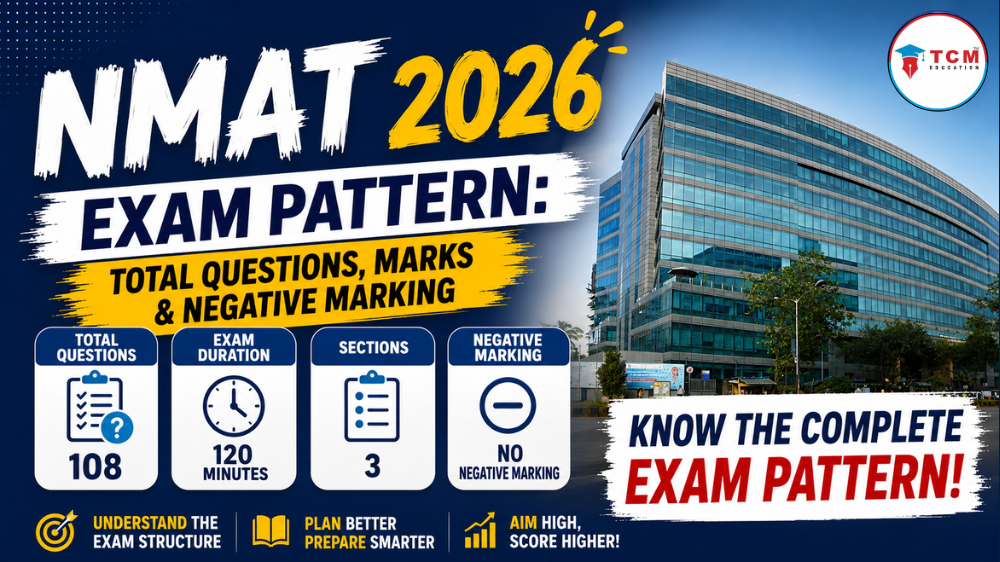
Having a complete understanding of the test formats, scoring system and time management systems is important for management admissions. The NMAT 2026 Exam Pattern organized by the Graduate Management Admission Council (GMAC) is one of the most flexible yet strategically devised examinations for Indian and global business school aspirants. The exam is a computer-adaptive test. This is because it offers candidates a customized testing experience. While testing, the difficulty of questions will adjust based on the real-time performance of candidates. As students prepare for various competitive formats like CAT, CLAT, IPMAT, and CUET; it is very important to study the specific nuances of NMAT.
The NMAT by GMAC differs from other linear entrance exams in the importance placed on speed and accuracy, as well as the ability to choose the order of sections attempted. A structural focus on standardised evaluation helps aspirants realise the exact equilibrium between the density of the question and the time windows of sections. The guidance given to candidates at TCM Education focuses on helping the students understand these algorithmic parameters. This ensures they are equipped to turn their knowledge of the test format into the best B-school cut-offs.
| Exam Feature | NMAT 2026 Specification Detail |
| Conducting Authority | Graduate Management Admission Council (GMAC) |
| Test Delivery Mode | Computer-Based Test (CBT) / Computer-Adaptive Format |
| Total Exam Duration | 120 Minutes (2 Hours) |
| Total Number of Questions | 108 Multiple-Choice Questions (MCQs) |
| Number of Test Sections | 3 Sections (Language Skills, Quantitative Skills, Logical Reasoning) |
| Sectional Time Limits | Enforced Individually Per Section (28, 52, and 40 Minutes) |
| Negative Marking Policy | Zero Penalty for Wrong or Skipped Questions |
| Total Scaled Score Range | 36 to 360 Points |
| Sectional Scaled Score Range | 12 to 120 Points per Section |
| Maximum Allowed Attempts | Up to 3 Attempts (1 Main Test + 2 Retakes within testing window) |
Comprehensive Breakdown of the NMAT 2026 Exam Pattern and Sectional Architecture
So, the NMAT 2026 exam pattern it’s sort of set up in a way that feels pretty balanced, like each of the three skill domains gets the same question weightage. The overall NMAT 2026 total question setup comes to exactly 108 questions, and they’re split into three parts of 36 each, pretty evenly. But the catch is the time you get for each section doesn’t match that neat 36-36-36 rhythm, so there is this real pacing difference throughout the test.
Then, when you look at NMAT 2026 section-wise questions and the time distribution framework, you can see the pressure levels are not the same. The Language Skills section has the most restrictive time, you only get 28 minutes for 36 questions, so yeah it’s kind of hurried. On the other hand, the Quantitative Skills section gives you 52 minutes to handle 36 questions which makes sense, because it s more calculation heavy, including the whole quantitative and data interpretation kind of set. Finally, Logical Reasoning sits in between those two, with 40 minutes for the 36 items, sort of bridging the gap without feeling too relaxed.
| Test Section | NMAT 2026 Number of Questions | Allocated Time | Scaled Score Range | Average Time Per Question |
| Language Skills | 36 Questions | 28 Minutes | 12 – 120 Points | ~46.6 Seconds |
| Quantitative Skills | 36 Questions | 52 Minutes | 12 – 120 Points | ~86.6 Seconds |
| Logical Reasoning | 36 Questions | 40 Minutes | 12 – 120 Points | ~66.6 Seconds |
| Total / Overall | 108 Questions | 120 Minutes | 36 – 360 Points | ~66.6 Seconds (Average) |
Operational Rules that Guide Section Switching and the Attempt Windows
The way the test runs is kinda different from the usual management entry style assessments. Before the examination starts , test-takers get the freedom to pick the order in which they try the three sections. As soon as they choose that order, it stays fixed for the entire test attempt with no take-backs.
Each section has its own timer, and the timers work on their own, period. If someone finishes a section quickly, the leftover minutes don’t get transferred or carried into the next section. When a section timer runs out, the test system auto-submits the answers from that section and then it moves you straight to the next assigned section. During the active timer, candidates may look again, flag items, and update answers. But once a section is submitted, they can’t circle back to view or revise what was already sent.
GMAC allows candidates to take the NMAT as much as three times within one yearly testing window, this window includes one main attempt and then up to two additional retakes. Also, to keep prep time realistic, there’s an enforced 15-day break between attempts.
Analysis of the NMAT 2026 Scoring Pattern and adaptive mechanics
Getting what the NMAT 2026 scoring pattern is really doing means separating raw mark creation from the later computer‑adaptive score scaling. In a lot of basic introductory writeups, you will see the idea that the exam uses a simple raw structure like +3 marks for each correct response, but GMAC itself runs things using an Item Response Theory, or IRT, approach for the final reported numbers.
So in this adaptive setup, the NMAT 2026 marking scheme is not judging every question on one fixed uniform point value. Rather, the score granted for a correct answer changes, depending on how hard that particular question is at the time it appears. The test platform pulls items from a large bank, it does this based on the candidate’s live accuracy, and then keeps adjusting as you move through the sections.
[Adaptive Difficulty & Scoring Workflow]
[Initial Baseline Question: Moderate Difficulty]
|
+-----------------------+-----------------------+
| |
[Correct Answer Submitted] [Incorrect Answer Submitted]
| |
Difficulty Steps UP Difficulty Steps DOWN
Higher Scaled Value Potential Lower Scaled Value Potential
| |
+-----------------------+-----------------------+
|
[Final Scaled Score: 12 - 120 Range]
The adaptive engine starts each portion with questions that sit at a moderate baseline difficulty level. If answers are correct, the software starts feeding progressively more complex items , and those later items end up having more statistical pull toward the end scaled result. If an answer is wrong, the system sinks back into lower difficulty tiers. The raw points collected across these different difficulty paths are then converted into a standardized scaled score that runs from 12 up to 120 per section, so the overall composite NMAT score lands somewhere between 36 and 360.
Strategic Implications of the NMAT 2026 Negative Marking Policy
One real structural advantage for candidates is the total lack of negative marking in NMAT 2026. In other words candidates face zero point subtraction for incorrect selections, or for items left blank.
Still, the assessment specialists at TCM Education point out a key second order point about the same rule: even without a direct deduction, failing to attempt questions before the section ends can quietly cost you scaled score potential. Since the adaptive engine looks at the full set of item responses to judge score convergence, blank entries end up withholding the data the algorithm would need to grant the higher tier scaled credit.
So because a totally unattempted item has effectively zero chance of being revisited for scoring, candidates should try every single question before the sectional time limit runs out. Even an informed guess, or a randomized attempt, can still keep roughly a 20% to 25% chance of correctness, and it does that without any score penalty attached.
Topic-Wise Syllabus Distribution and Test Weightages
To prepare effectively, test-takers must align their study plans with the topic distribution patterns observed across recent exam windows.
Language Skills Sectional Breakdown
The Language Skills section assesses verbal reasoning, grammatical precision, and reading comprehension under tight timing (28 minutes for 36 questions).
| Sub-Domain Topic | Typical Question Weightage | Dominant Skill Assessed |
| Reading Comprehension (3 Passages) | 12 Questions | Passage Analysis, Main Idea, Inference |
| Paragraph Jumbles / Paraforming | 4 Questions | Structural Logic, Coherence |
| Word Analogies | 5 Questions | Vocabulary Relationships, Semantic Precision |
| Preposition & Grammar Usage | 5 Questions | Applied Syntactic Rules, Spotting Errors |
| Error Identification (Underlined Parts) | 5 Questions | Contextual Grammar, Sentence Structure |
| Sentence Completion & Cloze | 5 Questions | Vocabulary in Context, Fillers |
| Total Language Skills | 36 Questions | 28-Minute Attempt Window |
Quantitative Skills Sectional Breakdown
Quantitative Skills evaluates numerical ability, mathematical concepts, and data-driven analytical capability over a 52-minute window.
| Sub-Domain Topic | Typical Question Weightage | Dominant Skill Assessed |
| Arithmetic (Percentages, Ratios, SI/CI, Profit) | 10 – 12 Questions | Numerical Calculation, Speed Math |
| Algebra & Linear/Quadratic Equations | 6 – 8 Questions | Algebraic Manipulation, Inequalities |
| Data Interpretation (Tables, Bar/Line Graphs) | 8 – 10 Questions | Data Extraction, Quantitative Reasoning |
| Geometry, Mensuration & Coordinate Geometry | 4 – 5 Questions | Geometric Properties, Spatial Relations |
| Modern Mathematics (Permutations, Probability) | 4 – 5 Questions | Combinatorics, Probability Theory |
| Data Sufficiency | 3 – 4 Questions | Logical Evaluation of Quantitative Data |
| Total Quantitative Skills | 36 Questions | 52-Minute Attempt Window |
Logical Reasoning Sectional Breakdown
Logical Reasoning tests analytical puzzles, critical reasoning, and verbal deduction within a 40-minute window.
| Sub-Domain Topic | Typical Question Weightage | Dominant Skill Assessed |
| Critical Reasoning (Strengthen/Weaken/Inference) | 8 Questions | Argument Analysis, Premises & Assumptions |
| Implicit Statements & Assumptions | 3 Questions | Logical Deduction, Unstated Assumptions |
| Statement & Course of Action | 2 Questions | Practical Decision Making, Policy Evaluation |
| Strong & Weak Arguments | 2 Questions | Analytical Evaluation of Positions |
| Decision Making | 2 Questions | Contextual Logic, Criteria Matching |
| Syllogisms & Formal Deductions | 1 Question | Categorical Logic, Venn Analysis |
| Analytical Puzzles (Arrangements, Coding, Family) | 10 Questions | Structural Logic, Sequence Building |
| Miscellaneous Reasoning (Series, Directions) | 8 Questions | Pattern Recognition, Spatial Orientation |
| Total Logical Reasoning | 36 Questions | 40-Minute Attempt Window |
Strategic Comparison: NMAT 2026 vs. CAT and XAT Architectures
To position NMAT within the broader management entrance landscape, candidates must evaluate its structural parameters against other top national examinations, such as the Common Admission Test (CAT) and Xavier Aptitude Test (XAT).
| Architectural Feature | NMAT 2026 Pattern | CAT Exam Pattern | XAT Exam Pattern |
| Total Questions | 108 Questions | 68 Questions | 95 Questions |
| Total Duration | 120 Minutes | 120 Minutes | 180 Minutes |
| Question Formatting | 100% MCQs (5 Options) | MCQs (4 Options) & Non-MCQ (TITA) | 100% MCQs (5 Options) |
| Scoring Methodology | Scaled Score (36–360 Total) | Raw Marks (+3/-1) Scaled to Percentile | Raw Marks (+1/-0.25) Scaled to Percentile |
| Negative Marking | None (0 Penalty) | Yes (-1 for incorrect MCQs) | Yes (-0.25 for incorrect MCQs) |
| Section Navigation | Candidate Chooses Order Initially | Fixed Administrative Sequence | Flexible within Core Test Window |
| Testing Model | Computer-Adaptive (IRT) | Linear Computer-Based | Linear Computer-Based |
| Annual Retake Option | Yes (Up to 3 Attempts) | No (Single Annual Attempt) | No (Single Annual Attempt) |
The contrast between NMAT, CAT, and XAT really shows different kinds of prep stress. Like, CAT and XAT they do those heavy penalties for wrong picks, negative marking n all, so people tend to skip anything that feels too risky. Meanwhile, NMAT wants fast movement across all 108 questions, it’s not really the same vibe. And since NMAT is computer-adaptive the difficulty kind of shifts on the fly for each candidate, but CAT and XAT keep it more like fixed question sets for that particular slot. Also, the chance to pick your order of sections, plus the option to retake NMAT up to three times, it honestly helps calm that single-day exam anxiety too, even if it’s still there a little.
Cross-Examination Synergy: Using CAT, CLAT, IPMAT, and CUET Preparation Together
A major pattern in competitive aptitude preparation is how the same underlying syllabus shows up across many national exams. Mentors at TCM Education notice that candidates targeting undergraduate or postgraduate entry tests such as CAT, CLAT, IPMAT, and CUET end up practicing skills that map directly onto the NMAT style.
CAT aspirants already have a solid quantitative background, plus reading comprehension strengths , so they mostly just need pacing tuning to move from longer, heavier problem solving into quicker execution. CLAT aspirants tend to come with sharper critical reasoning and faster reading habits, which gives a big advantage for NMAT’s verbal and logic sections. At the same time, IPMAT and CUET candidates bring practical comfort with timed computer-based tests, mental math tricks, and solid grammar foundations.
[Aptitude Exam Skill Synergy Matrix]
[CLAT Preparation] [CAT Preparation] [IPMAT / CUET Preparation]
| | |
Critical Reasoning & Advanced Quant & Speed Calculations &
Fast Reading Speed Reading Comprehension Timed CBT Execution
| | |
+----------------------------+------------------------------+
|
[NMAT 2026 Readiness Baseline]
Institutional Weightage of NMAT Scores in Final Selection
Achieving a high score on NMAT is a critical milestone, but candidates must also understand how management institutes incorporate the NMAT scaled score into their final selection decisions. Top B-schools, including NMIMS Mumbai, use multi-stage selection criteria.
| Selection Component | Composite Weightage Percentage | Evaluation Focus |
| NMAT by GMAC Scaled Score | 10% – 30% | Baseline Quantitative, Logical & Verbal Aptitude |
| Competency Assessment Test / WAT | 50% – 60% | Written Communication, Case Analysis, Analytical Writing |
| Personal Interview (PI / AI-PI) | 15% – 20% | Domain Knowledge, Communication, Fitment |
| Academic Diversity & Work Experience | 10% – 15% | Past Academic Consistency, Professional Track Record |
| Total Composite Selection Weight | 100% | Comprehensive Candidate Assessment |
A competitive NMAT scaled score usually sits around 215 to 235+, though it can drift depending on the institution’s cutoffs, and how balanced your sections are.
Strategic ideas to improve performance within NMAT rules
Since NMAT 2026 has specific structural mechanics, candidates really should do tactical, slightly targeted adjustments so their overall scaled score gets the best chance.
Picking the right section order
NMAT lets test takers choose the section sequence so it helps to match that with your personal focus, energy curve, and stamina patterns:
- Endurance-first approach: if you tend to fatigue near the end, put your most demanding section first (for instance , Quantitative Skills or Logical Reasoning).
- Momentum-first approach: beginning with Language Skills helps you clear 36 questions in about 28 minutes, which creates early confidence, before you enter the calculation heavy sections.
- Strength-first approach: starting with your strongest section often reduces anxiety, and helps you gain early traction, so the rest feels more manageable.
Pacing and computer adaptive tactics
- Prioritize early accuracy: In computer-adaptive tests the first questions sort of “set” the starting difficulty trail. If you put real care into the first 5 to 8 questions, you usually get the adaptive engine pushed toward tougher bands, which then lifts the possible ceiling for scaled results.
- Eliminate and guess strategically: Since there is zero negative marking, leaving anything blank basically means 0 points. When you’re unsure, use a methodical cut-down: remove one or two clearly wrong options, then your final guess odds can climb from around 20% up to nearly 50%. That helps protect your score potential without any deduction risk .
- Monitor the clock: With strict sectional timers, candidates can’t drift too much. It’s better to allocate time per question according to the section limits, otherwise you may end up rushing on later items, and then accuracy drops a bit.
Mentorship and mock analysis at TCM Education
To really master an adaptive exam, you need practice with simulated tests that behave like the actual test pattern. At TCM Education, the Prayagraj and Varanasi branches let students use AI-driven mock analytics plus personalized mentoring. This sort of guided structure supports candidates in sharpening their section sequence, boosting the speed–accuracy balance, and handling the shift between CAT, CLAT, IPMAT, CUET, and NMAT more calmly, even with pressure.
Conclusion
Getting a grip on the NMAT 2026 pattern, the whole 108 questions with a 120-minute flow, plus the zero negative marking rule and that adaptive scoring setup, really matters if you want to plan smartly. Once you understand how it works, you can build a strategy that actually clicks. Like, you can use the flexible section ordering, aim for steady accuracy in the early part, and try every single question , because that approach helps you maximize your score and improve your chances of hitting the cutoff for top B-schools.
And if you want to level up your prep for CAT, CLAT, IPMAT, CUET, or NMAT, having a structured roadmap can be the difference between guessing and performing. Check out TCM Education for expert-led prep programs and personalized mentorship—so your test-taking tactics get sharper and your academic targets start feeling more reachable.
Frequently Asked Questions FAQ
What is the format of the NMAT 2026 exam?
NMAT 2026 is a computer adaptive test, made up of 108 multiple-choice questions split equally across three parts: Language Skills, Quantitative Skills, and Logical Reasoning, 36 questions each. The exam runs for 120 minutes ,and each section has its own fixed time limit.
Is there any negative marking in NMAT 2026?
No, NMAT 2026 uses zero negative marking. That is, no marks are cut for wrong answers or for questions left unattempted. Just be sure you answer every question before the section timer ends, like before it hits 00:00.
How does NMAT’s adaptive scoring actually function?
NMAT follows an Item Response Theory (IRT) framework, where each question’s difficulty changes on the fly depending on how you’re doing so far. If you get a question right, the next question usually becomes more demanding and earns scaled credit. If you miss it, you’ll tend to get items that are less demanding. The section score can fall between 12 and 120, and all sections together create a total score from 36 to 360.
Can candidates decide the order of sections they want in NMAT?
Yes, you can choose a section order that suits you before the exam starts. But once you pick that sequence, it stays locked for that attempt, and you cannot move time from one section to the next ,even if you feel you need extra minutes.
How many attempts are allowed for NMAT in a year?
GMAC lets candidates attempt NMAT up to three times, like 1 main attempt plus 2 retakes, within a single testing window. There should also be a mandatory 15-day gap between attempts, so it is not just back to back.
What is considered a good scaled score on the NMAT?
In general, a total scaled score in the 215 to 235+ range is often viewed as competitive, especially for getting calls from top tier institutes such as NMIMS Mumbai.
How does preparing for exams like CAT, CLAT, or IPMAT help with NMAT?
Many core aptitude areas overlap across these exams. For example, CAT and IPMAT prep usually builds a solid base in quantitative thinking and data interpretation, while CLAT preparation tends to sharpen reading pace and sharper critical reasoning. With support from TCM Education, students can convert these same strengths into NMAT’s adaptive, high speed style of questions, without too much friction.