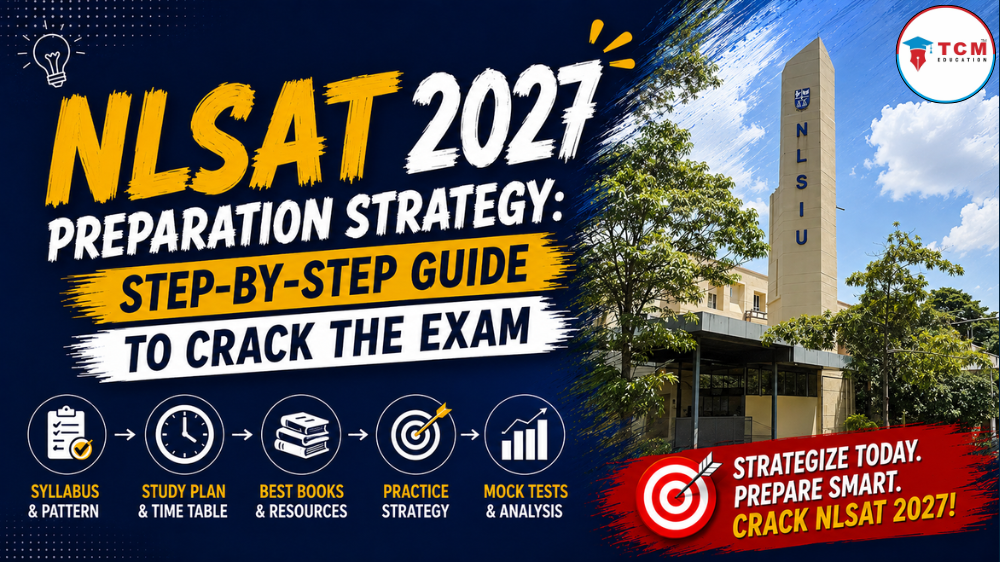
If you’ve spent the last few weeks scrolling through CLAT forums, IPMAT groups, and CUET prep pages trying to find one clear answer to “how do I prepare for NLSAT 2027,” you’ve probably noticed something frustrating most advice out there is basically recycled from other law entrance exams. And that’s the catch because NLSAT doesn’t really play by the same rules.
A solid NLSAT 2027 preparation plan has to start from a different place, all together. This exam wasn’t made to check how much legal text you’ve memorized — it’s built to test how you think, how you read, and how you write when the time is tight. Once that idea sinks in, a good chunk of the confusion around “where do I even start” starts to sort itself out.
This guide walks you through exactly that, a hands-on step-by-step method to prepare without the usual noise.
Why NLSAT 2027 Needs a Different Kind of Preparation
Here’s something worth sitting with for a second: NLSAT is the entrance test for NLSIU Bengaluru’s 3-Year LL.B. (Hons) programme, and it’s meant for students who’ve already finished a bachelor’s degree — could be engineering commerce humanities science, basically anything. Not law graduates. Not the CLAT ones who keep topping. Just regular graduates who want to pivot into law.
That one detail pretty much changes everything about how you should prepare , honestly.
Most other law entrance exams kind of assume you already have some familiarity with legal terms, constitutional provisions, or those famous landmark judgments. NLSAT doesn’t. It just assumes you can read carefully, reason clearly, and write in a coherent way—skills you may have picked up during your undergraduate years without even noticing.
So if you’re entering this from a CLAT or CUET background, don’t fall into the habit of just recycling your old notes. NLSAT seems to prefer a slightly different approach, it rewards comprehension , reasoning, and expression more than any memorized legal knowledge.
Get the NLSAT 2027 Exam Pattern Absolutely Clear First
You can’t really build a strategy for a test you don’t fully understand, not even a little. Before you open a single book, sit down and get the exam pattern into your mind so thoroughly that you could explain it to someone else, like on the spot.
So, the overall “thing” aspirants should kinda work around is, yes.
- Total duration: 150 minutes , and it’s offline using pen and paper, not on a system.
- Part A (Objective): is 75 marks. Usually it’s MCQs, mixed across English comprehension, current affairs, general knowledge and some critical or logical reasoning or whatever you wanna call it.
- Part B (Subjective): is also 75 marks, but here you’ll get short legal reasoning questions, plus one analytical essay.
- The Marking Scheme: Part A has negative marking for wrong answers, and also for unattempted ones. Part B typically does not punish you like that, generally speaking.
- The Screening Filter: only candidates who cross a certain benchmark in Part A , get their Part B answers evaluated at all.
That last bit actually changes everything. Like seriously. If your Part A score isn’t strong enough, then it doesn’t matter how brilliant your essay was , because it won’t even be opened for checking. That’s why accuracy in Part A deserves the same amount of respect in your prep as your writing ability does for Part B.
A lot of students prepare for both parts with the same lazy confidence . That’s a mistake. Treat Part A as the gate you have to walk through, and Part B as the room where you need to impress people, once you are inside.
How to Prepare for NLSAT 2027: a Step by Step Study plan (for real)
Ok, let’s talk about the plan now. Imagine it like a chain of things you do in order, not a random checklist where you can skip steps then somehow “catch up” later.
Step 1: Start with an honest self assessment
Before you build anything, you need to know where you’re standing. Take a sample paper, or a simple diagnostic test, and do it in timed conditions — no checking answers mid way, no “I’ll just look quickly” moments.
Afterwards, ask yourself (even if it feels uncomfortable):
- Did I lose time, or did I lose ideas?
- Where did I drop the most marks - comprehension, reasoning, or writing?
- Did negative marking quietly eat into the score I felt was safe?
This one exercise basically tells you your baseline more clearly than a whole month of vague reading, without direction.
Step 2: Build a NLSAT 2027 study plan you can actually follow
Big plans sound impressive, but they usually crumble in about ten days. What works tends to be dull in a good way—specific, consistent, realistic.
If your exam is expected around April 2027, work backwards from that date. A usable rhythm could look like this:
- Foundation phase (first few months): Develop reading habits, get used to different reasoning question formats, and set up a current affairs routine that you actually maintain
- Strengthening phase (middle months): Raise the difficulty level, do timed sectional practice, start writing essays regularly
- Full length practice phase (final couple of months): Move closer to full mock tests most days, then spend real time on error analysis, plus revision
And inside each week, try splitting your effort across all three Part A sections, while also doing at least one Part B writing task. Preparing only MCQs, then postponing writing practice until “later”, is a regret a lot of aspirants bring up after results come out.
Step 3: Sharpen Your English and Reading Comprehension
This part really rewards depth, not those speed-reading hacks that everyone keeps talking about. NLSAT passages often check if you can actually follow the argument, catch the author’s tone, and tell what is implied, versus what is plainly stated.
Some habits that do help, a lot:
- Read long-form opinion pieces and editorials daily , not only exam-style stuff
- After each article, try summarizing the core claim in just two sentences
- Practice spotting assumptions and inferences, not merely replaying facts from memory
Don’t just consume - interrogate what you read. Ask yourself why the author made that point, and whether you even agree with it
Step 4: Make Current Affairs a Daily Habit, Not a Sprint
Cramming current affairs one month before the exam rarely pays off, because the sheer range of possible questions makes last-minute memorisation pretty shaky. So treat it like a slow-burn practice instead.
- Stick to one dependable daily news source, instead of juggling ten scattered ones
- Keep brief weekly notes, rather than building huge monthly compilations that you’ll never read
- Pay extra attention to legal, constitutional, and policy-related changes , because they tend to overlap with reasoning questions and essay themes as well
The point isn’t to know everything. It’s to build enough context, so when an unfamiliar topic shows up in the exam you don’t feel instantly thrown off.
Step 5: Train Your Brain for critical and logical reasoning
This part is often what splits the preparation from the rest, not because it’s complicated on paper, but because it cannot really be memorised , it has to be worked on.
- So, go through puzzles, syllogisms, and critical reasoning sets, regularly not in those big occasional bursts.
- Also time yourself section-wise so the pace becomes natural, instead of this “forced sprint” feeling.
- When you miss a question, don’t only mark the right answer - take a minute to see where your logic slipped. like what exact flaw showed up in your chain of thought.
Reasoning usually gets better via pattern recognition. The more varied question formats you feed your mind with, the more composed you will feel when something unfamiliar appears on exam day.
Step 6: Don’t Ignore Part B - keep practicing legal reasoning and essay writing
Here’s the slightly uncomfortable reality: many aspirants focus super hard on Part A, and then treat Part B like a leftover task. Since both sections carry equal weightage, that mismatch becomes expensive, quietly.
For legal reasoning questions:
- Practice applying a principle to a fresh factual situation, because that’s typically the real skill they test, not just “legal knowledge” as a concept.
- Keep your responses organized: first name the principle, then apply it, and finally state your conclusion in a clean, clear way.
For the analytical essay:
- Practice writing within a strict time limit every single week
- Focus on structure — a clear opening stance, well-organised arguments, and a conclusion that ties back to your original point
- Get your essays reviewed by someone who can give you honest, specific feedback, not just a "looks good"
Writing is a skill that improves through repetition and feedback, not through reading about how to write.
Step 7: Make NLSAT 2027 Mock Tests Non-Negotiable
If there's one component of your NLSAT 2027 preparation that deserves more respect than it usually gets, it's mock tests.
Mocks do three things that self-study alone can't:
- They simulate real exam pressure and the mental fatigue of a 150-minute paper
- They expose blind spots you didn't know existed
- They train you to make quick, calculated decisions about which questions to attempt given the negative marking
But here's the part most students skip: reviewing the mock matters more than taking it. After every test, spend real time understanding:
- Which questions you got wrong due to concept gaps versus careless errors
- Where negative marking hurt you because of over-guessing
- Whether your Part B answers were rushed or well-structured
Taking twenty mocks without reviewing any of them properly is far less useful than taking eight and analysing each one thoroughly.
NLSAT 2027 Exam Strategy for the Actual Exam Day
Preparation gets you ready. Strategy is what you actually do once the clock starts, sorta like, you know, real life pressure kicks in. A couple of things that you should decide in advance, not in the exam hall itself:
- Decide your attempt order beforehand. A lot of aspirants do better by starting with the section they feel more confident about, so you get some early momentum, before you even touch the tougher questions.
- Set rough time checkpoints. Since the total is 150 minutes, don’t allow one section to silently eat up the time you planned for another one. Keep an eye on it, not by overthinking but by checking.
- Be clear about when you guess. Because Part A has negative marking, attempt only when you can rule out at least a couple of options with confidence. Random guessing across many questions is more harmful than leaving some questions unattempted.
- Don’t rush into Part B. Only shortlisted Part A scorers get evaluated, so it’s tempting to under-prepare mentally for Part B on exam day. But don’t do that. Walk in with the same focus for both parts, even if your brain wants to slow down.
- Leave a few minutes to review your essay. A quick pass, just to fix unclear sentences, or adjust a thin conclusion can make a noticeable difference in how your answer is perceived.
None of this replaces preparation , but the right exam-day approach often decides how much of your preparation actually shows up on paper.
Common Mistakes Aspirants Make (And how to avoid them)
A lot of students unintentionally sabotage solid preparation with a couple of avoidable habits. You know, the kind that feel small at first but then somehow keep piling up.
- Carrying over CLAT-style prep without adapting it. NLSAT isn't testing legal memorisation, so heavy reliance on legal GK from other exams often wastes valuable prep time.
- Treating current affairs as a one-time revision task instead of a daily habit, which usually backfires closer to the exam.
- Ignoring essay writing until last month. Writing skills take time to develop and rarely improve overnight.
- Over-attempting in Part A out of exam-day anxiety, without accounting for the negative marking penalty.
- Skipping mock analysis. Taking a test and moving on without reviewing it is one of the most common - and most fixable - mistakes aspirants make.
If even one of these sounds familiar, that isn’t a red flag. It’s just a clue about where to redirect your energy next.
Quick NLSAT 2027 Preparation Tips to Remember
A couple grounding reminders to stay close with you as you move through your prep, okay
- Prioritise understanding over memorising — this exam pretty consistently rewards clear thinking
- Read something analytical every day, even when you are not “in prep mode”
- Practice writing regularly too, not just reading about how to write well ,because it’s different
- Take mock tests seriously, and take the analysis even more seriously
- Track your negative marking losses specifically, they usually show the exact accuracy weak spots you need to fix
Why the right guidance makes the difference
Preparing alone isn’t impossible, but it can feel like you’re carrying every call on your own shoulders — what to study, how much to do, when to pivot, and whether your essay responses are actually strong enough
That’s where structured mentorship sort of changes the equation
At TCM Education the method is built around the exact gaps aspirants often stumble on when they are trying to do everything themselves. Regular full length mock tests made around the real NLSAT rhythm, straight feedback on your essay and legal reasoning answers, and mentors who have guided students through this particular exam before
It’s less about pushing more content at you, and more about helping you point your study time in the right direction, even when you feel stuck
Frequently Asked Questions about NLSAT 2027 preparation
1. What is the best NLSAT 2027 preparation strategy for someone starting from scratch?
First, take a good look at the exam pattern, like really absorb it, then slowly build a plan around three pillars - reading and comprehension, current affairs, and reasoning - while still giving equal focus to essay practice and legal reasoning for Part B. Honestly a staged approach works better, from basics to complete mock tests, rather than jumping into advanced material too early, even if it looks tempting.
2. How many months are enough to prepare for NLSAT 2027?
There’s no single right answer because it mostly depends on your current reading habits and how strong your reasoning skills already are. Still, most aspirants feel that six to eight months of steady, well-structured effort beats a rushed two-month sprint, especially since writing skills, plus current affairs awareness, takes time to settle properly.
3. Do I need a law background to start NLSAT 2027 preparation?
No. NLSAT is meant for graduates from any academic background - engineering, commerce, humanities, or science. The exam checks your reading, reasoning, and writing capability, not prior legal knowledge, so a non-law degree shouldn’t put you at a disadvantage at all, really.
4. How many NLSAT 2027 mock tests should I actually take?
Quality matters more than raw numbers. Take a small set of full-length mocks and analyse them deeply - basically figure out exactly why each question went wrong, and what to correct next - this helps far more than taking many tests without review, kind of end up doing them for nothing. Near the exam date, try to make mocks a weekly routine, not a rare activity.
5. Does negative marking apply to both Part A and Part B?
So, looking at how these exams are usually arranged, negative marking tends to apply to Part A mostly the objective bit, that’s why accuracy really matters more than just, attempting everything. Part B is more subjective, so it generally doesn’t get the same kind of penalty, even though it still has to be assessed to support that shortlisted 1:5 ratio, based on how well you did in Part A.
6. How can TCM Education help with my NLSAT 2027 preparation?
TCM Education gives you a more or less step by step route that matches what NLSAT actually checks — like full length mock exams, shaped to fit the real exam flow, along with detailed performance review, and then personalised guidance on essay as well as legal reasoning answers from mentors who know this exam context well. Overall, it is aimed to plug those exact gaps that most self preparing candidates find difficult to spot, let alone correct.
7. Does TCM Education provide essay and legal reasoning evaluation for NLSAT 2027?
Yes. Because Part B carries almost the same weightage as Part A, TCM Education puts a serious focus on writing feedback. They help students arrange arguments better, make essays sharper and more concise, and handle legal reasoning prompts with better clarity, and more confidence, not just guesswork.
8. Is coaching necessary to crack NLSAT 2027, or can I prepare on my own?
You can prepare on your own, completely yes, especially if you stay disciplined with mock tests and continuous writing practice. Still, a structured support system from TCM Education can cut down your time, since it highlights weak points early, gives you candid essay evaluation, and keeps your NLSAT 2027 plan on a steady pace, instead of turning it into a last minute scramble.
Final thoughts
Cracking NLSAT 2027 isn’t really about outworking everyone else , it’s more about getting what the exam is genuinely asking you and preparing with that same clarity from day one. Good reading habits and steady reasoning practice , plus actual writing skills , all paired with disciplined mock test analysis will probably take you further than last-minute pressure ever could.
Try to start early, keep it consistent, and don’t let this exam catch you off guard the way that generic prep advice sometimes does. Also, if you want some organized support along the way, TCM Education is a solid place to start and figure out your next step.