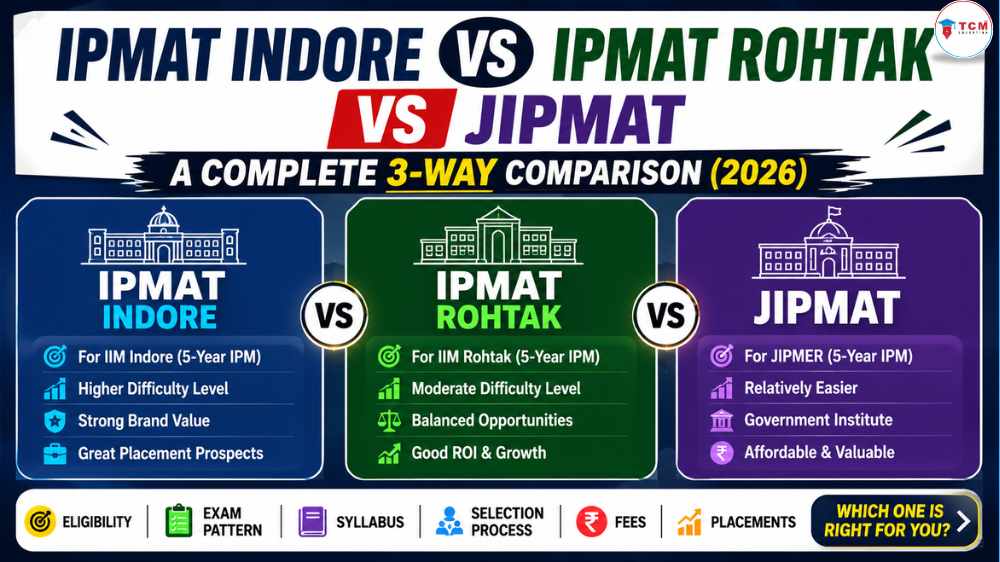
Three exams, three very different games. Here is everything you need to know before you decide which one to sit for in 2026.
If you are a Class 12 student planning to pursue an integrated MBA, you have probably already heard the names IPMAT Indore, IPMAT Rohtak, and JIPMAT thrown around in the same breath. And it makes sense to consider all three, since they are all gateway exams to 5-year integrated management programmes at premier institutions. But treating them as interchangeable is a mistake that catches a lot of aspirants off guard.
Each of these exams has a different structure, a different level of difficulty, and, more importantly, a different destination. Before you pick your strategy, you need to understand exactly what you are signing up for.
What are these exams, and who conducts them?
Let us start with the basics before getting into the comparisons.
IPMAT Indore is conducted by IIM Indore for admission to its 5-Year Integrated Programme in Management (IPM). This is the original IPMAT and, by reputation, the most competitive of the three. IIM Indore has been running its IPM since 2011, and the brand value it carries is enormous.
IPMAT Rohtak is conducted by IIM Rohtak, also for a 5-Year IPM. It was launched later than the Indore programme but has carved out its own identity. The exam structure is notably different from Indore, and the admit score dynamics are quite distinct.
JIPMAT is a joint entrance exam conducted by NTA for two institutions: IIM Bodh Gaya and IIM Jammu. If you clear JIPMAT, you get to apply separately to both. It is generally considered the most accessible of the three in terms of difficulty, but that does not mean you can walk in underprepared.
Quick numbers at a glance
| IPMAT Indore | IPMAT Rohtak | JIPMAT | |
| Conducted by | IIM Indore | IIM Rohtak | NTA (IIM BG + IIM Jammu) |
| Approx. Seats | ~180 | ~120 | ~240 (combined) |
| Duration | 90 minutes | 120 minutes | 150 minutes |
| Sections | 3 (QA-SA, QA-MCQ, VA) | 4 (QA, LR, AS, VA) | 2 (QADI, VARC) |
| Difficulty | Highest | High | Moderate |
| Question Type | MCQ + Short Answer | MCQ only | MCQ only |
| Negative Marking | Yes (MCQ only) | Yes | Yes |
Seat counts are approximate and can vary slightly year to year. Always verify directly on the official IIM website before making decisions.
Exam structure: where the real differences begin
IPMAT Indore
Indore has three sections: Quantitative Ability (Short Answers), Quantitative Ability (MCQs), and Verbal Ability. The short-answer QA section is what gives it a reputation for being unforgiving. There is no negative marking for wrong MCQ answers, but blank short-answer questions cost you nothing while a wrong one does. Time per section is fixed, which means if you are slow in one area, you cannot borrow time from another.
The Verbal section at Indore is considered moderately difficult. It tests reading comprehension, grammar, and vocabulary at a level that rewards students who actually read, not just those who have drilled grammar rules. If you have a strong English background, this section is where you make up ground on quant.
IPMAT Rohtak
Rohtak's structure has four sections: Quantitative Aptitude, Logical Reasoning, Analytical Skills, and Verbal Ability. The addition of Logical Reasoning and Analytical Skills as separate sections changes the preparation profile significantly. Students who rely purely on math and English need to actively build their reasoning and DI muscles for Rohtak.
The overall difficulty is comparable to Indore, though many students find the Rohtak paper slightly more forgiving on the quant side. That said, the broader syllabus means you need to spread your preparation wider, which can be a challenge if you are balancing this with board exams.
JIPMAT
JIPMAT is conducted by NTA and has two sections: Quantitative Aptitude and Data Interpretation, and Verbal Ability and Reading Comprehension. It is MCQ-based throughout, with negative marking. The difficulty level is lower compared to both IPMAT variants, but the NTA-style paper rewards speed and accuracy rather than depth. If you have prepared for JEE or CUET at any point, the test-taking feel will be familiar.
The institutions: what are you actually studying for?
This is the part of the conversation that often gets skipped, but it matters more than most aspirants realise.
IIM Indore's IPM is the most established integrated management programme in the country. The alumni network is strong, the campus placements are solid, and the brand carries weight in corporate India. Graduates from the Indore IPM have gone into consulting, investment banking, and product management at firms that do not typically recruit from tier-2 campuses.
IIM Rohtak's IPM is younger, but IIM Rohtak as an institution has grown steadily. The placements are decent, and the infrastructure is improving. If you get into Rohtak's IPM, it is a legitimate pathway to good opportunities, even if the brand is not yet at Indore's level.
IIM Bodh Gaya and IIM Jammu are both newer IIMs. The honest answer is that they are still building their placement records and alumni networks. If JIPMAT is your only option, it is still a worthwhile degree, but you should go in with realistic expectations and a plan to maximise your time there rather than assuming the IIM tag alone will do the heavy lifting.
Eligibility: do not overlook this
All three exams require you to have passed or be appearing in Class 12. But there are aggregate percentage requirements that differ, and they matter if you are on the borderline.
IPMAT Indore typically requires 60% in Class 10 and Class 12 for general category candidates (55% for SC/ST). IPMAT Rohtak and JIPMAT have similar benchmarks. Age limits also apply, usually capping at 20 years for the general category. Check the official notification for the year you are applying, since these numbers can change slightly.
Should you appear for all three?
Generally, yes. There is no good reason not to. The exams are held on different dates, the registration fees are reasonable, and the syllabus overlap is high enough that preparation for one naturally benefits the others. Many successful candidates take all three and use the JIPMAT attempt as a confidence-building exercise before the IPMAT papers.
If you are serious about an integrated MBA, treat JIPMAT as your floor, IPMAT Rohtak as your middle target, and IPMAT Indore as your reach. Prepare for Indore, and the other two will largely follow.
The verdict: who should target which exam?
| Strong quant + strong English | Prioritise IPMAT Indore. Your profile is built for it, and the payoff is the highest. |
| Average quant, strong reasoning | IPMAT Rohtak suits you well. The sectional diversity rewards a balanced profile. |
| Limited prep time or late start | Focus on JIPMAT first. Secure a seat, then evaluate next steps. |
A final word
The mistake most students make is spending the first three months of preparation wondering which exam to focus on, rather than actually preparing. The core syllabus across all three is the same: Quantitative Aptitude, Verbal Ability, and Logical Reasoning. Start there. Once you have two solid mock tests under your belt, you will know instinctively which paper suits your natural strengths.
Do not let the brand conversation paralyse you either. An IIM Indore IPM is a great outcome, but a genuinely well-prepared student at IIM Bodh Gaya who networks hard and builds skills will outperform a complacent student at a supposedly better institution every single time. The exam gets you in. What you do next is what actually matters.
Good luck. Prepare well. All three papers are winnable.
Learn More