You want an IIM on your résumé before you are 21. Then you open the page for IPMAT. After about ten minutes, you feel stuck.
IIM Indore asks you to write your own answers in one part. IIM Rohtak gives you a whole set of logical reasoning questions. One exam type also forces a fresh countdown every forty minutes. The other lets you use the full two hours in the way you choose.
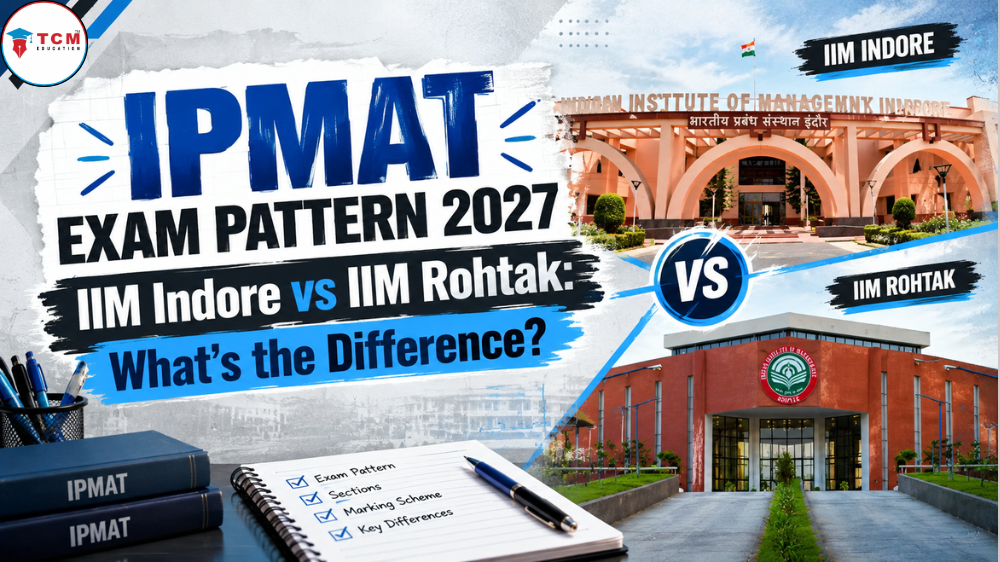
So what should you aim for? And does the IPMAT Exam Pattern 2027 actually shift how you study? Yes, it does. More than many students think.
In this write-up, we lay out the IPMAT Indore vs Rohtak setup in simple terms. We cover the sections, the marks, the negative marking rules, the time limits, and what each test style expects from you on the day. If you are also handling CUET, CLAT, or CAT plans, this should help you decide where to put your effort.
Let’s clear the confusion.
Why It Helps to Know the Exam Layout Before You Start Studying
You might want to dive right in. Formulas first. Word lists next. It feels like real work, so it is easy to do. Reading about the test format can also seem like a delay.
Still, people who have been through it notice something. Two students can have the same level of skill. Yet one gets a higher score. The difference is often how well they read the paper. They spot easy parts fast. They know when to leave a question. They pick good guesses. They also manage time so they do not run out too soon. The other student treats each question like it has the same value. They end up finishing late and still have a chunk of the paper left.
Knowing the layout is a plan. It helps you decide how many hours to spend on verbal versus quant. It also tells you whether you should practise answers in a typing format. It guides how you set up your practice tests. When you get this early, the time you study after that pays off more.
Before we start: what people call the “2027 pattern”
Both IIM Indore and IIM Rohtak share their IPMAT updates not too long before the application window. The exam is usually expected around May 2027. For now, the best working version of the IPMAT 2027 format is the one used in the latest cycle. This blog is built on that.
Will anything stay the same? Not really. The two IIMs have adjusted the exam formats in past years. So use this as a rough plan, not a final promise. Keep the official IIM Indore and IIM Rohtak admission pages in your bookmarks. Recheck them when the notifications are released. It can help you avoid last minute shocks.
IPMAT Exam Pattern 2027 at a Glance: Indore vs Rohtak
Here's the quick comparison before we go deeper.
| Feature | IIM Indore | IIM Rohtak |
| Mode | Computer-based test | Computer-based test |
| Sections | QA (Short Answer), QA (MCQ), Verbal Ability | Quantitative Ability, Logical Reasoning, Verbal Ability |
| Total questions | 90 | 120 |
| Total marks | 360 | 480 |
| Duration | 120 minutes | 120 minutes |
| Sectional time limit | Yes, 40 minutes per section | No |
| Question types | MCQ + Short Answer | MCQ only |
| Marking | +4 / −1 for MCQs; +4 / 0 for Short Answer | +4 / −1 for every question |
| Language | English | English |
Two hours can feel the same, yet the people in the room can be quite different. Indore leans on a tighter setup. It reads like a technical paper. You get firm time limits and a part that expects answers typed in the exact way. Rohtak feels more open. The plan gives equal weight to three parts and uses one common timing for all of them.
IIM Indore IPMAT exam pattern for 2027, in plain terms
Three sections, and each one has its own clock
In the IIM Indore IPMAT exam pattern for 2027, there are 90 questions in three sections. Each section has 40 minutes. The split goes like this:
- Quantitative Ability (Short Answer): 15 questions
- Quantitative Ability (MCQ): 30 questions
- Verbal Ability (MCQ): 45 questions
What makes this a bit hard is how the time works. Once the 40 minutes for a section ends, that section stops. Any leftover seconds do not carry forward. You also cannot return to fix what you missed in an earlier section. Finish a section early and you do not get extra time later. Each section stays separate, like its own small test.
Short answer section. Where weak prep appears
In the short answer part, you get no choices to pick from. There is no back-solving. No cutting down options. No guesswork that saves you. You work it out and enter the number.
It can feel tense. Still, there is a plus. There is no negative marking. So a wrong attempt does not take points away. That means you should try every question. What matters most is getting it right. One small mistake in calculation can ruin the final answer, even when the plan was correct.
You have 15 questions in 40 minutes. That gives you about 2.5 minutes for each one. It seems easy at first. Then a longer, multi-step problem shows up at the worst time. Learners who start doing this early often get used to checking their sums. Once that becomes a habit, it helps you on later questions too.
Verbal Ability makes up half the paper
Some students who like maths assume this test is a “quant” test. Check the marks. Verbal Ability has 45 questions that add up to 180 marks. That is half of the full 360 marks. Quant, including MCQ and short answer, covers the other half.
Your reading level can decide how you do. If reading is not steady, you may feel it fast. If reading is strong, it can carry you. Reading comprehension, grammar, and vocabulary in real sentences improve with regular practice. You cannot fix that in a hurry in just the last few weeks.
IIM Rohtak IPMAT Exam Pattern 2027: What to Kno
- Three parts, equal weight
- Only multiple-choice questions
In 2027, the IIM Rohtak IPMAT paper has 120 MCQs. You will see 40 questions each from Quantitative Ability, Logical Reasoning, and Verbal Ability. Each question is worth 4 marks. So each section comes to 160 marks, and the full paper totals 480.
There are no typed answers. The exam uses one consistent question style throughout. The options are shown for every question, so you can use elimination when you are unsure.
One timer for everything, not per section
Indore is different because Rohtak does not split the exam into sectional time limits. You get 120 minutes overall. You decide how to spend that time across the three sections.
This can feel like a plus. If Verbal questions are quick for you, you may finish them faster and save time for Quant. Still, it can also slow you down. A single hard logical reasoning set can take too long. Then you realize late that the second part is already underway. There is no warning bell.
You must manage your pace yourself Time per question With one common clock for all 120 questions, the average is about 1 minute for each question. Keep that in mind as you start.
How logic changes what you need to study
Logical Reasoning is about one third of the Rohtak paper. Puzzles, layouts, and data logic are not usually taught in school the way algebra is. So many students begin with very little here.
The good part is that this skill can be improved with practice. If you solve a few sets each day for three or four months, you can often see a clear rise in your scores. Also, Indore does not include a Logical Reasoning section. So if you are targeting both, this becomes the extra area you should focus on.
IPMAT parts and marks: scoring split
Here are the two papers shown together, so you can compare them easily.
IIM Indore
| Section | Questions | Marks per question | Maximum marks | Time |
| QA (Short Answer) | 15 | +4 | 60 | 40 min |
| QA (MCQ) | 30 | +4 | 120 | 40 min |
| Verbal Ability (MCQ) | 45 | +4 | 180 | 40 min |
| Total | 90 | 360 | 120 min |
IIM Rohtak
| Section | Questions | Marks per question | Maximum marks | Time |
| Quantitative Ability | 40 | +4 | 160 | Shared |
| Logical Reasoning | 40 | +4 | 160 | Shared |
| Verbal Ability | 40 | +4 | 160 | Shared |
| Total | 120 | 480 | 120 min |
What do these numbers suggest? In Indore, Quant and Verbal each take 50% of the total marks. In Rohtak, Quant, Verbal, and the third area sit at roughly 33% each. If a student is very good at Verbal but just average at Quant, they may have an easier path to improve at Rohtak. Indore tends to favor students who do well in both areas.
Also, do not plan to ignore any one section at either place. In shortlisting, both overall and section cutoffs are used, so your balance matters. Keep an eye on the official rules when they come out.
What each section checks
Marks show the weight of each section. Here is what you actually face.
Quantitative Ability draws from Class 10 to 12 math. You will see arithmetic like percentages, profit and loss, time and work, and ratios. There is also algebra, geometry, and mensuration, plus the number system. Some modern topics show up too, such as permutations, combinations, and probability. At Indore, the short answer questions often feel tough within the quant section. At Rohtak, quant is made of MCQs, but they can take time, so working fast helps.
Verbal Ability focuses on reading comprehension, grammar, and sentence correction. It also includes vocabulary used in context and sentence rearrangement. This section often rewards steady reading habits more than last minute study.
Logical Reasoning is only at Rohtak. It usually covers arrangements, puzzles, syllogisms, series, blood relations, and problems that rely on data. If you like patterns, this section can become a strong scoring area after enough practice.
IPMAT Negative Marking 2027: Guessing or Skipping?
Here are the rules.
- Indore MCQs (Quant and Verbal): +4 if correct, −1 if wrong.
- Indore Short Answer: +4 if correct, no cut if wrong.
- Rohtak (all sections): +4 if correct, −1 if wrong.
- Unattempted questions: 0 marks in every case.
Now the strategy part.
There are four options. A correct pick gives +4. A wrong pick gives −1.
With that setup, the break point is at 20% correct. That means if your accuracy is below that, guessing will hurt you over time.
Does this mean you should guess at random? Not really. Each guess takes time, and time is limited. Also, guessing can make your results jump around, depending on luck.
Aarav tries 30 MCQs. He marks 24 correct and 6 wrong. So his score comes out as 96 minus 6, which is 90. Meera tries 22 MCQs. She gets 20 correct and 2 wrong, so 80 minus 2 gives 78. Meera is more accurate. Still, Aarav ends up with the higher score since he attempts more questions. Accuracy helps, but the one mark cut usually is not enough reason to ignore questions you can solve.
A few simple rules to follow:
- For short answers, attempt all questions at Indore. You do not lose anything by trying.
- For MCQs, do not guess right away. First, remove at least one or two choices.
- If a question looks totally new to you, skip it fast. Do not get stuck staring at it.
- In mock tests, watch your accuracy. A decent target is to stay above 80 percent on the questions you decide to attempt.
Good guessing is mostly elimination done well. That skill grows with practice, not with luck.
IPMAT Exam Duration 2027: Making Every Minute Count
Both exams run for 120 minutes, but you'll spend that time very differently.
| Section | Time | Approx. time per question |
| Indore: QA (Short Answer) | 40 min | About 2 min 40 sec |
| Indore: QA (MCQ) | 40 min | About 80 sec |
| Indore: Verbal Ability | 40 min | About 53 sec |
| Rohtak: all sections | 120 min shared | About 1 min on average |
Play the Indore clock
- Start each part as if it is brand new. Do not bring the bad feeling from one part into the next.
- In a part, grab the simple questions first. Then go back to the tougher ones.
- For Verbal, do not get stuck on one long passage for the whole 40 minutes.
- Leave the last few minutes in every part to look over what you flagged.
Play the Rohtak clock
- Plan your time split before test day. You can begin with this: 45 minutes for Quant, 35 for Reasoning, 40 for Verbal. Change these numbers after you check your mock tests.
- Set a gentle time reminder for each section. If you pass your time, wrap up the current question and shift to the next one.
- Do the easier reasoning sets first. Leave the harder puzzle style items for later.
- Keep about five minutes for the end. Last minute mistakes happen fast, especially from careless slips.
Take mocks for each pattern
If a mock does not fit the exam style, it is not doing much for you. So use the same format as your target paper.
For Indore
Practise in fixed 40 minute blocks. After a block ends, move on. Do not flip back to earlier questions. Start adding short answer questions to your quant work from the beginning, not only in the last weeks.
For Rohtak
Check your score and your pace at the 40 minute point and again at the 80 minute point in every test. Run a few mocks using different time splits. Do this over three or four tests. Pick the split that gives you the strongest result.
For both
Use the same amount of time to review a mock as you used to take it. Write down each mistake and sort it as one of these: concept gap, wrong method or calculation, or time pressure. This shows what to fix next, and it is the gap between just practising and actually getting better.
IPMAT Indore vs Rohtak: Which fits you best?
First, check where you are strong.
Pick IIM Indore if:
- You are okay with Class 11 and 12 maths.
- You can work through problems without relying on options.
- You read a lot and feel fine with English passages.
- You do well when the plan is clear.
- You can stay on track in set time slots.
- You double-check numbers before you move on.
Pick IIM Rohtak if:
- You like puzzles and reasoning.
- You can plan your own time.
- You feel calmer when answer choices are visible.
- You want a paper that feels more even.
- You do not want it to be too focused on quant alone.
Quick mentor note: do not choose just because one paper seems simpler on the page. Take one full mock for each pattern. Then compare your marks, your accuracy, and how tense you feel. Your own results matter more than any guide. Even this one.
Yes, You Can Prepare for Both: Use a Clear Plan
A lot of what you study will help in both exams. Quant and Verbal make up the main part, so many serious students try for both. If you are also aiming for CUET or CLAT, you will see more common ground in English and reasoning.
Think of your prep as three parts, not one big pile.
- First part, the base: Quant needs arithmetic, algebra, geometry, number system, and modern math. Verbal needs reading comprehension, grammar, vocabulary, and questions built around sentences.
- Second part, Indore: Do short answer practice where you do not have options. Also take full mock tests with sections that must be finished in 40 minutes each.
- Third part, Rohtak: Solve logical reasoning sets every day. Then take mocks where you work under one overall 120 minute time limit.
Start with the base. Add the extra parts later, step by step, as the months pass.
Common errors we notice in students
- Not treating the two papers as equal. One mock helps, but it does not cover everything for the other.
- Missing verbal practice for Indore. Many marks come from that section.
- Waiting until the last month for short answers. Writing answers with no options is its own skill.
- Spending too long on one reasoning set for Rohtak. One puzzle should not turn into ten minutes.
- Skipping full-length mocks. Two hours is a test of focus, and you build that with practice.
- Taking mocks but not reviewing them. If you do not analyse, you do not learn much.
A simple plan for Oct 2026 to May 2027
You have about seven months. Use them like this:
- October to December: Strengthen basics. Revisit Class 10 to 12 maths. Read each day. If you are aiming for Rohtak, start learning the core reasoning ideas.
- January to February: Shift to practice by topic. Add short answer questions and do regular reasoning sets. Take your first full mocks for both paper types.
- March to April: Do full-length mocks every week. After each one, analyse properly. Then work on weak areas with focused practice.
- Last few weeks: Keep revision light. Do one or two mocks only. Sleep well and stay steady. Do not begin new topics in the final week.
Frequently Asked Questions
Q1. What is the IPMAT exam pattern for 2027 at IIM Indore?
Ans: As per the newest pattern, there are 90 questions in 120 minutes. The paper has 15 short answer questions, 30 MCQs in QA, and 45 MCQs in Verbal Ability. You get 40 minutes for each part. The full paper is for 360 marks.
Q2. What is the IPMAT exam pattern for 2027 at IIM Rohtak?
Ans: The exam has 120 MCQs in 120 minutes. They are divided evenly among Quantitative Ability, Logical Reasoning, and Verbal Ability. The total score is 480 marks. There is no sectional time limit.
Q3. Is there negative marking in IPMAT 2027?
Ans: Yes, there is negative marking for MCQs. For both IIM Indore and IIM Rohtak, a wrong option cuts one mark. In IIM Indore, the short answer section does not have negative marking.
Q4. What is the exam duration for IPMAT 2027?
Ans: Both exams are 120 minutes long. IIM Indore uses three parts of 40 minutes each. IIM Rohtak uses one common time window for the entire paper.
Q5. Which exam is tougher, Indore or Rohtak?
Ans: It varies from person to person. IIM Indore can feel tough for some due to the short answer section and fixed timers.IIM Rohtak can feel tough for some because of the reasoning section and the fast pace of about one minute per question. Taking a mock for each can help you understand your level.
Final Thoughts: Pick a Path, Then Follow It
The IPMAT Exam Pattern 2027 has two parts. They do not feel the same. They run on different schedules and ask for different kinds of control. Indore focuses on accuracy with fixed timing. Rohtak asks you to manage your balance and your own pace in one stretch. Neither road is “better”. Both lead to the same end point. That is a five year integrated programme at an IIM.
After you know how each part works, the confusion drops fast. What remains is a simple routine. Read daily. Practice maths regularly. Work through reasoning sets. After each mock, check your results and be honest about what needs fixing.
You do not need to handle everything by yourself. At TCM Education, mentors guide students for IPMAT, CLAT, CAT, and CUET. We see how much easier it feels when you have a plan in hand and someone tracks your progress. If you want help deciding between Indore and Rohtak, or if you want a study plan that fits your strengths, reach out to our team. One chat today can cut down a lot of trial and error.
Seven months can be enough. Begin now. Keep going steadily. Let your work speak for itself.