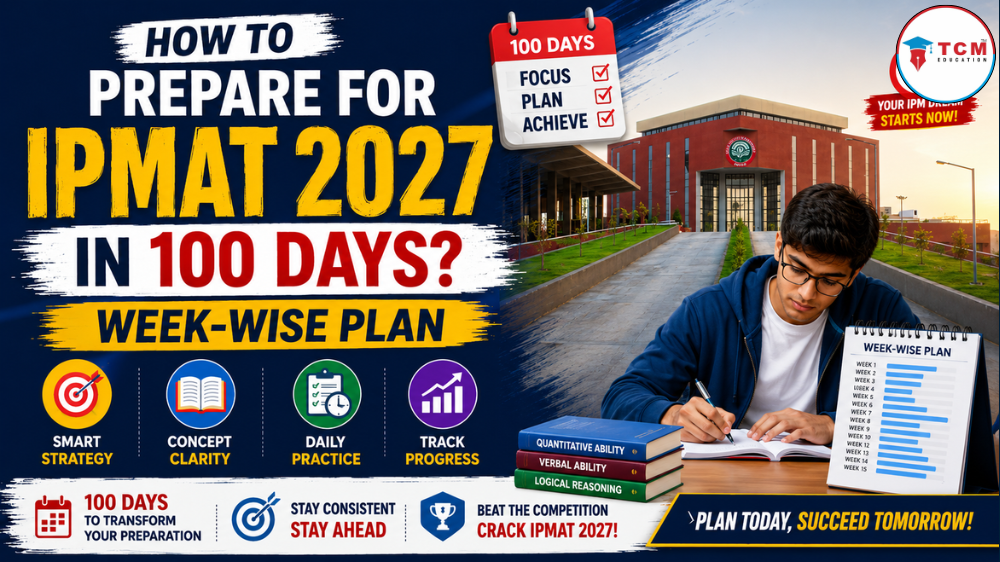
Are you balancing Class 12 board preparation while trying to crack one of India’s most competitive undergraduate management entrances tests? Like, stepping into the world of top-tier B-schools right after school is a dream that thousands of students share. But when you look at that huge syllabus, and you realize there are just over three months left, it can make even the most focused student wonder, is 100 days really enough to secure a call from IIM Indore, IIM Rohtak, or maybe Ranchi too?
The short answer is honestly yes, but only if you shift from random problem-solving to something more execution-based, an IPMAT 2027 Preparation Plan. A properly planned 100-day roadmap changes the whole vibe, from anxiety to actual action. It takes those big chunks of Quantitative Aptitude and Verbal Ability, and breaks them down into daily tasks that feel doable, like step by step, not chaos.
At TCM Education, our two decades of mentoring experience have shown again and again that performance in aptitude tests isn’t mainly about how many months you studied. It’s more about how strategically you use those last 100 days. This full guide gives you a clear 14-week execution blueprint meant to strengthen fundamentals, improve test-taking speed, and help you finally earn that IIM seat.
Decoding the IPMAT 2027 Architecture and Scoring Dynamics
Before you even touch the weekly schedule part, every aspirant has to understand how the exam is set up. A strong IPMAT 2027 Preparation Strategy depends on knowing the question distribution, the sectional time limits, and those negative marking rules that can quietly hurt you.
The Integrated Programme in Management Aptitude Test (IPMAT), conducted mainly by IIM Indore, checks your quantitative ability and your linguistic skills under strict time pressure. The paper is divided into three sections, each with a fixed 40-minute time window. Candidates are stuck in one section until the timer runs out,
| Section Name | Question Type | Question Count | Time Allotted | Correct Answer | Incorrect Answer | Sectional Weightage |
| Quantitative Ability (Short Answer - SA) | Numerical Entry (TITA) | 15 Questions | 40 Minutes | +4 Marks | 0 (No Penalty) | 60 Raw Marks |
| Quantitative Ability (Multiple Choice - MCQ) | 4-Option MCQ | 30 Questions | 40 Minutes | +4 Marks | -1 Mark | 120 Raw Marks |
| Verbal Ability (Multiple Choice - MCQ) | 4-Option MCQ | 45 Questions | 40 Minutes | +4 Marks | -1 Mark | 180 Raw Marks |
| Total / Overall Structure | Combined Format | 90 Questions | 120 Minutes | — | — | 360 Raw Marks |
Table 1: Detailed Sectional Architecture and Marking Scheme for IPMAT Indore 2027.
From a strategic angle, you can pick up two rather important insights inside this whole framework. First, Quantitative Ability (Short Answer) has zero negative marking. That means candidates still need to work out the exact values, no guesswork based on options to avoid reduction, but there is no deduction penalty, so honestly this portion becomes a pretty high return chance.
Second, Verbal Ability makes up 50% of the total raw score, 180 out of 360 marks over 45 questions. In IIM Indore’s overall composite scoring method, Verbal Ability is heavily weighted for shortlisting candidates to the Personal Interview (PI) stage. So linguistic command matters just as much as numerical skill, even if people think maths is the only game.
Also, candidates often eye secondary management entrances, like IPMAT Rohtak, which uses a slightly different exam layout and so the approach changes too.
| Parameter | IPMAT Indore Architecture | IPMAT Rohtak Architecture |
| Conducting Institute | Indian Institute of Management Indore | Indian Institute of Management Rohtak |
| Total Questions | 90 Questions | 120 Questions |
| Total Test Duration | 120 Minutes (40 mins per section) | 120 Minutes (Flexibility across paper) |
| Sections Included | QA (SA), QA (MCQ), Verbal Ability | Quantitative Ability, Logical Reasoning, Verbal Ability |
| Question Format | Short Answer (TITA) + MCQs | Exclusively Multiple Choice (MCQs) |
| Negative Marking | -1 for MCQs; No penalty for QA (SA) | -1 for all incorrect attempts |
| Maximum Marks | 360 Marks | 480 Marks |
Table 2: Comparative Analysis of IPMAT Indore versus IPMAT Rohtak Exam Specifications.
The Four Phases of Your IPMAT 100 Days Preparation Plan
So you do not just burn out, but also keep improving in a steady rhythm , your IPMAT 100 Days Preparation Plan needs a sort of phased, structured progression. TCM Education kind of breaks down the full 100-day journey into four separate execution phases, and honestly that makes it easier to follow
Phase 1: Conceptual Foundation & Core Building (Days 1 to 30 | Weeks 1 to 4)
The first month is mostly about re-building key mathematical ideas from Class 9 and 10, plus getting into consistent reading habits. If you jump straight into tougher practice, without that base, you end up with uneven accuracy , and it feels frustrating. Candidates should concentrate on arithmetic basics, algebraic operations, core grammar rules, and reading habituation, slowly but properly.
Phase 2: Advanced Application & Topic Mastery (Days 31 to 60 | Weeks 5 to 8)
After fundamentals, phase two moves toward higher-level coverage. This includes Modern Mathematics, Advanced Algebra, Geometry, Coordinate Systems, along with harder Reading Comprehension passages. Daily work starts to lean more into topic-wise tests, so you can judge problem selection , and also speed in a more realistic way.
Phase 3: Speed Enhancement & Sectional Testing (Days 61 to 80 | Weeks 9 to 11)
Phase 3 is more about exam performance than content learning. Candidates should attempt timed sectional tests to get used to the 40-minute clock. Here the focus stays on accuracy in Quantitative Ability (Short Answer) questions, and also on better elimination tactics for Verbal Ability MCQs , because that reduces silly errors.
Phase 4: Full-Length Mocks & Homerun Revision (Days 81 to 100 | Weeks 12 to 14)
The last stage is basically the “real exam feel” phase. Full-length mock tests help build mental endurance, sharpen score-maximizing strategies , and highlight the remaining weak spots that still need fixing. Intensive revision sessions, such as TCM Education’s specialized Homerun classes, consolidate key formulas, shortcuts, and verbal reasoning techniques prior to exam day.
The Ultimate IPMAT 2027 Week-Wise Plan (14-Week Blueprint)
Here is your week-by-week blueprint for structured IPMAT 2027 Exam Preparation. Designed by chief academic mentors at TCM Education, this schedule balances concept learning, practice sets, and mock assessments.
| Week Number | Execution Timeline | Quantitative Ability Mastery Focus | Verbal Ability & Reasoning Focus | Mock Assessment & Revision Goals |
| Week 1 | Days 1–7 | Number Systems, Divisibility Rules, HCF & LCM, Remainders | Nouns, Pronouns, Subject-Verb Agreement, Daily Editorial Reading | Diagnostic Baseline Test & Topic Test 1 |
| Week 2 | Days 8–14 | Percentages, Averages, Profit & Loss, Simple Interest | Tenses, Prepositions, Modifiers, Word Roots (Etymology) | QA Arithmetic & VA Grammar Sectionals |
| Week 3 | Days 15–21 | Ratio & Proportion, Mixtures & Allegations, Compound Interest | Vocabulary Expansion (Synonyms/Antonyms), Sentence Completion | Sectional Speed Drills & Review |
| Week 4 | Days 22–28 | Time, Speed & Distance, Work, Pipes & Cisterns | Para Jumbles (Non-MCQ & MCQ Formats), Reading Comprehension Basics | Phase 1 Foundation Assessment |
| Week 5 | Days 29–35 | Linear & Quadratic Equations, Polynomials, Inequalities | Contextual Word Usage, Phrasal Verbs, RC Inference Questions | Higher Algebra Sectional Test |
| Week 6 | Days 36–42 | Logarithms, Progressions (AP, GP, HP), Surds & Indices | Critical Reasoning, Assumptions, Inferences, Deductive Logic | Mid-Prep Benchmark Assessment |
| Week 7 | Days 43–49 | Geometry: Lines, Angles, Triangles, Polygons, Circles | RC Tone Analysis, Main Idea Identification, Error Spotting | QA Geometry Topic Test Series |
| Week 8 | Days 50–56 | Mensuration 2D & 3D, Coordinate Geometry, Trigonometry | Verbal Analogies, Idioms & Phrases, Foreign Words | Phase 2 Comprehensive Test |
| Week 9 | Days 57–63 | Permutations & Combinations, Probability Basics | Logical Consistency, Sentence Improvement, Para Completion | Modern Math Sectional Test |
| Week 10 | Days 64–70 | Set Theory, Matrices & Determinants, Functions & Graphs | Advanced RC Sets, Odd One Out, Speed Reading Practice | Full-Length Mock 1 & Analysis |
| Week 11 | Days 71–77 | Data Interpretation (Tables, Charts), Mixed QA Sets | Mixed Verbal Sectionals, Error Logging & Correction | Full-Length Mocks 2 & 3 |
| Week 12 | Days 78–84 | High-Level QA Short Answer (SA) Numerical Drills | Full Verbal Ability Drills under strict 40-minute timers | Full-Length Mocks 4 & 5 + AI Analytics |
| Week 13 | Days 85–91 | Topic Revisions, Formula Sheet Reviews, Weak Area Remediation | Grammar Review, High-Frequency Vocabulary Revision | Full-Length Mocks 6 & 7 + Error Analysis |
| Week 14 | Days 92–10 | Homerun Intensive Workshops, Previous Year Question (PYQ) Reviews | High-Yield Verbal Refinement, Strategy Finalization | Final Strategy Calibration Mocks |
Table 3 : Comprehensive IPMAT 2027 week wise plan for 100 day execution.
Detailed weekly execution breakdown
Weeks 1 to 2 : Arithmetic foundations and core grammar rules
The initial fortnight kinda sets your mathematical calculation speed and overall grammatical awareness, so it feels like the first layer.
- Quantitative Ability focus: Mastering prime factorization, remainder theorems, divisibility rules, percentage calculations, and fraction-to-percentage conversions. Arithmetic is basically the base for advanced word problems, so if you build speed here it really pays dividends later.
- Verbal Ability focus: Review core grammar rules with Subject Verb Agreement , Pronoun antecedent rules , and tense consistency. Also, create a daily routine of reading high-quality publications (such as The Hindu , The Indian Express, or Aeon Essays) for 30 to 45 minutes, because it improves reading velocity and vocabulary, at the same time.
Weeks 3 to 4: Equations, etymology, and reading habits
Weeks 3 and 4 introduce algebraic relationships alongside a more structured vocabulary expansion approach, not just random lists.
- Quantitative Ability focus: Practice linear equations, ratios, averages, and work-time computations. The goal is to convert complicated word problems into clean mathematical equations quickly, even if you feel the question is messy at first.
- Verbal Ability focus: Move away from pure rote vocabulary lists to etymology based learning using Latin and Greek roots, prefixes, and suffixes. For example, studying the root MAL (meaning bad or evil) helps you understand words like Malice, Malevolent, Malfeasance , and Malignant without needing individual memorization. Then start practicing structural reading techniques for Reading Comprehension passages, so your brain knows where to land.
Weeks 5 to 6: Higher Algebra, Logarithms, and Logical Reasoning
This middle phase of conceptual prep brings in stuff with high weightage in the IPMAT exam, like Quadratics, Logarithms, and logical reasoning bits. It kinda sets the base for the more intense questions later on, and yeah, it’s not just theory.
- Quantitative Ability Focus: Go through quadratic equations , discriminant behavior, modulus based inequalities, log rules, and the sequence summations too (AP, GP, HP). Try doing both MCQ and Short Answer (SA) work, so you get comfortable landing on exact numeric answers without depending too much on eliminating options, just because.
- Verbal Ability Focus: For Para Jumble , solve both 4-sentence and 5-sentence arrangements. Keep an eye on mandatory structural connections, pronoun-referent matching, and the chronological sequence. Also, start using critical reasoning , like spotting implicit assumptions and checking how strong an argument actually feels.
Weeks 7 to 8: Geometry, Mensuration, and Passage Analysis
Geometry and Mensuration have historically been a big slice of the Quantitative section in IPMAT Indore, so don’t treat them casually. This is where practice really matters, because diagrams and properties need repeat recall.
- Quantitative Ability Focus: Cover lines, angles , triangles (congruence and similarity, plus center-related properties), polygons, circles, coordinate geometry, and 3D solids. Maintaining a separate formula notebook for geometric properties and spatial calculations, and not let it become a random pile, organized slightly is better than nothing.
- Verbal Ability Focus: Read passages that deal with heavy topics, like philosophy, economics, and abstract humanities. Then answer inference- based questions and author-tone style questions with decent accuracy, but under time pressure , so your speed stays stable, not just your correctness.
Weeks 9 to 10, Modern Mathematics and data interpretation
Modern Mathematics—like permutations and combinations, plus probability, and even a bit of set theory—usually becomes this key score differentiator among strong candidates, it’s not just “nice to have”. You should focus on:
- Quantitative ability: practice basic counting rules, circular arrangements, conditional probability, Venn diagrams for set theory, and yes matrix operations. Also bring in Data Interpretation sets, tables, bar charts, pie charts, and work on quick approximation methods, even when it feels a little rushed
- Verbal ability part: practice more advanced verbal topics such as foreign words and idioms, sentence completion sets, and those logical consistency problems. Also try to finish full-length Verbal Ability sectional tests but under strict 40-minute limits, no casual pauses or anything.
Weeks 11 to 14, Mock integration, error logs, and homerun revision
By the final month, the emphasis shifts toward test-taking strategy, timed simulation, and focused revision (like really targeted).
- Mock Execution: Complete two to three full-length mock tests per week under realistic exam conditions. Analyzing test results through performance analytics helps identify pacing issues and accuracy gaps across sections.
- Error Logging: Maintain an error log categorizing mistakes into conceptual gaps, calculation errors, or poor question selection. Re-solve missed questions to ensure complete understanding before test day.
- Revision Sessions: Participate in intensive revision programs, such as TCM Education's Homerun classes, to review high-yielding question types, past IPMAT papers, and shortcut techniques.
Smart Strategies for Quantitative and Verbal Mastery
Quantitative Ability execution framework, kinda the whole game is about speed with numerical exactness, plus knowing when to skip and when to push. Since there are 45 quantitative questions across two separate sections in just 80 minutes, question selection really matters. You can’t just solve everything on autopilot, not even close.
- For Quantitative Ability short answer (SA) attempt all non-penalty questions: in this part, wrong responses do NOT bring negative marking. So candidates should try every single SA item, and focus on getting the precise numerical solution, because there is no penalty for attempting.
- Now for QA (MCQ) use a two-pass approach: in that 40-minute MCQ section, start by quickly scanning and finishing the simpler arithmetic and algebra questions first. If time is still there later on, keep the harder parts like geometry or those multi step modern math questions for a second pass.
- Also apply quick estimation methods: learn mathematical shortcuts like digital roots , ratio splitting, and smart approximation techniques. These save time on calculation heavy problems so you stay on pace without losing control of accuracy.
Verbal Ability Execution Framework
In this section you’re basically tested on linguistic precision, how deep your vocabulary really is, and how efficiently you can read. There are 45 questions and you have 40 minutes,so you need a steady rhythm of less than one minute per question,otherwise it starts to slip away.
- Structural reading: While going through the passages, try to catch the core idea, the primary intent, the overall tone, and how the transitions actually work. Don’t spend too much time trying to retain tiny details, like it’s some kind of memory exercise.
- Context driven Vocabulary: Instead of only depending on dictionary meanings,train yourself to decode word meanings using surrounding clues,also look at root word structures. Sometimes that’s enough for the right interpretation.
- Strategic sequencing for Para Jumbles: When the sentences are jumbled, focus on the internal links. For example noun to pronoun references, cause-and-effect connectives,or chronological hints. This helps you rebuild the sentence set faster, and with less guessing.
Why TCM Education is Your Strategic Partner for IPMAT 2027
Getting ready for competitive exams usually means structured guidance,study materials that actually stay relevant, and mentoring that feels practical not vague. TCM Education has supported test-takers for more than twenty years, guiding students to prepare for CAT, CLAT, IPMAT and CUET, so you get that kind of experience behind the plan.
- Four-Stage Learning Framework: Students move in a steady way through four stages— Fundamental, Concept Building, Advance, and Challenger. With this kind of sequence, the basic ideas are nailed first before students jump into harder exam-style questions, it keeps everything clean and manageable.
- Dual-Mentor Model: Each subject is handled by two specialized mentors, so students don’t get stuck with just one style. They can explore multiple problem-solving approaches and still get proper, deep coverage of each topic.
- Small Class Sizes: The offline classroom batches in Prayagraj (Civil Lines) and Varanasi are kept under 25 students. That smaller number helps with more talk in class, more personal attention and quicker doubt resolution, which actually matters when you’re revising daily.
- AI-Driven Analytics: Students follow their progress with AI based mock analytics that track how time is spent, accuracy levels, and where the topic gaps really sit. It’s like you know the weak area immediately, not later.
- Mentorship from IIM Alumni: Strategy sessions one-on-one , plus interview preparation workshops for GD/WAT/PI are run directly by IIM graduates. They guide candidates through the entire admission process, step by step, with clear direction.
- Homerun Revision Classes: During the last weeks, high-intensity revision workshops are conducted to lock in core concepts, formulas, and a few time saving shortcuts. This phase turns scattered practice into something solid, fast.
So, whether you go for small-batch offline coaching in Prayagraj or Varanasi, or prefer flexible live online sessions, TCM Education brings the study resources, the right tools, and personal support so you can reach your target score.
Frequently Asked Questions (FAQs)
1. How many study hours per day are needed for the IPMAT 100-day preparation plan?
Candidates should target roughly 3 to 4 hours of focused daily study. Try to give about 1.5 to 2 hours for Quantitative Ability, 1 to 1.5 hours for Verbal Ability, then 30 to 45 minutes for editorial reading and vocabulary work. Also keep around 30 minutes for logging, plus analyzing your practice mistakes.
2. Can I crack IPMAT 2027 if I’m starting from scratch in 100 days?
Yes, 100 days can be enough time, but only if you stick to a proper weekly plan. If you concentrate on core ideas during the first month, then later shift into timed sectional tests and full-length mocks, you usually improve both accuracy and speed.
3. How is the Quantitative Ability Short Answer (SA) section different from QA MCQs?
For Short Answer, candidates actually calculate and type the numerical value directly into the test interface, rather than selecting an option. In this SA format, there is no negative marking penalty, while wrong MCQ answers typically deduct 1 mark.
4. Why does Verbal Ability matter so much for IPMAT Indore?
Verbal Ability contributes 45 out of the 90 questions, so it forms 50% of the total raw score. Since IIM Indore assigns heavy weight to Verbal Ability while computing composite aptitude test scores, you really need steady performance here to secure an interview call.
5. How do I balance Class 12 board preparation with IPMAT prep?
Try to keep a steady routine, like weekdays for Class 12 board topics and then use early mornings or late evenings for IPMAT stuff. On weekends, do longer practice blocks, sectional tests, and then some mock exams too. It helps if you don’t keep switching tasks too often.
6. When should I start taking full length IPMAT mock tests?
Start with a baseline diagnostic mock test at the beginning, just to see where you stand, like your starting skill level. After that, begin proper full length mock testing around Week 10, only once you’ve covered the fundamentals in Quantitative and Verbal sections. Otherwise it’s kind of just noise, honestly.
7. What offline coaching options does TCM Education provide?
TCM Education provides small batch offline classroom coaching, with a maximum of 25 students per batch, at their centers in Prayagraj (Civil Lines) and Varanasi. The program includes direct mentor access, structured study workbooks, weekly topic tests, plus full interview preparation support as well.
8. What are the main differences between IPMAT Indore and IPMAT Rohtak?
IPMAT Indore has 90 questions total, divided into three strictly timed sections (QA-SA, QA-MCQ, VA) and each section has its own time limit too. IPMAT Rohtak, on the other hand, includes 120 questions across Quantitative Ability, Logical Reasoning, and Verbal Ability, but it has no sectional time limits. Also, all questions are multiple choice, not mixed formats like Indore.
Turn Your 100-Day Strategy into IIM Success (IPMAT 2027)
Getting ready for IPMAT 2027 is really about staying focused , and putting in consistent effort, not just once but daily. If you follow a proper 100-day routine, where you start from basics, then shift into timed sectional practice and finally go through mock test reviews, you end up building both your problem-solving power and the test speed that actually matters on exam day.
Each practice set, every formula recap, and the way you analyze mock attempts, all of that moves you gradually nearer to your final target. And when you have expert mentorship along with a small-batch kind of support, plus dependable prep resources from TCM Education, it feels a lot easier to walk into the test with real confidence, not that last-minute stress.
So, ready to begin your journey toward an IIM? Check out TCM Education’s classroom and online IPMAT preparation programs now, and take the first step toward securing your seat at a top management institute.