If I could go back to my IPMAT preparation days, there is one thing I would definitely change: I would have taken it more seriously from the beginning.
Since most people start preparing for IPMAT alongside class 12, I was honestly a little more carefree about it. At that stage, I didn't fully realise how important consistent preparation was.
Looking back now, I know I would have approached it differently. I would have started earlier, followed my preparation more seriously and given myself more time to improve my weaker areas.
So don't make the mistake of thinking, “I’ll get serious about it later.” Starting early and taking your preparation seriously can give you a huge advantage.
You don’t need to be perfect from day one. You just need to be serious enough to start and consistent enough to keep going.
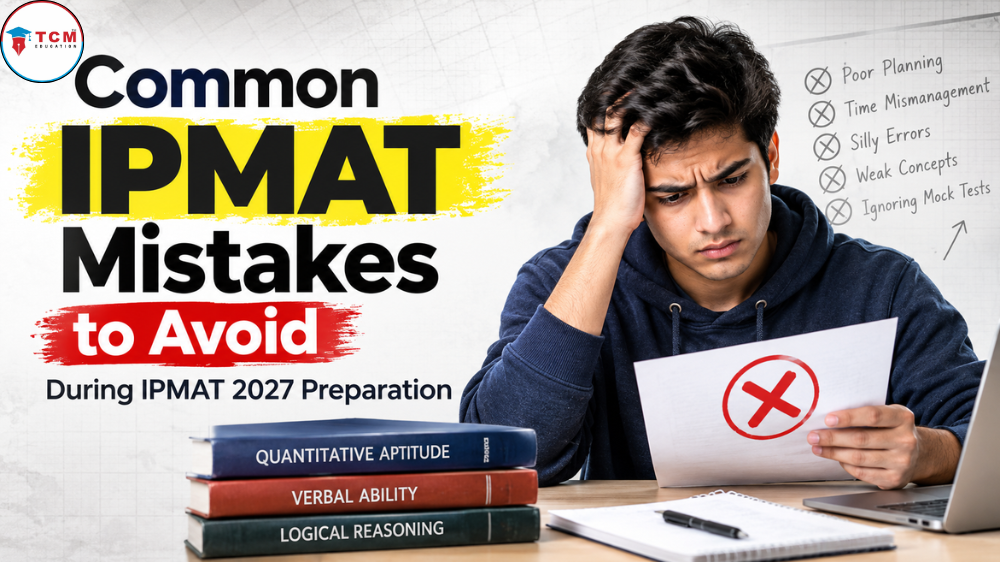
Instead of giving the usual “study hard and stay consistent” advice, here are some common IPMAT mistakes I would genuinely tell an IPMAT 2027 aspirant to avoid.
1. Starting Without Understanding the Exam:
One mistake I made initially was thinking IPMAT preparation basically meant doing Math's and English.
Before starting serious IPMAT Exam Preparation, look at previous-year papers and understand the sections, question types, difficulty level and time pressure.
I would honestly recommend spending a little time understanding the exam before making a huge timetable.
2. Studying Everything Instead of Studying What Actually Matters:
This was something I realized during my own preparation.
Your IPMAT Exam Preparation should have some priority.
First make your basics strong. Then practice different types of questions. And finally, focus on speed and accuracy.
3. Ignoring Speed:
In IPMAT, knowing how to solve a question is not enough. You also need to solve it within the given time.
I remember situations where I could solve a question correctly if I had enough time, but during a mock, I would spend too much time on it and then struggle with the questions at the end.
That is when I realized that knowing the concept and being able to use it quickly are two different things.
4. Avoiding Quant Because You Don't Feel Confident in It:
You open Quant. You see a difficult question. You think, “I’ll do this topic tomorrow.” Tomorrow comes. You suddenly have something else to study. I have done this too.
If Quants isn't your strongest area, don't try to become perfect immediately.
Start with your basics. Solve easier questions first then slowly increase the level and most importantly, give Quant regular time instead of studying it only when you are in the mood.
5. Ignoring Previous-Year Questions:
Don't keep PYQs for the last few weeks.
I would strongly recommend looking at them during your preparation itself.
They help you to understand the exam and sometimes you'll notice that a topic which looks terrifying in a book isn't actually tested in the same way in the exam. It helps you to understand the level and style of the questions. So make sure to practice it well.
6. Not Keeping Track of Your Repeated Mistakes:
Suppose you make the same calculation mistakes a number of times. You solve the question, check the answer and move on. But if you write it down somewhere, you might eventually notice the repetition of your silly mistakes.
Sometimes fixing your repeated mistakes can improve your score more than solving another random set of questions.
7. Not Practising With a Timer:
I realised that being able to solve a question and being able to solve it within the required time are two different skills.
So first focus on getting the answer right. Then work on getting it right faster.
8. Comparing Your Preparation With Someone Else’s:
During preparation time, you'll definitely find people saying that they have completed the syllabus, someone giving multiple mocks and someone scoring much higher especially if you are in a coaching.
It can make you question your whole preparation journey and can make you feel like you're behind.
I've also experienced this.
But someone else's timetable or schedule is not gonna help you, instead ask yourself this question “Am i better than where i was last month?”
That’s a much more useful comparison.
9. Taking Verbal Ability Too Casually:
Because English generally feels easier than Quants as we have this in mind because it's something we are studying from class nursery, students sometimes don't give it enough attention.
I made this mistake too, “English toh ho hi jayegi.”
But Verbal Ability needs practice. Reading comprehension, vocabulary, para jumbles, grammar-based questions and other question types require different approaches.
One thing that helped me was simply reading regularly.
The aim is to make reading feel normal instead of something you only do while studying.
10. Ignoring Silly Mistakes:
Not every wrong answer means that you don't know the concept.
Sometimes you simply read the question incorrectly.
Sometimes you calculate something wrong or mark the wrong option or sometimes you solve the entire question correctly and still manage to make a silly mistake.
Yes, it happens.
But don't just look at your wrong answer and move on.
Maintain a small mistake log.
That is actually one of the most useful things you can do during IPMAT Exam Preparation.
11. Focusing Only on Studying and Forgetting About Revision:
When you are preparing for a competitive exam for several months then studying a topic today and completely forgetting it after 2 days is natural, it happens.
Keep short notes of formulas, concepts, vocabulary and mistakes you frequently make. And revisit them.
So revision needs to be a regular part of your IPMAT Preparation Tips.
12. Waiting For the “Perfect Time” to Start Mock:
Start giving mocks.
I think this is one of the biggest lessons I personally took from competitive exam preparation.
You don't need a perfect time.
And you definitely don't need to 100% complete your syllabus.
You don't need to feel completely ready before starting something.
Start with whatever level you are currently at and improve from there.
As your preparation is supposed to make you better. You don't have to already be good at everything before you begin.
13. Giving Mocks without Analysing Them:
Giving more mocks automatically meant better preparation.
It doesn't.
After every mock, check:
- Which questions did I get wrong?
- Which ones took too much time?
- Which mistakes were conceptual?
- Which were just silly mistakes?
- Which questions could I have attempted but left?
Your mock score tells you where you stand, but the analysis tells you how to improve.
14. Collecting Study Material Instead of Studying It:
Don't confuse collecting resources with preparation.
For IPMAT preparation, pick a limited number of reliable resources and finish them properly.
You don't need to solve everything that exists on the internet.
15. Thinking That One Bad Mock Means Your Preparation Is Bad:
A bad mock can genuinely ruin your mood.
But don't judge your entire preparation based on one mock. Instead, find out why the score dropped.
Once you know the reason, you can work on it.
What I Would Do Differently for IPMAT 2027
If I had to prepare for IPMAT again, I would keep things much simpler.
I would understand the exam properly first instead of immediately collecting study material.
I would work on my basics and my weaker areas regularly instead of avoiding them.
I would start timed practice earlier.
I would analyse every mock properly instead of focusing only on the score.
Most importantly, I wouldn't waste so much energy comparing my preparation with other students.
Because your IPMAT preparation is your own journey.
You are going to have bad mocks, unproductive days and topics that take longer than expected. It's completely normal.
The important thing is to learn from those mistakes instead of repeating them for months.
Final Thoughts:
IPMAT preparation isn't about studying for the maximum number of hours.It's about studying the right things, practising consistently and actually learning from your mistakes.
And trust me, you will make mistakes. I did too.The goal isn't to have a completely perfect preparation journey.The goal is to make sure that every mistake teaches you something and makes your next attempt a little better.