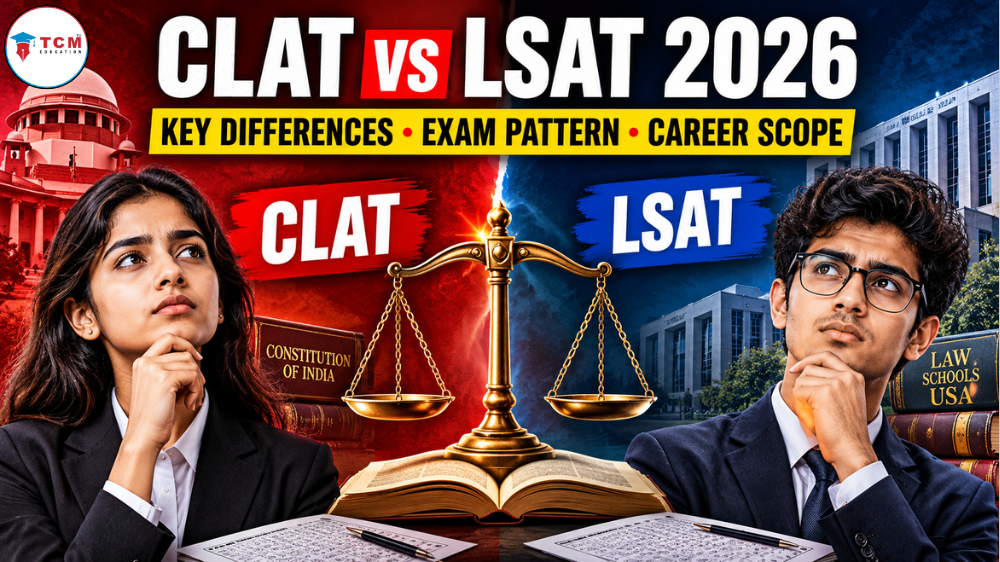
You’ve probably done this already. One tab has your latest CLAT mock analysis. Another has an LSAT prep video. And somewhere on your phone, a friend has written, “Just give LSAT, it’s easier.”
So which one should you actually prepare for? This guide to CLAT vs LSAT 2026 puts the exam pattern, syllabus, eligibility and career scope side by side, using official information from the Consortium of NLUs and LSAC.
There’s one catch that many older articles miss, and it changes your decision. The LSAT that Indian private law colleges used to accept, LSAT–India, has been discontinued. The LSAT that still exists is the global one, built mainly for law schools in the US and Canada.
So the real question isn’t “which one is easier?” It’s “where do I want to study law, and where do I want to practise it?” By the end of this post, you’ll have a clear answer and a simple next step.
CLAT vs LSAT 2026 at a Glance
This guide uses the latest official details: the CLAT paper on 6 December 2026 (officially named CLAT 2027, because it leads to the 2027–28 session) and LSAC’s 2026–27 testing year. That keeps it useful whether you search for 2026 or 2027.
| CLAT UG | LSAT (global) | LSAT–India (retired) | |
| Conducted by | Consortium of NLUs | LSAC | LSAC, with Pearson VUE |
| Leads to | 5-year integrated LLB at NLUs | JD at US and Canadian law schools | LLB at private Indian law colleges |
| Status | Active; next exam on 6 December 2026 | Active; several sittings a year | Discontinued after 2024 |
| Mode | Pen and paper | Computer-based, at a test centre for almost everyone since August 2026 | Online, from home |
| Questions | 120 | About 75–80 scored | 92 |
| Time | 2 hours | Four 35-minute sections (three longer ones from August 2027) | 2 hours 20 minutes |
| Marking | +1 correct, −0.25 wrong | No negative marking; 120–180 score scale | Not applicable now |
| Fee | ₹4,000 (₹3,500 for SC/ST/BPL) | US$253 for 2026–27 | ₹3,999 per sitting, when it ran |
| Frequency | Once a year, in December | Multiple sittings a year | Twice a year |
Read the last column as history, not as an option. Here’s why.
What Happened to LSAT–India?
If someone tells you to “just give LSAT,” they usually mean LSAT–India. For years it was a home-proctored test accepted by a long list of private law colleges, including Jindal Global Law School.
That test is gone. LSAC described the decision as a business one, and a notice on the official LSAT–India site announced it by December 2024. The last sittings took place in 2024, and LSAC offered no plan to replace it with another law entrance exam in India.
Colleges adjusted. Jindal Global Law School’s admissions site now lists LNAT-UK for its five-year and three-year LLB programmes. Many other private universities moved to CLAT scores, SLAT or tests of their own.
So when you see “LSAT” in 2026, it means one of two things:
- The global LSAT, run by LSAC for JD programmes in the US and Canada. Indian students take it when they plan to study law abroad.
- An outdated article that still lists LSAT–India dates. Close that tab.
That’s why this comparison is still worth making. It’s no longer CLAT against an Indian rival. It’s CLAT, the gateway to India’s National Law Universities, against the LSAT, the gateway to law schools overseas.
One habit will save you from most mistakes: before you pay for any exam, open the college’s own admissions page and read which tests it accepts this year. Policies change faster than blog posts do, and that includes this one.
CLAT vs LSAT Differences That Actually Matter
Skip the long tables for a minute. Four differences decide most students’ choices.
1. Where your score takes you
CLAT opens the door to the NLUs, 26 of them this cycle by most counts, for five-year integrated programmes. (NLU Delhi runs its own test, AILET.) The LSAT opens the door to a JD abroad. That means a different degree, a different cost and a different route to the bar.
2. What the paper rewards
CLAT is a reasoning test with an awareness layer: current affairs, general knowledge and basic maths sit alongside English and logic. The LSAT is pure reasoning. There’s no general knowledge, no maths and no law to memorise. You can’t cram your way through it. You can only get better at thinking under time pressure.
3. Pace
CLAT gives you 120 questions in 120 minutes, built on passages of about 450 words. That’s roughly a minute per question, reading included. An LSAT section gives you around 25 questions in 35 minutes, so about 1.4 minutes each. CLAT feels like a sprint across many passages. The LSAT feels like a long game of chess played with arguments.
4. Second chances
CLAT happens once a year. Miss your mark and you wait twelve months. The LSAT is offered several times a year, so a retake is possible, although law schools can see your score history.
CLAT vs LSAT Exam Pattern: How the Papers Work
CLAT UG exam pattern
The Consortium has kept the pattern unchanged for this cycle. Here’s what you’ll face on 6 December, from 2 PM to 4 PM:
- 120 multiple-choice questions, 1 mark each
- 0.25 marks deducted for every wrong answer, and nothing for unattempted questions
- Pen-and-paper (OMR) format, in English
- Passage-based questions in every section
| Section | Approx. questions |
| English Language | 22–26 |
| Current Affairs, including General Knowledge | 28–32 |
| Legal Reasoning | 28–32 |
| Logical Reasoning | 22–26 |
| Quantitative Techniques | 10–14 |
Counts vary a little every year, so treat these as ranges rather than promises.
LSAT exam pattern (global)
Until the June 2027 sitting, the multiple-choice LSAT has four sections of 35 minutes each:
- Two Logical Reasoning sections (about 24–26 questions each)
- One Reading Comprehension section (about 26–28 questions)
- One unscored section, of either type, which LSAC uses to test new questions. You won’t know which one it is.
Wrong answers don’t cost you marks, and your raw score converts to a 120–180 scale. A separate Argumentative Writing task is unscored, but law schools receive it. The old Logic Games section was retired in August 2024, and since August 2026 almost everyone sits the test at a Prometric test centre instead of at home.
For students in India, LSAC’s remaining 2026–27 international sittings are scheduled for 15–16 January, 9–10 April and 11–12 June 2027. Registration closes on 1 December, 25 February and 29 April respectively. Confirm everything on lsac.org before you plan around it.
LSAC has also announced a format change from the August 2027 test. Unscored questions will be mixed into the scored sections, so everyone will sit three sections in a fixed order: Reading Comprehension (52 minutes, 40 questions), then two Logical Reasoning sections (45 minutes and 32 questions each), with a 10-minute break after the first and second. LSAC says the question types and the scoring stay the same. If you plan to test before June 2027, the current format applies. After that, practise in the new one. LSAC plans to release matching LawHub materials in February 2027.
What the patterns mean for your strategy
For CLAT, accuracy beats bravado. With four options and a 0.25 penalty, a blind guess is worth only about +0.06 marks on average. Eliminate one option and the same guess is worth roughly +0.17. So guess when you can rule something out, and skip when you truly can’t.
For the LSAT, never leave a blank. There’s no penalty, so answer everything. Your real challenge is stamina: several back-to-back sections of dense reading.
In both, start with your strongest passages. Marks are marks. Ten minutes spent wrestling with one tough passage can cost you three easier ones.
CLAT vs LSAT Syllabus: Same Muscles, Different Workouts
The Consortium describes UG-CLAT as a test of the aptitude and skills needed for legal education, rather than of prior knowledge. Here’s what each section actually asks.
- English Language: passages of about 450 words from fiction and non-fiction. You’ll infer, summarise, compare viewpoints and understand words in context.
- Current Affairs, including General Knowledge: passages drawn from news and journalism. Expect questions on national and world events, arts and culture, international affairs and historical events of continuing significance.
- Legal Reasoning: passages on legal matters, public policy or moral questions. You don’t need prior legal knowledge. You find the rule in the passage and apply it to new facts.
- Logical Reasoning: short passages where you spot arguments, premises and conclusions, and judge what strengthens or weakens them.
- Quantitative Techniques: numerical information presented as text, using Class 10 maths such as ratios, proportions, basic algebra, mensuration and statistical estimation.
The LSAT syllabus is shorter. Logical Reasoning covers short arguments: finding assumptions and flaws, strengthening and weakening, drawing inferences, and reasoning by principle or parallel. Reading Comprehension uses long, dense passages from fields such as law, the humanities and the natural and social sciences, including one pair of comparative passages. That’s all of it.
Now the part that matters if you’re deciding where to invest your hours:
| Skill | CLAT | LSAT | Also useful for |
| Reading dense passages | English, plus passages in every section | Reading Comprehension | CAT VARC, IPMAT Verbal Ability, CUET English |
| Analysing arguments | Logical Reasoning | Logical Reasoning | CUET General Test |
| Applying rules to facts | Legal Reasoning | Principle questions within Logical Reasoning | Case analysis in law school |
| Current affairs and GK | Yes, about a quarter of the paper | No | CUET General Test, other law entrances |
| Basic maths | Yes, Class 10 level | No | IPMAT, CUET General Test |
By weightage, roughly two-thirds of CLAT (English, Legal Reasoning and Logical Reasoning) is reading-and-reasoning work of the kind the LSAT also tests. The habits transfer. The exact question styles don’t, and many students find LSAT Logical Reasoning more formal and precise than CLAT’s version, so give yourself time to adjust if you switch.
If you’re also eyeing CAT, IPMAT or CUET, here’s the good news: reading practice is never wasted. One daily habit of long-form reading feeds all of them.
CLAT and LSAT Eligibility Criteria: Who Can Apply?
CLAT UG (admission in 2027–28)
- Class 12 or equivalent, with at least 45% marks (40% for SC/ST/PwD candidates), as per the Consortium.
- No upper age limit, and no stream restriction. Science, Commerce and Arts students are all eligible.
- Students appearing in Class 12 can apply. Check the Consortium’s brochure for when you must submit proof of passing.
- Application fee: ₹4,000 (₹3,500 for SC/ST/BPL).
CLAT PG needs an LLB with at least 50% marks (45% for SC/ST/PwD).
The application window for the December 2026 exam closed on 7 November, after a one-week extension. If you missed it, your target is the next cycle, which has followed a steady rhythm: notification around July, applications from August, exam in December.
LSAT (global)
- The test itself isn’t tied to your board marks or stream. The real checkpoint is the law school: most JD programmes expect a completed bachelor’s degree.
- Registration costs US$253 for the 2026–27 year, charged in US dollars. Applications to law schools add further LSAC fees.
- Seats at test centres can fill up, so register early for the sitting you want.
Here’s a simple rule. Finishing Class 12 and wanting a law degree in India? CLAT. Graduate wanting law abroad? LSAT. Graduate wanting an LLM at an NLU? CLAT PG.
CLAT vs LSAT Career Scope: Where Each Path Leads
The CLAT and NLU route
NLUs are among the most sought-after law schools in India, and the competition shows it. Recent years have seen more than 80,000 candidates chasing a few thousand UG seats across the participating universities. Seat counts differ by source and change as new NLUs join, so check the official brochure.
What do graduates actually do? Common paths include:
- Litigation in trial courts, High Courts and the Supreme Court
- Corporate law firms (deals, disputes, regulatory work)
- In-house legal teams in companies, banks and start-ups
- Judiciary and public service
- Policy work, think tanks and legal tech
- Academia, usually with an LLM and a PhD
A word on the judiciary, because the rules are moving. The Supreme Court restored a three-year practice requirement for entry-level civil judge exams in May 2025, then softened it in August 2026. Fresh graduates are eligible for exams notified until March 2027, and after that the requirement drops to about one year of practice. State rules vary, so read the notification for the state you’re targeting.
The LSAT and overseas route
A strong LSAT score, along with your grades, opens US and Canadian JD programmes. From there, paths include US firms (after clearing the relevant state bar), international arbitration, global compliance work and academia. It’s an expensive and competitive route. The test fee is only the beginning, because application services and tuition abroad make up the bulk of the cost.
One point students often overlook: a JD and an Indian LLB are different degrees with different licensing paths. Decide where you want to practise before you choose a degree.
And the private law college route?
Many good private colleges stopped relying on a single national test once LSAT–India went away. So build a small basket of exams instead:
- CLAT for the NLUs
- AILET for NLU Delhi
- SLAT for Symbiosis Law Schools
- LNAT-UK for Jindal Global Law School’s LLB programmes
Most of these share the same reading-and-reasoning core, so one solid preparation can open several doors.
So which path has better scope?
Honestly, neither wins in the abstract. Your scope depends on your marks, your internships, your writing, and the kind of lawyer you want to become. The degree gets you through the door. The work you do over the next five years decides what happens inside.
CLAT or LSAT: Which Is Better?
If you’re finishing Class 12 in India, CLAT is the better choice for most students. Not because it’s easier, but because it leads to the degree most of you are actually planning to earn.
Choose CLAT if:
- You’re in Class 11 or 12, or a recent school-leaver, and want a five-year law degree in India
- You want to practise in India: courts, law firms, the judiciary or policy
- You’re comfortable with a mixed paper that includes current affairs and some maths
Choose the global LSAT if:
- You already hold, or are about to finish, a bachelor’s degree
- You want a JD in the US or Canada and have thought through the cost
- You prefer a purely reasoning-based test and can sit it at an LSAC test centre
And about the claim that “LSAT is easier”: treat it as a trap. The LSAT has no general knowledge and no maths, but its arguments and passages are tightly built, and many students find the last few questions of a section brutal. CLAT brings volume, speed and negative marking. Neither is easy. “Easier” really means “more suited to how you think.”
Try this 30-second check. Where do you want to practise in five years? Can your family fund an overseas degree? Do you enjoy reading long passages every day? If your answers are India, no and yes, you already know your exam.
How to Prepare: A Practical Plan
If you’re writing CLAT on 6 December
You have about 17 days. This is not the time for new books. Use the time like this:
- Practise at exam hour. Take a full mock between 2 PM and 4 PM every other day, so your brain learns to perform at that time.
- Analyse more than you attempt. For every wrong answer, note the reason: a knowledge gap, a misread passage or a rushed guess. Patterns show up fast.
- Revise current affairs from your own notes, covering roughly the last 6 to 12 months. Don’t start fresh sources now.
- Lock your section order and timing, using your last two mocks as the template for exam day.
- Sort the small things two days ahead: admit card, ID, pens, the route to your centre. Then sleep properly.
If you’re aiming for the next CLAT, or the global LSAT
Think of it in three phases.
- Months 1 to 3, build the base. Read 40 minutes of editorials or long-form writing every day. Add a few short Logical Reasoning sets daily. For CLAT, brush up Class 10 maths.
- Months 4 to 8, practise by section. Rotate sections week by week and track accuracy and time per passage. For the LSAT, use LSAC’s own LawHub PrepTests, which are the closest thing to the real paper.
- The final 3 to 4 months, mocks and analysis. Take one or two full mocks a week, and follow each with a proper error log.
If you plan to take the LSAT in August 2027 or later, switch to the new three-section practice material once LSAC releases it.
This is also the stage where a mentor makes the biggest difference. Someone who reads your mock analysis and says, “You’re losing marks in Legal Reasoning because you rush the last paragraph,” can save you weeks of guesswork. That kind of honest, specific feedback is what we focus on at TCM Education.
Frequently Asked Questions
Is LSAT–India conducted in 2026?
No. LSAC discontinued it, so there is no LSAT–India exam, application form or result for 2026.
Can I get into an NLU with an LSAT score?
No. NLUs admit through CLAT, and NLU Delhi uses AILET.
Is CLAT harder than the LSAT?
They’re hard in different ways. CLAT tests speed across a wider syllabus, with negative marking. The LSAT tests deeper reasoning across a narrower one.
Can I take both?
Yes, nothing stops you. But they serve different goals, so take both only if you’re genuinely weighing an overseas JD against an Indian degree.
Will CLAT preparation help me for CAT, IPMAT or CUET?
Reading, reasoning and basic maths overlap with all three, so a good part of your work carries over. Each exam has its own pattern, so practise its papers before test day.
Final Thoughts: Choose Clearly, Then Start
Let’s go back to the question you started with.
CLAT vs LSAT 2026 isn’t a contest with one winner. CLAT is the route into India’s NLUs, and for most school students it’s the right one. The LSAT is a route abroad, and it makes sense only once you’ve decided on a JD. LSAT–India, the “easier” option your friend mentioned, no longer exists.
So here’s what to do this week. Write down where you want to practise. Open the admissions pages of two or three colleges you like and note which exams they accept. Then pick your exam and put a mock test on tomorrow’s calendar.
Choosing well is half the work. The other half is steady, guided practice. If you’re preparing for CLAT, CAT, IPMAT or CUET and want a mentor who will read your mock analysis honestly and help you plan the next 90 days, TCM Education is here to help. Reach out to our team, tell us where you stand today, and let’s map the way forward together.
You don’t need to be the fastest student in the room. You need a clear plan and the habit of showing up. Start today.
Official sources used: the Consortium of NLUs (consortiumofnlus.ac.in) for the CLAT 2027 notification, syllabus and eligibility; LSAC (lsac.org) for LSAT dates, fees, format and the August 2027 change; and Jindal Global Law School’s admissions site. Details were checked on 19 November 2026. Always re-check dates and fees before you register.