Imagine this. You start a mock test and land in the Legal Reasoning part. The first passage talks about a court decision on a topic you have never touched. The rule does not sound like your notes. The facts feel messy. Then you see four options, and each one looks like it could fit.
If you feel this, you are not alone. Most test takers face this problem. It often comes from a simple issue with CLAT Legal Reasoning 2027: where do you start?
This write-up helps you plan. We will cover the section one part at a time. You will learn what to study first, and what you can leave for later. You will also learn the main habit that lifts marks the most. CLAT 2027 is on 6 December 2026. You do have less time, but you can still do well if you follow the right order.
CLAT Legal Reasoning 2027: What the Section Checks
Before you pick topics, note the test format. Here is what it looks like now:
- The UG paper has 120 multiple-choice questions. You must finish them in two hours. The exam is offline, with pen and paper.
- Legal Reasoning has about 28 to 32 questions. That is close to one quarter of the paper.
- One correct answer gives one mark. One wrong answer cuts 0.25 marks. If you leave a question, there is no negative mark.
- The authority has said the syllabus and the pattern will not change.
So, Legal Reasoning is one of the two most scoring sections, near Current Affairs. A solid score here can support your overall result.
Now for the part a lot of students skip. This section does not ask you to know law. It tests if you can read well, reason clearly, and use what you read in a realistic scenario. You do not need prior legal training. Still, some basic ideas can make reading feel easier. If you recognize a concept, the passage is simpler to follow. But the needed answer is still found in the passage itself.
You will see three common types of passages.
- First, principle plus facts. The passage gives a rule. then it adds a fresh case. your job is to use the rule on the new facts.
- Second, Judgment or legal discussion. These passages summarize what a court considered, or they describe a legal debate. You need to pick out the main point, make careful conclusions, and judge what makes an argument better or worse.
- Third, Policy and moral questions. These focus on public policy or ethical issues. Here, you must focus more on the logic behind the view than on any single technical term.
Keep these categories in mind. They show why your reading method matters as much as your preparation.
CLAT Legal Reasoning Syllabus 2027: Official Wording vs. the Real Exam
The official syllabus is brief. It says the test will use passages tied to legal topics, public policy, and moral or philosophical questions. Then you get questions that ask you to spot principles and use them in fact based situations.
It also avoids naming specific Acts. That missing detail is one reason many students feel unsure. In the real exam, passages usually come back to similar themes and areas:
| Area | What it covers | How it shows up | Priority |
| Constitutional law | Fundamental rights, judiciary, federalism | Rights-based scenarios, court reasoning | Start here |
| Law of torts | Negligence, liability, defamation, nuisance | Rule-and-facts questions | Start here |
| Criminal law | Intention, offences, general exceptions | Rule-and-facts questions | Start here |
| Contract law | Offer, acceptance, consent, breach | Rule-and-facts questions | Start here |
| Recent legal developments | Landmark and recent judgments | Passages built on legal news | Second round |
| Consumer, privacy, tech, environment | Modern statutes and principles | Policy-style passages | Second round |
| Family, property, IP basics | Core ideas only | Occasional questions | Second round |
| Maxims and legal terms | Common Latin phrases | Support knowledge | Last |
The rest of this post explains that order.
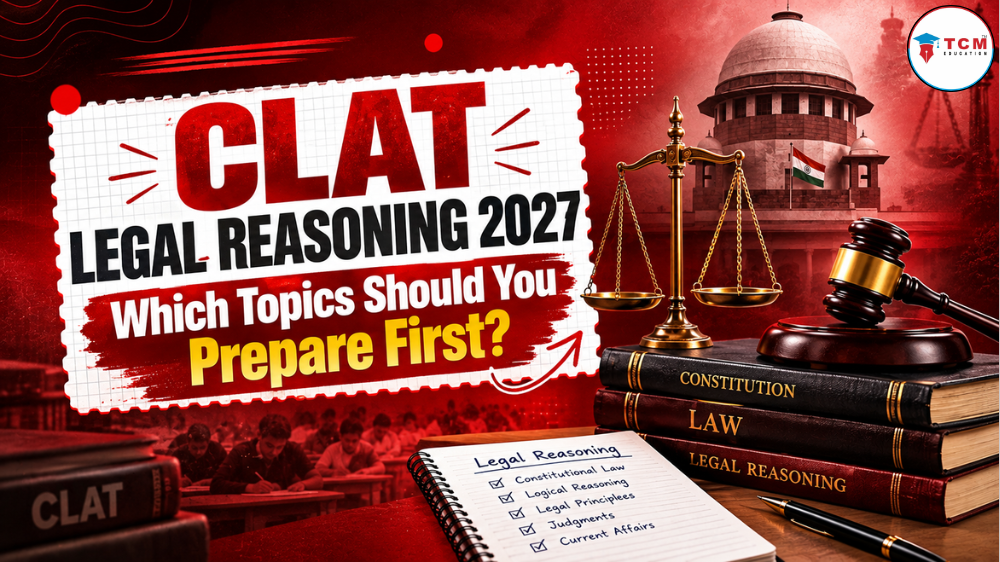
CLAT Legal Reasoning: What to Study First
The start matters. Pick the areas that show up a lot, have clear rules, and do not take forever to learn. When you score early, you stay calm. Then the next chapters feel less strange because you already understand the basic legal pattern.
1) Constitutional Law first
Constitutional law links Legal Reasoning with Current Affairs. So the work you do does not stay in one box. It also gives you the words used for rights and limits, plus the way courts talk in questions.
Focus on:
- Fundamental Rights. Especially Articles 14, 15, 19, and 21. Also include religious freedom and Article 32 remedies
- Directive Principles and Fundamental Duties, and how they sit beside rights
- Separation of powers, judicial review, and the basic structure idea
- Federalism, and how Parliament, the President, and courts share power
Small tip: For each right, note three points. First, what it protects. Second, what restricts it. Third, one landmark case. Kesavananda Bharati, Maneka Gandhi, and the privacy ruling in Puttaswamy are solid choices. This setup is enough for most constitutional passages.
2) Law of Torts: A Topic You Can Score Well In
Torts covers civil wrongs and compensation. The concepts are usually clear, so it helps with training how you link principles to facts.
What to study
- Negligence: duty of care, breach, damage
- Strict and absolute liability
- Vicarious liability
- Nuisance and trespass
- Defamation
- Defences like consent, act of God, and necessity
Study method: Make each tort into a short checklist of its parts. Then, if a question gives you a rule, test the facts for each part in order. If one part is not met, you do not get liability.
3) Criminal law: focus on mind and act
Most criminal law questions hinge on a few small words. Intended. Knew. Was careless. Attempted. Learn those early.
Main topics to cover
- Actus reus and mens rea
- General defences. Private defence, mistake, necessity, and insanity
- Culpable homicide versus murder
- Theft, robbery, cheating, and criminal breach of trust
- Attempt, abetment, conspiracy, and common intention
One more thing about your books
If your notes still say IPC, check the date. In July 2024, the Bharatiya Nyaya Sanhita took over from the Indian Penal Code. The new code changed how procedure and evidence work. Still, there is no need to panic. Many questions state the rule you must use. They also keep the main ideas that were there before. So you usually do not have to memorise section numbers.
4) Contract Law: Simple Rules, Direct Answers
Contract law is neat. The rules are set out clearly. Because of that, many questions become easy to score once you spot the key parts.
Study focus:
- Offer versus invitation to treat
- Acceptance and when it is communicated
- Consideration
- Capacity to contract
- Free consent, including coercion, undue influence, fraud, misrepresentation, and mistake
- Void and voidable agreements
- Breach and damages, plus quasi-contracts
Tip: Think of it like a chain. The links are offered, acceptance, consideration, capacity, free consent, and a lawful object. If one link fails, the contract can fail too. A lot of exam questions are really testing whether you can spot the weak link.
Round Two: Add More After You Can Handle the Basics
Recent court updates and key rulings. Many passages are based on current legal news. Try reading one or two short summaries of judgments each week. That also supports your current affairs work.
Focus areas next: consumer, privacy, tech, and environmental law. Learn the Consumer Protection Act, 2019. Learn the Digital Personal Data Protection Act, 2023. Also study the right to privacy. For the environment, pick up ideas like polluter pays and the precautionary principle.
Family, property, and IP only at the basic level. These topics show up now and then. Keep it to the core ideas. Do not spend weeks on them.
Final Part: Maxims and Common Legal Terms
Questions on direct maxims show up less now that the exam is more passage based. Still, a small list of frequent maxims and terms helps the passages feel easier. Spend about ten minutes a day. Think of it as small seasoning, not the main part of your plan.
The skill that matters most is not a topic at all
You can study every subject and still miss marks if you skip one habit. Use what the passage says. Do not swap it with your own views.
Do this once.
Start with the rule, then test it.
Rule: A person who controls a place is liable to a visitor only when two things fit. First, the visitor must enter with the owner’s permission. Second, the owner must have failed to warn about a danger the owner already knew.
Facts in this case
Mehul knew the floor by the back door was wet and unsafe after he mopped. He did not put up any sign. Priya worked as a delivery agent. She came in through that back door without asking or getting permission. She slipped.
Question
Does Mehul owe liability here?
Your first reaction might say yes. He knew the risk and he did not warn.
But the rule has two parts. Priya does not meet the first part, since she entered without permission.
So the rule says Mehul is not liable.
To build this habit, follow four steps
- Read the rule before anything else. Mark the parts that limit it, like only if, unless, and provided that.
- Match each marked part to the facts, one at a time.
- Do not use outside law or outside guesses. If they disagree with the passage, set them aside.
- Cut answers that add details or assume things the passage never stated.
This habit is the gap between students who reach 24+ and those who sit near 15.
CLAT Legal Reasoning: a 10 week study plan
Use this as a base for CLAT 2027. If your schedule is tight, adjust the length of each part. Keep the same order.
Weeks 1 to 2: Constitutional law
Focus on the main articles and key cases. Do two short passages each day.
Weeks 3 to 4: Torts and contracts
Learn how each topic is built. Use simple checklists for the basics. Also start a mistake notebook and update it daily.
Weeks 5 to 6: Criminal law and legal current affairs
Add one sectional test each week. Read short summaries of judgments so you stay familiar with the style.
Weeks 7 to 8: Mixed practice
Do timed sets that cover all topics. Work more on what you usually miss. Add the second round topics too.
Weeks 9 to 10: Full mocks
Do full length mocks at the end. The exam is offline, so practice on paper. After each mock, review it. Then do a light revision of your notebook.
If you cannot do ten weeks, shrink each block. Still, do the last two weeks. Most of the gains come from mock reviews.
How to review a practice mock in a real way
Don’t stop at your final score. Look at each wrong answer and sort it into one group:
- You misread the passage: You missed a key word, or you skipped a condition like only.
- You used the rule wrong: You got the idea, but you applied it in the wrong way.
- You chose a trap option: It sounded close, but it added something the text never said.
Do this for two or three mocks. After that, you will see a clear trend. That trend shows what to change next. It is usually not a vague fix like “I need more law study.”
About negative marking
One wrong answer costs you a quarter of a mark. So if you have removed two choices, a careful guess often pays off. Guessing without thought across the whole passage is not a plan. Let your practice tests help you find the right level of risk.
Are you preparing for CAT, IPMAT, or CUET and thinking about CLAT next?
A lot of students handle more than one test. The good part is that practice carries over.
If you studied verbal for CAT or IPMAT, you already know how to process passages fast. In CLAT Legal Reasoning, the focus is different. You must use a stated rule in a real scenario. Train yourself for that kind of shift, on purpose.
If you are coming from CUET, you might be used to facts and direct answers. CLAT reading can be longer and more based on hints and inference. To build that habit, read editorials each day and write a short summary in two lines.
Overall, when you build your reading and reasoning routine for CLAT, it can support your other exams as well.
Mistakes to watch for
- Do not try to memorize section numbers. The passage already gives the rule. Learn the idea first, not the digits.
- Do not study law the way you would read a full textbook. You do not need a whole book on every topic. You just need a solid grasp of the key points.
- Do not rely on real world law answers. If the passage says something else, follow the passage.
- Do not leave legal reasoning until the end. It is a tough part. Start doing it in week one.
- Do not skip mock analysis. Doing ten mocks and moving on helps less than doing five mocks and reviewing each one closely.
- Do not ignore legal updates. Even a short check each day helps you stay used to the material that passages use.
Conclusion
Legal Reasoning can feel scary at first. A big reason is that it seems like something you were meant to already know. You have not missed out. It is a learned skill.
The method is simple. Read the question closely. Identify the rule. Use the rule in a clear way. Begin with constitutional law. Then add torts, criminal law, and contracts. Keep going by using what has changed in recent legal cases. Also practise questions that ask you to mix the rule with the facts. Do it every day.
If you stick with it, the topic that once felt like your hardest part can become the place where you pick up more marks.
At TCM Education, we focus on three basics: set clear priorities, practise on a regular schedule, and get feedback that tells you the truth. If you want a plan that is laid out, practise support, or feedback from a mentor on your mock answers, check what TCM Education provides. A sensible place to start is to try a Legal Reasoning sectional test this week, then review how it goes. From there, build the next part of your plan.
Frequently Asked Questions on CLAT Legal Reasoning 2027
How many questions are in Legal Reasoning for CLAT 2027?
Legal Reasoning usually has 28 to 32 questions. That is about a quarter of the 120 questions. Current Affairs also has a similar share, so plan your time from the start.
Do I need past law study to attempt this section?
Not really. This part checks how well you understand passages and apply what you read. You are not expected to know legal subjects from prior study. Some basic awareness can help, but the needed information is in the passage in most cases.
Which topics should I cover first?
Start with constitutional law first. After that, do torts, then criminal law, and then contract law. Once you are comfortable there, move to recent legal changes, consumer law, privacy law, and environmental ideas. Save maxims and legal phrases for the end.
Has the Legal Reasoning syllabus for CLAT 2027 changed?
The exam body has said the syllabus and the exam format will stay the same. So you can use the same preparation plan that helped in earlier years. Still, check the official notification to be safe.
Should I read the IPC or the BNS?
I would focus on the core ideas. Look at intent, the general defenses, and abetment. Those themes stayed the same even after the Bharatiya Nyaya Sanhita replaced the IPC. Most notes tell you the rule first, so the section number is not the main thing.
How much time should I set aside for Legal Reasoning each day?
Start with about 60 to 90 minutes. Use part of that time for one topic. Use the rest to work through one or two questions. Change the split based on your day. Still, try not to vary the total too much.
Is it smart to guess, since there is negative marking?
If you pick the wrong option, you lose 0.25 marks. If you leave a question blank, you do not lose anything. Once you cut down two choices, a guess can help. But guessing every step in a full passage usually wastes points.