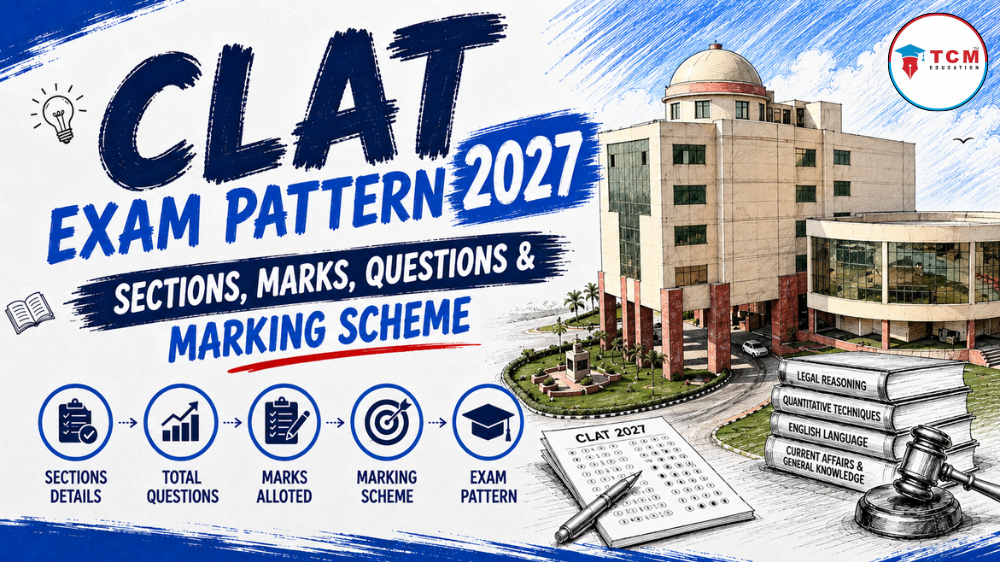
The Common Law Admission Test (CLAT) serves as the primary national-level entrance assessment for admission into undergraduate law programs across premier National Law Universities (NLUs) in India. Administered by the Consortium of NLUs, understanding the CLAT Exam Pattern 2027 is fundamental for candidates aiming to secure a high merit rank. The examination evaluates cognitive aptitude, analytical reasoning, and reading comprehension rather than passive information recall. The undergraduate test is conducted offline via Optical Mark Recognition (OMR) sheets, requiring candidates to attempt 120 multiple-choice questions within a two-hour window.
Executive Summary and Macro Architectural Overview
The structural framework of the undergraduate CLAT examination has evolved to prioritize analytical depth over raw speed. The exam features CLAT 2027 Total Questions amounting to 120 items, distributed across five core subject domains: English Language, Current Affairs including General Knowledge, Legal Reasoning, Logical Reasoning, and Quantitative Techniques. Each question carries a weight of one mark, establishing a total potential score of 120 marks.
Each of the five sections is dealt with using passage-based comprehension sets. The candidates are given passages averaging 450 words in length—or data sets, in the case of Quantitative Techniques—along with a series of four to six multiple-choice questions. This format means that the candidates have to maintain their reading comprehension and critical thinking abilities for the entire 120-minute period.
| Parameter | Specifications of CLAT UG 2027 |
| Exam Name | Common Law Admission Test (UG-CLAT 2027) |
| Conducting Authority | Consortium of National Law Universities |
| Testing Mode | Offline (Pen-and-Paper, OMR Response Sheet) |
| Medium of Examination | English Only |
| Total Duration | 2 Hours (120 Minutes) |
| Total Number of Questions | 120 Multiple-Choice Questions (MCQs) |
| Maximum Marks | 120 Marks |
| Question Format | Passage-Based Comprehension Sets (~450 words per passage) |
| Evaluation Scheme | +1.00 mark for correct response; -0.25 marks for incorrect response |
| Standard of Difficulty | Up to Class 12 level (Class 10 standard for Quantitative Techniques) |
The Shift to a 120-Question Format
The Consortium of NLUs changed the structure of the undergraduate examinations by reducing the total number of questions from 150 to 120 without altering the total length of the test, which remained at 120 minutes. As a result of this change, the average time available for each question increased from 48 seconds to 60 seconds.
This change in structure was not designed with the aim of making the test easier. On the contrary, it was meant to bring the test in line with its main objective: that of assessing high-level comprehension and the ability to apply analytical skills, rather than relying on quick scanning of the text. Since the paper involves reading thousands of words in five different subjects, the current format of the CLAT 2027 Exam rewards slow but steady reading speed, conceptual clarity, and careful choice of questions.
CLAT 2027 Marking Scheme: the math behind it
To plan your attempt well, you first need to know how the CLAT 2027 scoring works. This test uses a penalty setup. It aims to stop random guessing. It also gives an edge to answers that are correct, especially when time is tight.
Here is what happens for each type of answer.
1) Correct answer
+1.00 mark is added to your raw score.
2) Wrong answer
The -0.25 mark is taken out from your raw score.
3) Question left blank
0.00 marks. There is no add-on and no cut.
Your final score is then worked out with the usual net scoring rule:
Net Score=(Total Correct Answers×1.00)−(Total Incorrect Answers×0.25)
Strategic risk and how penalties work
The rule of 1 to 4 sets up a clear trade-off. If you get four questions wrong, it cancels out the gain from one correct response.
If you skip a question, your total stays the same. Nothing is added, and nothing is taken away. But if you answer and it is wrong, you lose value. You miss the full mark you could have earned for correct work, and you also take a 0.25 mark hit on what you already have.
| Attempt Strategy Scenario | Correct Attempts | Incorrect Attempts | Unattempted | Raw Positive Score | Negative Penalty | Final Net Score |
|---|---|---|---|---|---|---|
| High Attempt / Low Precision | 80 | 40 | 0 | 80.00 | -10.00 | 70.00 |
| Balanced Attempt / Standard Precision | 80 | 20 | 20 | 80.00 | -5.00 | 75.00 |
| High Precision / Selective Attempts | 90 | 10 | 20 | 90.00 | -2.50 | 87.50 |
| Disciplined Precision / High Accuracy | 85 | 5 | 30 | 85.00 | -1.25 | 83.75 |
Raw attempt volume alone often drags scores down when accuracy is not strong. People who strike out wrong choices and skip the ones they are not sure about usually end up with better net marks than those who answer everything at random. So, for CLAT 2027, you need both solid subject understanding and a careful plan for the test.
Section split and the CLAT 2027 format
The NLUs’ Consortium sets the paper into five sections. They give expected percentage ranges, not fixed counts. Even so, past papers point to a steady pattern of how questions are spread across the full test.
| Subject Section | Approximate Question Range | Total Marks | Percentage Weightage | Recommended Time Budget |
| Current Affairs including General Knowledge | 28–32 questions | 28–32 marks | ~25% | 10–12 minutes |
| Legal Reasoning | 28–32 questions | 28–32 marks | ~25% | 35 minutes |
| English Language | 22–26 questions | 22–26 marks | ~20% | 25 minutes |
| Logical Reasoning | 22–26 questions | 22–26 marks | ~20% | 25 minutes |
| Quantitative Techniques | 10–14 questions | 10–14 marks | ~10% | 15 minutes |
| Total Evaluation | 120 Questions | 120 Marks | 100% | 120 Minutes |
The CLAT 2027 Section-Wise Weightage shows that Current Affairs, Legal Reasoning, and Logical Reasoning together account for nearly 70% of the entire paper. Developing strong accuracy across these three sections is critical for securing a top merit rank.
Detailed Analysis of Subject Domains and Syllabi
Understanding the CLAT 2027 Syllabus and Exam Pattern requires examining the specific core competencies tested within each subject area.
Legal Reasoning Section
The Legal Reasoning section comprises 28–32 questions (~25% of the paper) and serves as a primary test of a candidate's suitability for legal education.
Passages are approximately 450 words each and draw from legal commentaries, public policy debates, ethical inquiries, or landmark judicial decisions. Prior legal training is not required. The passage provides the relevant rules, principles, and propositions. Candidates are evaluated on their ability to:
- Identify legal principles and rules embedded within textual narratives.
- Apply those principles accurately to hypothetical factual scenarios.
- Analyze how modifications to a rule alter its legal outcome when applied to specific facts.
- Evaluate the relationship between legal rules, moral principles, and public policy goals.
Candidates should stick to the rules in the passage. They should not bring in outside ideas while they analyze it. Some coaching tracks, like the TCM Education programs run by NLU alumni, spend a lot of time on this same method.
Current Affairs and General Knowledge
This part has 28 to 32 questions. That is about a quarter of the test. It also affects how fast the test moves and how points get counted.
Each reading is usually around 450 words. The source material comes from news reports, editorial writing, and non-fiction essays.
The smaller questions check how well a candidate:
- Contemporary national and international events of major significance.
- Historical events, arts, culture, and legal history of continuing relevance.
- International organizations, treaties, and public policy developments.
- Linking broad news coverage to underlying legal or constitutional contexts.
This part is mostly about remembering details from the given passage. Most candidates finish it in about 10 to 12 minutes. That short time window helps leave room for the sections that ask for more reading, like Legal and Logical Reasoning.
English Language Section
You get 22 to 26 questions here. They carry around 20 percent of the total weight. The goal is to check how well you understand what you read, how well you use vocabulary in context, and how strong your language skills are.
The reading passages are about 450 words each. They come from modern fiction, older historical texts, philosophy, and newspaper style essays. The level matches what most students handle at Class 12.
The questions test whether you can:
- Comprehend central themes, core arguments, and main ideas.
- Draw logical inferences, implicit deductions, and valid conclusions.
- Summarize texts and compare contrasting arguments within a passage.
- Identify the contextual meaning of complex vocabulary, phrases, and idioms.
Improving both speed and recall helps test takers move through this part faster. They do not have to go back and read the same lines again and again.
Logical Reasoning Section
This section has 22 to 26 questions. It counts for about one fifth of the total score.
It checks how well you think through arguments and how you read them.
Most passages run around 450 words. They usually include formal reasoning, persuasive writing, or close analysis.
You are expected to do things like this:
- Spot the parts of an argument, like the reasons, hidden beliefs, and the final claim.
- Look at how the logic is built, and notice flawed thinking, contradictions, or confusing claims.
- Judge how an added fact, or a changed premise, can make the argument stronger or weaker.
- Reach a result from what is given, then use that inference in a new case.
Overall, this section leans on reading based critical reasoning. It is not the usual logic puzzle style. The focus fits what legal studies require.
Quantitative Techniques Section
This part has the smallest share in the exam, about 10 to 14 questions, close to 10%. But it can still separate strong candidates from the rest.
You do not just answer math drills here. Most questions come as small caselets in text, or as charts, graphs, and data tables. The content links to Class 10 level math.
Each set asks you to do things like the following.
- Pull numbers from a passage or from a table, then put them in order.
- Use ratios, proportions, percentages, basic algebra, simple area and volume ideas, and quick estimation.
- Turn a story or description into clear math steps.
If you handle the Data Interpretation style questions well, you can earn marks in a steady way. That advantage is hard to get if someone leaves the Quantitative part blank.
Time Management and Attempt Sequencing
Completing 120 passage-based questions in 120 minutes requires a clear, deliberate time management strategy. Attempting the test in strict numerical order is rarely optimal due to the varying cognitive demands across sections.
| Phase Sequence | Subject Section | Recommended Time | Primary Execution Focus |
| Phase 1 | Current Affairs & General Knowledge | 10–12 Mins | Build early score momentum; process factual recall quickly. |
| Phase 2 | Legal Reasoning | 35 Mins | Analyze rule-to-fact scenarios while mental freshness is highest. |
| Phase 3 | Logical Reasoning | 25 Mins | Evaluate argument structures, assumptions, and inferences. |
| Phase 4 | English Language | 25 Mins | Maintain steady reading speed on comprehension passages. |
| Phase 5 | Quantitative Techniques | 15 Mins | Convert text-based caselets into numerical solutions. |
| Final Buffer | Review & OMR Verification | ~8 Mins | Check OMR accuracy and resolve marginal candidate questions. |
Starting with current affairs is a good move. It helps you build momentum early. It also gives you some extra time later.
You can use that saved time for legal and logical parts. Those sections make up half of the exam marks.
Structural comparison: CLAT UG versus CLAT PG.
Looking at the UG paper and the PG exam shows how the consortium tests you.
| Structural Feature | CLAT UG 2027 | CLAT PG 2027 |
| Target Audience | Class 12 Students / Gap-Year Candidates | Law Graduates (LL.B. Degree Holders) |
| Core Metric Assessed | General Aptitude, Critical Reasoning & Reading | Knowledge of Core Legal Jurisprudence |
| Format of Questions | Passage-Based Comprehension Sets (~450 words) | Passage-Based MCQs on Cases & Statutes |
| Subject Breakdown | English, CA/GK, Legal, Logical, Quant | Constitutional Law, Jurisprudence, Contracts, Torts, Criminal Law, etc. |
| Total Questions | 120 Questions | 120 Questions |
| Duration & Total Score | 2 Hours / 120 Marks | 2 Hours / 120 Marks |
| Negative Marking | -0.25 marks per incorrect response | -0.25 marks per incorrect response |
| Prior Legal Knowledge | Not Required (Tested via passage text) | Required (Based on LL.B. curriculum) |
The comparison shows the undergraduate paper checks raw thinking, steady reading ability, and problem handling. It does not focus on deep, specific legal knowledge.
Preparation Frameworks, Mock Analytics, and Institutional Support
Getting ready for CLAT means having a plan, not just reading at random. The work is usually split into a few stages that move from learning to execution.
- Base stage: Here the goal is to cover core ideas across all five parts. You also build a daily habit for reading longer passages. At the same time, you practice simple number work.
- Skill stage: You start doing timed practice, including section tests. You also try applying rules to facts in questions. Over time, you get better at removing wrong choices.
- Mock stage: You take full length tests in an offline style, with time pressure like the real exam. After each test, you check where your marks dropped. Then you adjust how you spend time.
Role of Specialized Prep Programs and Mock Analytics
Structured coaching environments help students navigate the exam's demands by providing targeted study plans and performance analytics:
- Long span courses are built for basics. Examples include TCM Education’s Aarambh and CLAT Agni Plus. These are two-year programs for Class 11 students. The aim is steady work on reading skills, logic, and quantitative topics, so the core gets strong over time.
- Then there are faster intensive tracks. Lakshya and the CLAT Agni and Vijay series fit this style. These are one-year options for Class 12 and gap-year students. They cover the full syllabus and include routine sectional tests, both in class and online.
- For the final push, some centers run revision batches. The Brahmastra Booster Series is one example. These late modules focus more on exam strategy, practice that is high yield, and fixing weak spots based on results.
Many modern prep ecosystems also use diagnostic analytics to follow student progress. A tiered test plan is used so students can raise the level step by step. TCM Education’s Test Panel 1, then Test Panel 2, and the A1 Rankers Series are placed in a clear order. With these tests, candidates can check accuracy, watch how long they take per question, and review trends in negative marking.
Along with the analytics, students get help from experienced faculty and NLU alumni. This structure supports the shift from learning concepts to landing strong net scores.
Final thoughts
Clearing CLAT as per the CLAT Exam Pattern 2027 means you need to manage three things at once. You must read fast enough, solve with care, and choose your moves wisely. The structure of the test matters too. There are 120 questions in 120 minutes. You will answer passage based questions. There is also a negative marking of minus 0.25, so careless guessing can hurt more than it helps.
A good plan is to start with the topics that usually carry more weight, like Legal Reasoning and Current Affairs. Keep up daily reading so your stamina grows. Also, take mock tests on a regular schedule. This helps you see weak spots and fix them in time. With consistent effort and a clear study routine, you can stay on track. Using practice checks and guidance, such as the specialized law entrance programs from TCM Education, can support your preparation. In the end, this gives you a better chance of getting into top National Law Universities.
Frequently Asked Questions (FAQs)
1. What is the overall exam format and duration for CLAT 2027?
The Common Law Admission Test (CLAT) 2027 for undergraduate admissions is an offline, pen-and-paper examination conducted using OMR response sheets. Candidates must complete 120 passage-based multiple-choice questions within a total duration of 2 hours (120 minutes).
2. What is the marking scheme for CLAT 2027?
The paper follows a structured penalty-based scoring system:
- Correct Response: +1.00 mark
- Incorrect Response: -0.25 marks (negative marking)
- Unattempted Question: 0.00 marks (no penalty or positive credit)
3. What are the five core sections tested in CLAT 2027, and what is their weightage?
The 120 questions are distributed across five subject domains:
- Current Affairs including General Knowledge: 28–32 questions (~25% weightage)
- Legal Reasoning: 28–32 questions (~25% weightage)
- English Language: 22–26 questions (~20% weightage)
- Logical Reasoning: 22–26 questions (~20% weightage)
- Quantitative Techniques: 10–14 questions (~10% weightage)
4. Do I need prior legal knowledge to score well in Legal Reasoning?
No prior formal knowledge of law is required. The section provides passages (~450 words each) containing all relevant legal rules, principles, and propositions. You are evaluated strictly on your ability to read the passage carefully and apply the given principles to hypothetical fact scenarios.
5. Why did the Consortium of NLUs reduce the question count from 150 to 120?
The question volume was reduced to 120 while retaining the 120-minute time limit to shift the test's focus from rapid speed-reading to deep comprehension, analytical reasoning, and accurate decision-making.
6. What is the ideal section-wise time allocation strategy during the exam?
To maximize score output and maintain pace, a recommended timing framework is:
- Current Affairs & GK: 10–12 minutes
- Legal Reasoning: 35 minutes
- Logical Reasoning: 25 minutes
- English Language: 25 minutes
- Quantitative Techniques: 15 minutes
- OMR & Buffer Review: ~8 minutes
7. What type of questions are asked in the Quantitative Techniques section?
Instead of standalone geometry or algebra problems, Quantitative Techniques features short textual caselets, graphs, data tables, or charts derived from Class 10 mathematics. Questions test Data Interpretation (DI), ratios, percentages, mensuration, and basic statistical estimations.
8. How does TCM Education assist aspirants in preparing for CLAT 2027?
TCM Education provides structured prep programs (such as Aarambh for 2-year aspirants, Lakshya for 1-year aspirants, and Brahmastra for revision) featuring:
- NLU Alumni Faculty: Legal Reasoning modules led by National Law University graduates.
- AI-Powered Mock Test Series: Tiered practice panels (Foundation, Advanced, and A1 Rankers) with real-time diagnostic analytics.
- Mentorship & Doubt Resolution: 1-on-1 progress tracking, customized study roadmaps, and 24/7 doubt resolution support.