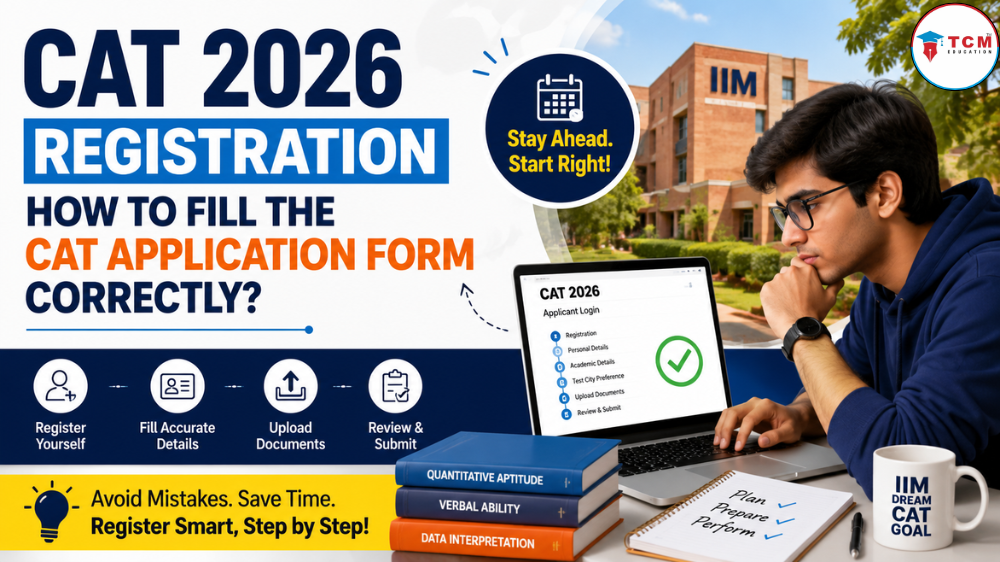
The initiation of the CAT 2026 Registration process really starts this first foundational phase in the annual selection cycle, for postgraduate management admissions across the top Indian business schools. It is administered by the Indian Institute of Management (IIM) Indore for the 2026 academic testing cycle , and the entrance examination works as the main screening mechanism for 22 IIMs—including the newly integrated IIM Guwahati—plus more than 1,000 non-IIM institutions like FMS Delhi, SPJIMR, MDI Gurgaon, and even the management faculties of the IITs. Candidate participation is expected somewhere around 2.75 lakh to 3.00 lakh applicants, so during form submission administrative accuracy is not optional.
Academic guidance from TCM Education points out that tiny administrative mishaps during registration can lead to instant application rejection, or later disqualification during post-examination institutional shortlisting. This matters a lot for students who are already preparing for national competitive examinations including CAT, CLAT, IPMAT and CUET , because one slip can upset the whole schedule.
Administrative Timeline and Operational Framework of CAT 2026 Registration
The official notification put out by IIM Indore describes the entire schedule for the examination cycle. The official CAT 2026 Registration Date is August 3, 2026 , beginning at 10:00 AM IST, and the CAT 2026 Registration Last Date is September 15, 2026, closing at 5:00 PM IST. Registration is done completely online via the official portal (iimcat.ac.in). While earlier cycles sometimes had short extension windows, applicants should aim to finish early , so they can avoid technical hassle tied to end-of-window server congestion.
So the computer based test is set for Sunday, November 29, 2026, and it is broken into three separate testing sessions, spread across roughly 170 designated host cities. The admit card for candidates can be downloaded starting from November 4, 2026 , until the actual day of the exam. As for results they are expected sometime in late December 2026 or maybe the first week of January 2027 , and the scores will stay valid up through December 31, 2027.
| Administrative Phase | Confirmed / Expected Schedule | Key Operational Details |
| Official Notification Release | July 25 / July 26, 2026 | Published on iimcat.ac.in by IIM Indore |
| Registration Window | August 03 – September 15, 2026 | Online submission opens at 10:00 AM and closes at 5:00 PM IST |
| Correction Window | September 24 – September 27, 2026 | Limited editing for photograph, signature, and test city preferences |
| Admit Card Availability | November 04 – November 29, 2026 | Downloadable via registered candidate dashboard credentials |
| CAT 2026 Examination Date | November 29, 2026 | Conducted in 3 sessions across ~170 test cities |
| Score Declaration | First Week of January 2027 | Normalized percentile scores valid until December 31, 2027 |
Eligibility Parameters and Statutory Reservation Policies
Before you jump into the application, it helps to know the eligibility parameters, kinda like what the institution expects. This is really about staying in line with their institutional criteria. The baseline requirement is a recognized Bachelor’s degree plus a minimum aggregate performance , at least as per the stated threshold.
For General applicants , as well as candidates from Economically Weaker Sections (EWS) and Non-Creamy Layer Other Backward Classes (NC-OBC) , the requirement is 50% aggregate marks , or an equivalent CGPA. But if you’re from Scheduled Caste (SC), Scheduled Tribe (ST), or Persons with Benchmark Disabilities (PwBD) categories then you need at least 45% aggregate marks.
Final-year undergraduate students, and also candidates who are still awaiting their final degree results can apply , as long as they end up completing all graduation requirements and also submit verified proof before the institutional deadlines. Those deadlines are the ones that will be specified during admissions, so keep an eye on that part.
Also, people holding professional qualifications like Chartered Accountancy (CA), Company Secretaryship (CS), Cost and Management Accountancy (ICWA/CMA), or Fellowship of the Institute of Actuaries of India (FIAI) are fully eligible too, no ambiguity there.
Once the eligibility part is handled, the entrance process then follows the statutory reservation policies for public institutions. In practice, this means seat portions are reserved for protected applicant categories, according to the prescribed percentages.
| Category Group | Statutory Reservation Quotas | Baseline Academic Threshold |
| General Candidates | Unreserved | 50% Bachelor's Aggregate |
| Non-Creamy Layer OBC (NC-OBC) | 27.0% | 50% Bachelor's Aggregate |
| Economically Weaker Sections (EWS) | 10.0% | 50% Bachelor's Aggregate |
| Scheduled Castes (SC) | 15.0% | 45% Bachelor's Aggregate |
| Scheduled Tribes (ST) | 7.5% | 45% Bachelor's Aggregate |
| Persons with Benchmark Disabilities | 5.0% (Horizontal Reservation) | 45% Bachelor's Aggregate |
No upper age limit is set for taking the test. Full- time paid post graduation work experience is not compulsory while filling the form , but any verified experience does add weight to the profile assessment during the post exam selection conversations.
Procedural Breakdown: How to Fill CAT 2026 Application Form
Getting through the CAT 2026 registration process needs a steady way of doing things across four separate administrative phases. Candidates should keep educational marksheets, category identity papers and digital photographs ready before starting the CAT 2026 Form Filling part.
Step 1: First Registration and Dashboard Credential Generation
Applicants go to iimcat.ac.in and open the registration portal. The system asks for core identity details, such as the candidate’s full legal name as written on Secondary School Leaving Certificates (SSLC / Class 10), date of birth, primary email address, mobile number, and nationality. Once you trigger the "Generate OTP" action, the verification code is sent over SMS and also to email. When the OTP gets validated properly, it creates a unique User ID and Password, which then gives access to the main application page.
Step 2: Personal, Academic, and Professional work experience data logging
Once the candidates log into the dashboard, they fill in four main information areas that feel kind of straightforward but still take a bit of time.
- Personal Profile: this includes parental names, communication address, emergency contact numbers, and category classifications. Candidates who are claiming reservation need to double check that their certificate details match the central government registries. If it does not match, then it can get messy later.
- Academic History: aggregate percentages get recorded for Class 10, Class 12 or an equivalent diploma program, undergraduate degree programs, and any postgraduate or professional qualifications. The percentage calculations should be based on the total aggregate percentage earned across all subjects shown in the official transcript, even if the university follows its own best-four or core subject style rules.
- Work Experience Logging: candidates record the months of full-time, paid employment done after completing their Bachelor’s degree. This is counted up to the cut-off date stated in the official bulletin. Part-time employment, unpaid internships, and any work before graduation should be left out, because they are not considered.
Step 3: Program selection and test city preferences
Applicants choose the particular IIM programs and the related interview city options. They are advised to pick every relevant academic program, so that shortlisting chances stay higher later among the participating institutes. Applicants also must choose five test cities in the order they prefer, out of the 170 examination locations available. Final city assignment is done by the organizing body, based on administrative capacity and operational feasibility.
Step 4: Document Uploads, Review, and Payment Execution.
Candidates submit digital copies of the needed documents, using the exact formatting rules given, and then they should really check the form summary carefully. After that, payment needs to be finished through the online payment gateway.
Financial Structure, Document Specifications, and Technical Guidelines
The application fee for the 2026 testing cycle shows a small upward shift compared to the older years. Payment must be done online, using the integrated digital payment options.
| Fee Classification Category | CAT 2025 Base Fee | CAT 2026 Base Fee | Fee Revision Delta |
| General / EWS / NC-OBC Candidates | ₹2,600 | ₹2,700 | +₹100 |
| SC / ST / PwBD Category Candidates | ₹1,300 | ₹1,350 | +₹50 |
Gateway service providers levy standard payment processing surcharges depending on the chosen payment method.
| Payment Gateway Option | Applied Transaction Processing Surcharges |
| Visa / MasterCard Credit Cards | 1.20% of transaction amount (Minimum threshold ₹5) |
| American Express Credit Cards | 2.85% of transaction amount (Minimum threshold ₹5) |
| Master / Visa Debit Cards | 0.75% (Transactions ≤ ₹2,000) / 0.90% (Transactions > ₹2,000) |
| Net Banking Portals | Flat ₹20 processing charge per transaction |
| Unified Payments Interface (UPI) | Standard processor terms via PayU, BillDesk, or Paytm |
You can avoid the rejection of uploaded files if you stick, very closely, to the official limits for the file format and size.
- For the Passport Photograph: submit a recent color photo taken against a light or white backdrop. The usual dimensions are to be kept properly, so there’s no bending or distortion.
- For the Scanned Signature: the signature should be written neatly on white paper with dark blue or black ink, then scan it so it looks clear and clean.
- For Category and Disability Certificates: candidates under SC, ST, NC-OBC, EWS, and PwBD need to upload proper, readable multi page PDF documents that are issued by recognized competent authorities. The NC-OBC and EWS certificates must also remain valid for the current financial year, as per central government norms.
Also, for a smoother experience, the recommended technical setup is to complete the application on an updated desktop browser environment. Using Google Chrome is suggested, as it helps reduce payment gateway timeouts and those rendering errors that can happen sometimes.
Strategic Mitigation of Common Registration Errors
When we look at applicant data from earlier testing rounds, a few recurring administrative mistakes show up again and again, and they can mess with candidature. If the verification is done in a systematic way, these risks get reduced a lot, maybe not perfectly, but close enough.
- Academic Percentage Computation: Mistakes often happen when candidates apply the university CGPA conversion rules wrong , or when they simply leave out failed or supplementary attempts from the total aggregate. Also, many people forget that all courses mentioned on the official marksheet must be included, otherwise the percentage and aggregate performance won’t match the real record.
- Category Certificate Non-Compliance: A big reason for category invalidation is when applicants upload the wrong kind of document, like a state-level reservation certificate instead of the central-format certificate. If the category claim is not validated properly, the system may reclassify the applicant to General, or it can even lead to application cancellation.
- Miscalculation of Work Experience: Some candidates include internships, training stretches, or work done before the degree is finished. During interview verification, that creates mismatch flags. What should be reported is only post-graduation, full-time paid employment, and it must be backed with proper service certificates along with pay slips.
- Over-reliance on the Correction Window: People sometimes assume the correction window is flexible. But the edit window allowed after registration is basically limited to changes in the uploaded photograph, signature, and city preference. The core fields are locked, including candidate name, category classification, academic scores, and contact details , and those cannot be edited after payment.
Institutional Guidance and Strategic Preparation Path
Successfully submitting the CAT 2026 Application Form finishes the administrative side of the testing process. After the form is submitted, candidates move toward a more dedicated exam preparation routine, concentrating on the three test sections: Verbal Ability and Reading Comprehension (VARC), Data Interpretation and Logical Reasoning (DILR), plus Quantitative Ability (QA).
Academic institutes, coaching ecosystems and mentoring platforms like TCM Education also offer a kind of structured prep toolkit, with practice sets that are analytical, and mentorship programs built around national entrance examinations. By using these specialized preparation frameworks, candidates can turn the administrative compliance step into stronger test results, which in turn supports admission outcomes at major management institutions.
Frequently Asked Questions (FAQs)
1. What are the key dates for CAT 2026 registration and examination?
- Registration Opening Date: August 3, 2026 (10:00 AM IST)
- Registration Closing Date: September 15, 2026 (5:00 PM IST)
- Form Correction Window: September 24 – September 27, 2026
- Admit Card Release: November 4, 2026
- CAT 2026 Exam Date: Sunday, November 29, 2026
- Result Declaration: First week of January 2027
2. What is the registration fee for CAT 2026?
- General / EWS / Non-Creamy Layer OBC (NC-OBC): ₹2,700
- SC / ST / PwBD Candidates: ₹1,350
Payment can be made online via Credit Card, Debit Card, Net Banking, or UPI during form submission. Additional transaction service charges may apply depending on the chosen payment portal.
3. What are the basic eligibility criteria to apply for CAT 2026?
- Academic Qualification: A Bachelor's degree with at least 50% aggregate marks or an equivalent CGPA for General, EWS, and NC-OBC candidates. For SC, ST, and PwBD candidates, the minimum aggregate requirement is 45%.
- Final-Year Students: Candidates in the final year of graduation or those awaiting final results are fully eligible to apply, provided they complete degree requirements and submit proof by the institution-specified deadlines.
- Age Limit: There is no upper age limit for appearing in CAT 2026.
- Professional Qualifications: Holders of degrees like CA, CS, ICWA/CMA, or FIAI are also eligible.
4. Can I edit my application form after submitting and paying the fee?
Most core details—including candidate name, category classification, contact details, academic marks, and selected IIM programs—cannot be edited once the registration fee is paid. However, IIM Indore provides a limited Form Correction Window (expected September 24 – 27, 2026) where candidates can modify only three fields:
- Candidate Photograph
- Candidate Signature
- Test City Preferences
5. Is full-time work experience required to register for CAT 2026?
No, prior work experience is not mandatory to appear for CAT. Fresh graduates can apply without any issue. However, if you have verified, paid, full-time employment completed after graduation, declaring it can earn you profile evaluation points during later interview shortlisting stages at top management institutes. Part-time jobs, training, and pre-graduation internships should not be listed as work experience.
6. How many test city choices can I select during form filling?
Candidates can choose up to five preferred test cities in order of priority from approximately 170 host cities across India. The organizing body makes every effort to assign one of the top choices based on center capacity and availability.
7. What documents do I need to keep ready before filling out the form?
Before starting the application process on iimcat.ac.in, ensure you have the following digital copies ready:
- Recent passport-size photograph against a light/white background
- Scanned signature executed in dark blue or black ink on white paper
- Class 10, Class 12, and Graduation mark sheets for accurate percentage entry
- Category certificate (SC/ST/NC-OBC/EWS) in central government format, if applicable
- Persons with Benchmark Disabilities (PwBD) certificate, if applicable
8. How is the aggregate percentage calculated for the CAT application?
The aggregate percentage must be calculated based on all subjects that appear on your official transcript or mark sheet, regardless of university-specific rules like "best four" or "core subjects only". If your university awards CGPA/grades, convert them to percentages strictly using your university’s official conversion formula.
9. Where can I complete the CAT 2026 registration online?
Registration must be completed exclusively through the official CAT portal: iimcat.ac.in. It is recommended to use updated browsers like Google Chrome on a desktop or laptop to avoid transaction delays or portal timeouts.