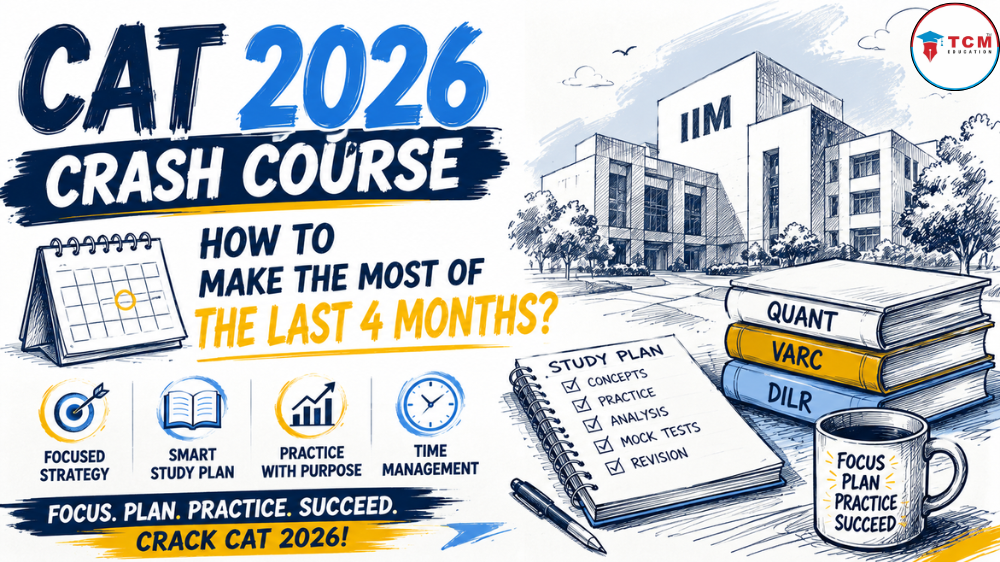
The last four months before the Common Admission Test (CAT) kinda feel like a turning point where proper preparation leads to rapid score improvement. Joining a targeted CAT 2026 Crash Course helps aspirants move from separate, not-so-organized study habits into one synchronized, high efficiency plan. Since the competition is basically serious and expects mastery in Quantitative Aptitude, Data Interpretation, Logical Reasoning, and Verbal Ability, candidates have to be careful about how they allocate time and also how they fine tune their diagnostic performance .
With a systematic approach during the Last 4 Months CAT Preparation, that nervousness converts into more measured exam performance. Platforms like TCM Education also talk about how structured support along with constant evaluation actually helps improve percentile results for competitive exams and undergraduate tests, including CAT, IPMAT, CLAT, and CUET.
Strategic Phases of the CAT 2026 Crash Course
To pull off a strong 4 Month CAT Preparation Strategy, it’s better to split the remaining time into clear, milestone type phases. Instead of spending forever revisiting theory, candidates do better with an objective based framework that gradually shifts from baseline diagnostics to intensive mock simulations . This kind of structure keeps syllabus coverage aligned with high yield topic buckets, and it also supports personalized skill strengthening which feels way more realistic .
| Preparation Phase | Strategic Timeline | Primary Academic Focus | Key Deliverables & Milestones |
| Phase 1: Diagnostic Assessment & Core Fundamentals | Month 1 (Days 1–30) | Baseline testing, core arithmetic, algebraic principles, reading comprehension structure | Complete initial diagnostic mock, construct weak-area inventory, establish basic formula mastery 1 |
| Phase 2: Advanced Application & Sectional Speed | Month 2 (Days 31–60) | Modern mathematics, geometry, multi-variable DILR sets, VARC inference logic | Transition to weekly sectional tests, target >80% accuracy in core sub-topics 2 |
| Phase 3: Intensive Revision & Workshop Mastery | Month 3 (Days 61–90) | Mixed-topic problem sets, Homerun intensive workshops, advanced shortcut techniques | Participate in live problem-solving sessions, double full-length mock frequency 2 |
| Phase 4: Simulated Testing & Final Strategy Refinement | Month 4 (Days 91–120) | Full-length adaptive mocks, error log auditing, stamina and pacing optimization | Finalize section-wise time allocation strategy, complete All-India mock series 3 |
The initial phase kinda sets a strict baseline, through a comprehensive diagnostic evaluation or whatever, you know. In that stage, candidates end up isolating fundamental conceptual gaps across certain quantitative sub disciplines and logical set types, without missing too much. Then as preparation kind of moves into the second and third months, the teaching emphasis changes, more on sectional speed and strategic question picking. Specialized revision modules like TCM Education’s “Homerun Classes” offer intensive problem-solving workshops, meant to turn theoretical knowledge into exam tempo application. And the final thirty days , honestly, go heavy on psychological conditioning, mock test review, and the consolidation of attempt strategies.
Sectional Master Plan for Comprehensive CAT 2026 Preparation
Putting together a solid CAT 2026 preparation strategy means tackling the unique cognitive demands of each exam section. The test evaluates analytical skill, data synthesis, and verbal logic all at once, under strict time constraints, so the preparation has to be tailored for each subject area.
| Exam Section | Core Competency Tested | High-Yield Sub-Topics | Strategic Pedagogical Approach |
| Quantitative Aptitude (QA) | Mathematical logic, numerical accuracy, speed computation | Arithmetic, Algebra, Geometry, Modern Math | Concept-first learning, 30-second problem decomposition, shortcut application |
| Data Interpretation & Logical Reasoning (DILR) | Structured data synthesis, matrix analysis, pattern recognition | Tables, Charts, Seating Arrangements, Puzzles, Games & Tournaments | Set selection optimization, step-by-step set decoding, elimination of trap sets |
| Verbal Ability & Reading Comprehension (VARC) | Structural passage analysis, contextual vocabulary, verbal logic | Reading Comprehension, Para Jumbles, Paragraph Summary, Odd Sentence Out | Active reading mapping, deceptive distractor elimination, contextual vocabulary building |
Quantitative Aptitude Pedagogy
Quantitative Aptitude performance depends way more on having a clear conceptual grip than on memorizing shortcuts or formulas that you just repeat. The teaching mindset, built by industry veterans—like Director Ajai Sir (20+ years teaching legacy) and Sunny Sir (17+ years mentoring experience)—tries to make tough mathematical ideas feel almost straightforward, with intuitive, 30-second solving steps. Through “Concept Builder” modules, candidates first lock in Arithmetic and Algebra fundamentals, then only after that they move into the heavier stuff, like complex geometric questions and modern math problems. Once that base is in place, candidates can spot faster calculation routes and they also stop wasting time on long algebraic derivations during the exam.
Data Interpretation and Logical Reasoning Strategy
For DILR, success comes more from choosing the right sets rather than finishing every set you see. A lot of candidates hit this weird performance plateau, mainly because they pick overly complex or multi-layered sets early, when the test window is still fresh. With guidance from specialized faculty like Manoj Sir, aspirants learn to sort sets based on structural complexity, data density, and the way variables are connected. Getting the discipline right—like bypassing the time-draining “trap” sets—helps protect your minutes for the higher-probability reasoning puzzles, which in turn keeps the section scores more consistent.
Verbal Ability and Reading Comprehension Refinement
VARC is basically a shift from passive reading to some real structural logic analysis. Under VARC specialists such as Anil Sir, candidates are trained to map the passage architecture, detect the author tone, and then evaluate the central arguments in a steady, systematic way. Because of this approach, even readers who are “average” can push to high accuracy, largely by eliminating subtle option traps in Reading Comprehension and by mastering sentence order in Para Jumbles. Furthermore, the logical reasoning skills developed in VARC create positive cross-exam synergies for students preparing for law and undergraduate management tests such as CLAT and IPMAT.
Data-Driven Performance Refinement and CAT 2026 Mock Test Strategy
A rigorous CAT 2026 Mock Test Strategy serves as the primary mechanism for transforming theoretical preparation into percentile performance. Attempting mock tests without systematic post-test diagnostic analysis yields diminishing returns. Candidates must implement a comprehensive error-logging process to categorize unforced errors, conceptual oversights, and strategic timing miscalculations.
| Error Classification | Primary Root Cause | Impact on Percentile Growth | Corrective Remediation Action |
| Conceptual Void | Incomplete understanding of fundamental underlying rules | Severe reduction in accuracy | Revisit Concept Builder modules and core foundational exercises |
| Selection Failure | Misjudging set difficulty or choosing low-yield questions | Major loss of time and increased stress | Refine initial section scanning and set prioritization frameworks |
| Calculation / Precision Slip | Hastiness during final execution or reading errors | Avoidable negative marking penalties | Implement structured scratchpad notation and two-point verification |
| Pacing Disruption | Poor time distribution across test segments | Inability to attempt easier questions | Enforce strict time caps per question and utilize timed sectional tests |
Mentor-led mock solving sessions end up being kinda crucial for decoding the actual test mechanics. During those post-test analyses, seasoned educators usually show the best question selection flow, plus how to do alternative elimination tactics, and even how to recalibrate pacing, so the whole thing stays under control. When adaptive test engines are added, with AI-driven analytics in the mix , aspirants can compare their speed and accuracy metrics versus nationwide benchmark cohorts. And then, if you pair full-length adaptive mocks with intense “Homerun” revision workshops, it sort of ensures the preparation stays synchronized with the shifting exam trends.
Behavioral Psychology, procrastination control, and mentorship dynamics
In the last stretch of exam prep, there’s often a strong psychological pressure, which then causes cognitive fatigue, and yes, it can also trigger procrastination. Aspirants typically deal with emotional turbulence from high performance expectations, worry about failing, and that constant career uncertainty. If psychological strain remains unchecked, it can quietly snowball into study delays, lower day-to-day output , and even stronger test anxiety.
Handling these psychological parts calls for structured operational tweaks. Candidates should define daily task priorities , so cognitive overload doesn’t creep in. Also, it helps to break study sessions into smaller focus windows, like a practical segmentation instead of long stretches. Another straightforward step is removing digital distractions and muting social media notifications during study time , because that protects concentration and improves retention. And there’s the idea of doing a daily reflective audit , where candidates review what practice sets they completed and what the mock results say. That process can keep an objective lens on progress and reduces the pull of negative self-talk.
Personal mentorship tends to be a kind of anchoring strength when the preparation gets really intense and yeah it can keep everything steady, especially in those last weeks where it’s easy to drift. When the system has institutional guardrails, like keeping batch sizes small cohorts, as TCM Education does by capping classes around 25 to 30 learners, you do get more face time with faculty and it actually matters. Then there’s continuous backing too—24/7 online doubt clearing, plus daily offline doubt counters, so you don’t hit that annoying learning wall. This kind of nonstop support really protects your study momentum and also quietly boosts candidate confidence, you know that feeling when you’re not stuck alone.
Comparative Analysis: Independent Self Study versus Structured CAT Crash Course
Now, in the final four months candidates have to think through what kind of structure they want, because self guided study and a formal crash course framework are not the same thing. Sure self study gives schedule flexibility, but it also frequently misses the diagnostic feedback, the curated study resources, and that strategic accountability which usually helps people push into top percentiles. Without those, many learners sort of move fast, but not always in the right direction.
| Preparation Parameter | Independent Self-Study Model | TCM Education Structured Crash Course Model |
| Study Plan Architecture | Unstructured; risk of over-indexing on comfortable topics | Structured step-by-step study map with weekly goals |
| Theoretical Foundation | Static text materials and unverified public video lectures | Interactive live and recorded Concept Builder classes |
| Doubt Resolution Speed | Self-reliant; unresolved queries cause learning delays | 24/7 Telegram/Chat support and daily 1-on-1 doubt counters |
| Performance Analytics | Manual score tracking lacking comparative depth | Real-time AI dashboards with All-India percentile benchmarking |
| Practice Content | Fragmented questions of variable quality | 5000+ updated question bank with printed and e-book materials |
| Holistic Selection Support | Limited to written exam preparation | Integrated GD / WAT / PI sessions conducted by IIM alumni |
A structured CAT Crash Course (kinda ) provides an integrated learning system, it is made to push preparation efficiency as much as possible. If you enroll in a full scale program like TCM Education's MasterPrep, you basically get access to 1200+ hours of structured content, plus personalized study blueprints, and expert mentorship too. And it does not stop at the written exam only, because it also includes coaching for Group Discussion (GD), Written Ability Test (WAT), and Personal Interview (PI), all guided by IIM alumni, so you stay covered for the whole selection journey, start to finish.
Formulating an Actionable CAT 2026 Study Plan for Final Execution
To maximize your score potential during the last four months, you need to actually run a CAT 2026 Study Plan in a disciplined way, with systematic revision , and constant diagnostic checks. The best candidates mix strong foundational concept mastery with intense test simulations, so they build both speed and accuracy while under pressure, the way it happens in the exam hall.
A full preparation model kind of ties together core concept development, sectional targeting practice, and post mock analysis feedback—so nothing stays “assumed” or ignored. As you move closer to the finish line, the support from experienced academic mentors, like the core faculty at TCM Education, helps you sharpen your strategy, move past annoying performance plateaus , and keep your consistency stable. Also, by using those personalized study blueprints, joining intensive revision workshops, and doing continuous performance tracking, candidates can walk into CAT 2026 with more confidence, and improve their odds of securing admission to top tier management institutions.
Frequently Asked Questions (FAQs)
1. Is 4 months really enough time to crack CAT 2026 with a high percentile ?
Yes, four months is more than adequate if you go with a structured and diagnostic way. Instead of trying to go through every chapter from scratch in a passive manner, a focused crash course can help you choose the most important high-yield stuff, sharpen core problem-solving methods, and improve your test-taking speed using regular simulated mock tests.
2. How many mock tests should I attempt during these 4 months of preparation ?
A smart ramp-up plan works best. First month, do 1–2 diagnostic baseline tests to spot where you’re weak. Then, in the second and third months, move to roughly 1 test per week. In the final month, you can push to about 2–3 full-length adaptive tests per week. Also, don’t ignore the “after” part, because post-mock review is crucial—spend equal time on analysis and update your error log after every test.
3. What exactly are TCM Education’s “Homerun Classes” ?
The Homerun Classes are intensive revision + problem-solving workshops that happen in the mid-to-late stage of prep. These sessions sort of bridge the gap between thinking about concepts and actually using them under exam pressure; they teach quick time-saving approaches, selection discipline, and trap removal strategies,so you don’t get stuck when the questions feel tricky .
4. How does small batch size help in a crash course setting?
In a short term window, like really quick preparation, it matters that doubts are cleared fast , and that guidance feels sort of personal, not generic. When the batch is kept to about 25 to 30 students, mentors can keep an eye on each learner, suggest more specific study blueprints, and keep doing daily doubt resolution without too much lag.
5. Does preparing for CAT also help with other management and entrance exams?
Yes, it does. The skills you build for CAT, such as analytical thinking, logical reasoning, quantitative focus, and verbal ability, also connect well with other exams. This is why the CAT foundation makes cross exam preparation much easier for other MBA entrance tests like XAT, SNAP, NMAT, and CMAT. It also supports competitive undergraduate exams , for example IPMAT, CLAT, and CUET.
6. What support is provided after clearing the CAT written examination?
A well rounded crash course covers the whole selection journey. After the CAT written stage, mentorship continues with specialized practice for Group Discussions (GD), Written Ability Tests (WAT), and Personal Interviews (PI). These sessions are managed by IIM alumni and domain experts, so feedback is practical and the training stays focused.